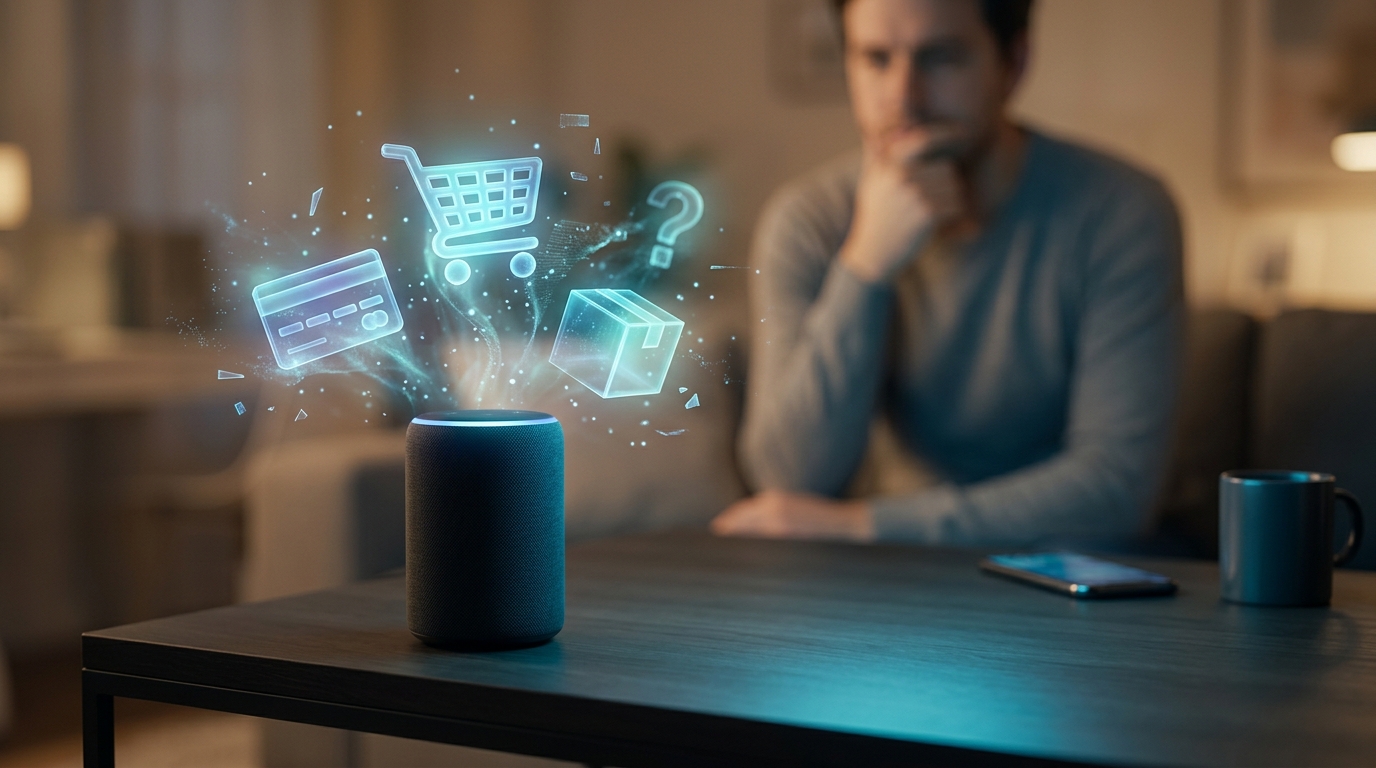
For years, tech companies promised that we would soon shop by simply speaking to a device on the kitchen counter. Smart speakers sit in millions of homes, yet most people still pick up a phone or open a laptop when they want to buy something. So what went wrong? This guide looks at the real reasons voice commerce has been slow to take off, where it already works, and what is changing now.
People rarely buy through smart speakers because voice is a poor fit for browsing and comparing. Without a screen, shoppers cannot see images, reviews or alternatives, and many do not trust voice for payments. Smart speakers have also become habit devices for music, timers and quick questions. Voice commerce works best for simple repeat purchases, and newer conversational AI assistants and phone-based voice agents may widen what is possible.
Voice commerce, sometimes called voice shopping or v-commerce, means completing a purchase or booking through spoken commands. It can happen on a smart speaker, a phone, a car dashboard, or over a phone call handled by an AI voice agent.
It is related to voice search, where people ask a question out loud, but the two are not the same. Searching is low commitment. Buying requires confidence in the product, the price and the payment.
The pitch was appealing: say what you want, and it arrives. In practice, adoption of shopping by speaker has lagged the adoption of the speakers themselves. Industry commentary has repeatedly noted that most owners use these devices for everyday utilities rather than purchases. Specific percentages are deliberately left out here because figures vary by survey and year, and any number should be checked against a current primary source before it is quoted.
“A smart speaker is excellent at answering questions. Shopping asks it to do something harder: earn trust.”
Shopping is visual. We judge photos, read reviews, check sizes and scan prices side by side. A speaker has to read that information aloud, one item at a time, and that is slow. Voice works when the choice is already made.
When you search online you see many options. When you ask a speaker, you often hear one. Shoppers reasonably wonder whether that result is the best, the cheapest, or simply the one the platform wants to promote. That uncertainty discourages first-time purchases.
Spending money requires confidence. Shoppers worry about accidental orders, someone else in the room triggering a purchase, and where their payment details are stored. Many platforms respond with confirmation steps or voice PINs, but each extra step adds friction.
Brand names, similar products and accents can trip up voice systems. A wrong order is more irritating than a wrong song, so tolerance for error is lower.
People adopted smart speakers for music, timers, weather and smart home control. Shifting that habit toward purchasing requires a reason, and for most shoppers, a phone is already one tap away.
If you cannot easily see what you ordered, confirm the size or track the delivery, buying feels riskier. Voice does not yet offer a smooth way to handle returns and exceptions.
Voice shopping offers fewer places to show ads, compare sponsored listings or upsell. That makes it less attractive commercially than a screen-based store, which reduces the incentive to push it hard.
| Barrier | Why it hurts | What may help |
|---|---|---|
| No screen | Cannot compare visually | Speakers with displays, voice-to-phone handoff |
| One-answer results | Doubt about value and bias | Conversational assistants that explain options and trade-offs |
| Payment trust | Fear of accidental or unauthorized orders | Voice profiles, confirmations, spending controls |
| Misunderstanding | Wrong product or quantity | Better language models, read-back confirmation |
| Habit | Speaker seen as a utility | Reorder reminders and subscription-style flows |
Voice is not a failure. It simply shines in narrower situations:
Earlier assistants relied on rigid commands. Newer systems built on large language models can handle more natural requests and follow-ups. Amazon has introduced a generative AI upgrade to Alexa, and Google has been moving its assistant experience toward its Gemini models. Product details and availability change quickly, so check the official pages, such as the Alexa developer site, for current information.
What this could mean for shopping: a customer might say, “Find a waterproof jacket under a budget I set, and read me the top reviews,” then refine the request in conversation. Whether shoppers will trust and use that behavior at scale is still an open question, and it is reasonable to stay cautious about bold forecasts.
HighDreamsLLC is a Colorado-based AI and digital growth agency. We build AI voice agents and chatbots, automate workflows, develop websites and apps, and manage e-commerce across Amazon, Walmart, Etsy and eBay. If you want to test voice where your customers already speak to you, we can design, build and measure it with you.
Voice commerce is buying products or services using spoken commands, typically through a smart speaker, a phone assistant, or an AI voice agent, instead of typing or tapping on a screen.
The main barriers are the lack of a screen for comparing options, trust and security concerns around payments, imperfect speech understanding, and the fact that most people use smart speakers for simpler tasks such as music, timers and questions.
Low-risk, repeat purchases such as reordering household staples, food orders, and straightforward bookings tend to suit voice best, because the shopper already knows what they want and needs little comparison.
It may. Conversational AI assistants can handle more natural requests, follow-up questions and context, which addresses some of the older limits of voice assistants. Real-world adoption remains to be seen.
Keep product and business data accurate and structured, write content that answers conversational questions, make reordering simple, and consider a voice agent for phone-based ordering and support.
Voice commerce has not failed; it has been misapplied. Speaking is a great way to reorder, book or ask, and a poor way to browse. The next wave of conversational AI may close some of that gap, but trust and habit change slowly. The practical move for businesses is to prepare their data, simplify repeat purchases, and add voice where customers already use it, starting with the phone.
Sources and further reading: Alexa developer site, Google Business Profile, Nielsen Norman Group (usability research on voice interfaces). Product features and survey data change often; verify current details with the original publishers.