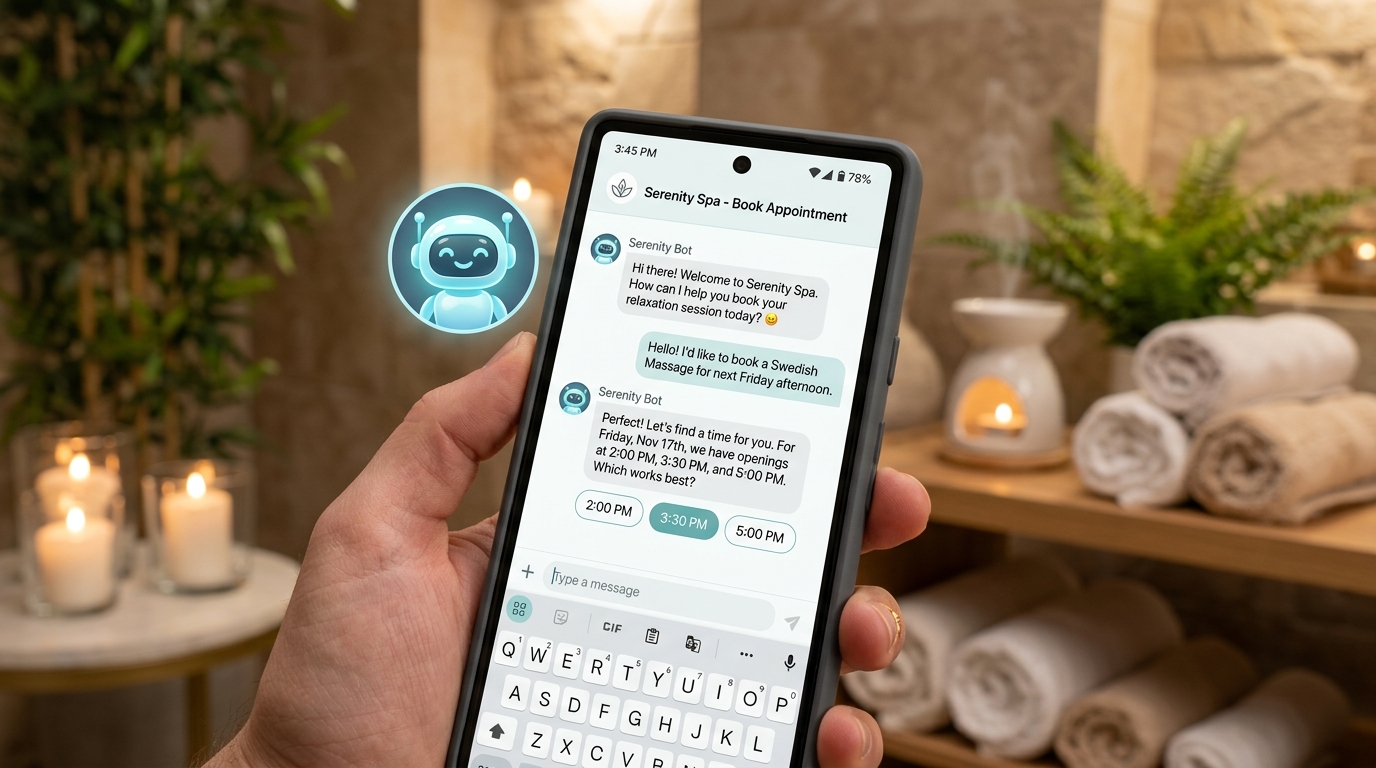
A service business doesn’t lose money the way a retailer does. There’s no abandoned cart, just a quote request that never got answered fast enough, or a visitor who left your site at 9pm because no one was there to tell them if you cover their zip code. AI chatbots solve a different problem for service businesses than they do for e-commerce: the job isn’t to sell a product, it’s to capture and qualify a lead before it goes cold. Here’s how contractors, agencies, clinics, salons, and consultants are actually using chatbots to do that in 2026.
The gap this closes is bigger than it looks. Traditional web contact forms convert at a median rate of just 6.6%, ranging from roughly 3.8% to 12.3% depending on the industry, meaning the overwhelming majority of visitors who might want your service leave without ever filling one out. Meanwhile, a large majority of customers now expect an immediate response the moment they reach out, not a callback the next business day.
That expectation gap is exactly where a chatbot earns its keep for a service business. It’s not competing with a “buy now” button, it’s competing with silence: a visitor landing on your site outside business hours, scrolling your services page and leaving because there’s no way to ask “do you do this in my area” without waiting until Monday.
An e-commerce chatbot’s success metric is usually a completed purchase in the same session. A service business chatbot’s success metric is a qualified lead handed off cleanly, a booked consultation, a scoped quote request, or a routed inquiry with the right context attached. That’s a fundamentally different design problem: fewer product-recommendation flows, more structured qualifying questions, and a much heavier emphasis on getting contact details and intent captured before the visitor leaves.
| Use case | What it replaces | Why it converts |
|---|---|---|
| Quote and estimate requests | A static contact form with no immediate response | Captures project details and contact info while intent is highest |
| Consultation or appointment booking | Phone tag and callback delays | Books directly against a live calendar in the same conversation |
| Service area and pricing FAQs | Repetitive questions eating staff time during business hours | Answers instantly, any hour, without waiting for someone to be free |
| Lead qualification and routing | Every inquiry treated the same regardless of fit or urgency | Filters serious inquiries from tire-kickers before a human gets involved |
| Post-service follow-up and reviews | Manual follow-up emails that often don’t go out at all | Consistently requests feedback and reviews right after service completion |
Decide upfront whether success is a booked call, a submitted quote request, or a qualified phone number captured, and design the whole conversation flow around that single outcome rather than trying to handle every possible visitor need at once.
Rather than a generic popup on every page, trigger based on behavior: time spent on a service page, scroll depth, or exit intent. A prompt like “Want to know if we service your area?” at the right moment converts far better than an immediate, untargeted greeting.
Structured questions covering service type, location, timeline, and budget range let the chatbot do real qualification work, not just collect an email address. This is what separates a lead-generation chatbot from a glorified contact form.
A qualified lead who can book a consultation slot immediately, without waiting for a callback, converts at a meaningfully higher rate than one who submits a form and waits. Every extra step between interest and a booked appointment is a chance for the lead to go cold.
A large share of service inquiries, home repairs, legal questions, salon bookings, arrive outside standard business hours precisely because that’s when people have time to think about them. A chatbot that’s live around the clock captures demand a phone line simply can’t.
Pricing negotiations, unusual project scopes, and anything emotionally sensitive should route to a person with full conversation context attached, not get handled by the bot. The goal is qualification and routing, not closing every deal inside the chat window.
A visitor who starts answering qualifying questions and then drops off is a warmer lead than a stranger. An automated follow-up message or email recovers a meaningful share of these instead of letting the conversation simply expire.
The number of conversations started tells you almost nothing on its own. Track what share of conversations produce a qualified lead, and compare that against your existing form conversion rate over a defined period to know if the chatbot is actually outperforming what it replaced.
The service businesses seeing the strongest results aren’t using an off-the-shelf popup widget, they’re using a custom-built AI chatbot scoped to their actual qualifying questions, service area, and booking flow, paired with workflow automation that routes qualified leads into a CRM automatically instead of sitting in an inbox. High Dreams LLC builds that integration layer specifically so a captured lead becomes a booked appointment, not just a notification someone has to act on manually.
Book a free consultation with High Dreams LLC to map your current lead capture gaps and see what a chatbot connected to your calendar and CRM could recover.
An e-commerce chatbot is built to drive a purchase in the same session. A service business chatbot is built to capture and qualify a lead, a quote request, a booked consultation, or a routed inquiry, since the actual sale usually happens in a follow-up conversation, not inside the chat window.
Traditional web forms convert at a median rate of around 6.6%. Chatbots that trigger at the right moment, ask focused qualifying questions, and respond instantly consistently outperform a static form, largely because they engage visitors who would otherwise leave without filling anything out.
For most service businesses, the chatbot should qualify and route, not close. Pricing negotiations and complex project scopes should hand off to a human with full context, while the chatbot’s job is making sure that handoff happens quickly and with a qualified lead attached.
Skipping calendar or CRM integration is the most common one. A chatbot that only takes a message and promises a callback reintroduces the same response delay it was meant to eliminate, which caps most of the potential conversion improvement.
Track conversation-to-lead rate and compare it against your prior contact form’s conversion rate over the same period. Chat volume alone doesn’t tell you much; what matters is how many conversations turn into a qualified, actionable lead.
For a service business, a chatbot’s value isn’t in mimicking a retail sales assistant, it’s in closing the gap between a visitor’s interest and a captured, qualified lead, at 9pm on a Sunday just as reliably as at 10am on a Tuesday. The businesses getting real results aren’t the ones with the flashiest bot personality, they’re the ones that defined a clear conversion goal, connected the chatbot to a real calendar, and built an honest escalation path for everything the AI shouldn’t try to handle alone.


AI Strategies that Save Time and Money - highdreamsllc.com
July 14, 2026 at 7:31 am
“ […] AI Chatbot for Service Based Businesses AI Voice Agent: Increase Appointment Bookings How AI Can Increase Business Revenue The ROI of Implementing AI Voice Agents The Role of AI Voice Agents in Growing Your Business Rapid Scaling and Infrastructure Challenges of Advanced AI […] “
AI Chatbot vs Live Chat - highdreamsllc.com
July 15, 2026 at 6:24 am
“ […] AI Chatbot for Service Based Businesses Why Every Business Needs an AI Chatbot in 2026 Why Businesses Are Investing in AI Customer Support How AI Is Changing Customer Service Forever How to Choose the Right AI Chatbot Development Company Voice AI vs Human Call Center […] “
Best AI Productivity Tools for Entrepreneurs Guide
July 28, 2026 at 6:20 am
“ […] AI Chatbot for Service Based Businesses […] “
How AI Is Reshaping the Future of Work in 2026
July 29, 2026 at 6:13 am
“ […] AI Chatbot for Service Based Businesses […] “
AI Chatbots for SaaS Companies: Growth Guide 2026
July 31, 2026 at 10:04 am
“ […] AI Chatbot for Service Based Businesses […] “
AI Trends Shaping Business Growth Next 5 Years
August 1, 2026 at 7:13 am
“ […] AI Chatbot for Service Based Businesses […] “
Etsy Email Marketing Guide for Repeat Customers
August 5, 2026 at 9:12 am
“ […] Digital Products to Sell on EtsyEtsy Management AI Chatbot for Service Based BusinessesAI Chatbot How AI Is Changing SEO Strategy for Ecommerce StoresAI and E-Commerce Why Every Business […] “