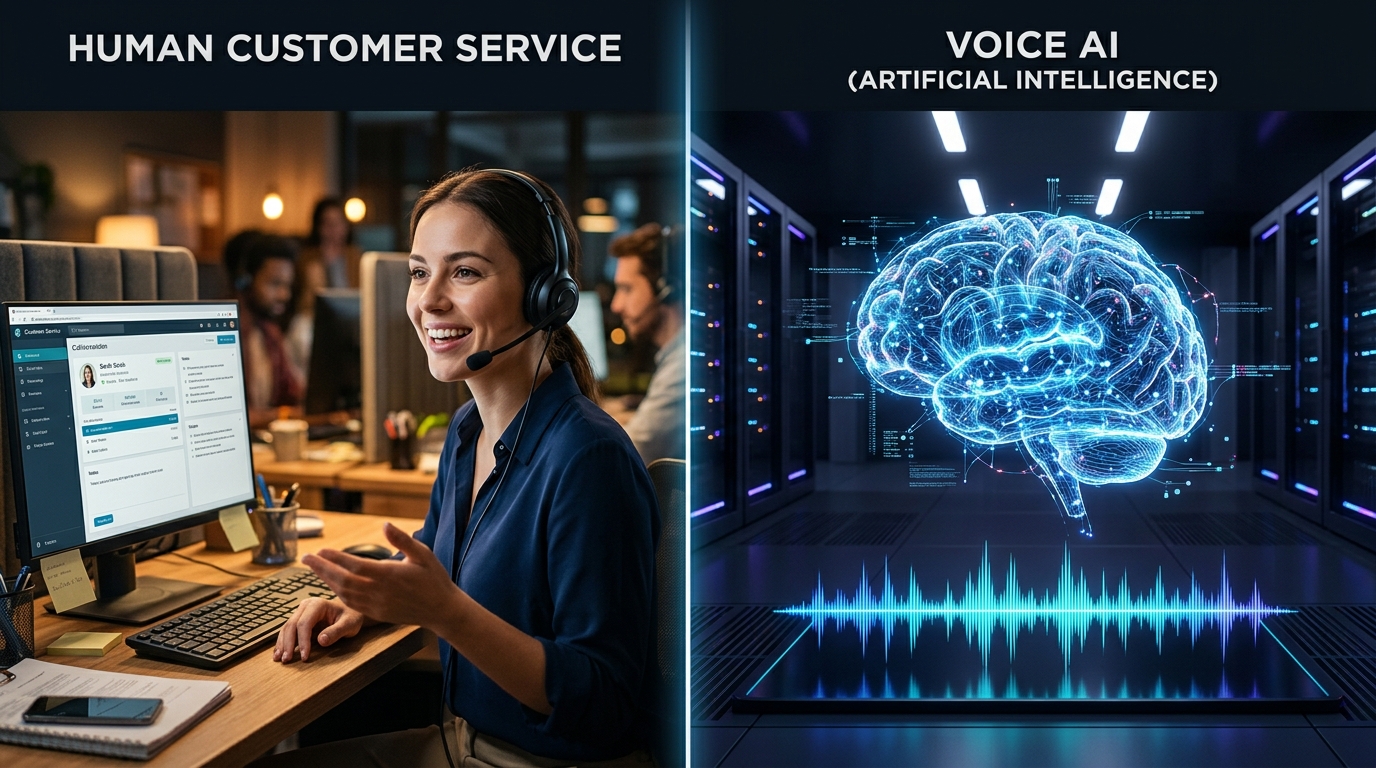
A US call center agent costs roughly $3 to $12 per call once wages, benefits, training, and turnover are factored in. A production AI voice agent handling the same call typically costs $0.20 to $1.20. That gap is real — but so is the fact that 79% of customers still say they prefer a human for complex or sensitive problems. This guide lays out what each option actually does well, where the cost numbers hold up under scrutiny, and why the businesses getting the best results aren’t choosing one over the other.
Voice AI wins decisively on cost per call, 24/7 availability, and scaling through call spikes without hiring. Human call center agents remain the better choice for complex, emotional, or high-stakes conversations where judgment, empathy, and trust matter more than speed. Gartner projects conversational AI will cut contact center labor costs by $80 billion in 2026, yet the same research firm found only 20% of service leaders have actually reduced staff because of AI — because the winning model in practice is hybrid: AI voice agents handling routine, high-volume calls, with a fast, well-contexted handoff to a human for everything else.
The per-call math is where the conversation usually starts, and it’s consistent across independent cost analyses. Domestic US call center agents run $3 to $12 per call once you account for wages, benefits, training, and idle time between calls — some analyses put fully-loaded US agent time at $1.33 to $2.73 per productive minute. Offshore human agents are considerably cheaper, often $1 to $4 per call, which matters for any honest comparison: AI isn’t automatically cheaper than every human option, just cheaper than domestic staffing.
AI voice agents typically run $0.07 to $0.25 per minute all-in, producing per-call costs of roughly $0.20 to $1.20 for a routine 2-to-4-minute interaction — a 70-95% cost reduction against domestic agents for the calls AI can fully handle. Gartner’s often-cited 2026 projection puts the aggregate effect at $80 billion in reduced contact center labor costs industry-wide.
Turnover adds a cost most comparisons miss entirely. Contact center agent turnover commonly runs 30-45% annually, with some centers seeing 60%. Replacing a single agent costs an estimated $10,000-$20,000 once recruiting, training, and ramp-up productivity loss are included — a real, recurring expense that AI systems don’t carry.
At $0.20–$1.20 per call versus $3–$12 for a domestic human agent, the unit economics favor AI clearly for high-volume, routine call types.
A single human covers about 40 hours a week; round-the-clock coverage requires three to four staff on rotating shifts. AI answers every call, every hour, without shift premiums.
Call volume during a product launch, weather event, or seasonal peak doesn’t require emergency hiring — AI capacity scales with volume automatically.
An AI agent gives the same accurate, on-script answer on the 1st call and the 10,000th. Human performance varies with fatigue, mood, and experience level.
Every caller gets picked up immediately rather than waiting in queue — a direct fix for the abandonment that costs businesses leads and bookings.
Modern voice platforms support dozens of languages out of the box, without recruiting bilingual staff for every shift.
Post-accident claims, cancellations, bereavement, and other high-emotion conversations still call for a human — surveys consistently find customers want empathy, not just an accurate answer, in these moments.
Situations that fall outside a defined script — a policy exception, an unusual complaint, a retention negotiation — require the kind of contextual judgment AI systems still struggle to replicate reliably.
Large purchases, legal matters, and healthcare decisions carry a trust premium that customers are more willing to extend to a person than to software, even when the software is accurate.
Speech recognition has improved sharply, but background noise, strong accents, and vague or multi-intent requests can still cause AI misunderstandings that a human would parse instantly.
| Factor | Voice AI | Human Call Center |
|---|---|---|
| Cost per call (domestic) | $0.20–$1.20 | $3–$12 |
| Availability | 24/7/365, no surcharge | Shift-limited; nights/weekends often cost more |
| Scaling for spikes | Near-instant | Requires hiring or overtime |
| Consistency | High — same script every call | Varies by agent, fatigue, experience |
| Emotional/complex handling | Limited; best paired with human handoff | Strong — judgment, empathy, exceptions |
| Turnover risk | None | 30–45% annual, up to 60% at some centers |
| Setup time | Days to a few weeks | Weeks to months (recruiting, training) |
Vendor cost comparisons make automation look like an obvious, universal win — but Gartner’s own research adds important nuance the sales pages tend to skip. The firm projects that generative AI’s cost per resolved customer service interaction could exceed $3 by 2030, potentially higher than many offshore human agents, once infrastructure, governance, and escalation handling are fully accounted for. In practice, only about 20% of customer service leaders report having actually reduced staffing because of AI, and Gartner expects roughly half of the companies that did cut staff to rehire by 2027. Full automation isn’t automatically the cheaper long-term path — it depends heavily on call complexity, escalation rates, and how well the AI system is scoped to what it’s actually good at.
High Dreams LLC is a Colorado-based AI and digital growth agency that has shipped AI voice agents for 150+ clients worldwide — moving from idea to production in 1 to 4 weeks, built specifically around the hybrid model this article describes rather than a wholesale replacement of your team.
Your actual call mix — routine versus complex — is mapped first, so AI is scoped to what it’s genuinely good at.
A working voice agent is tested against real call scenarios, including the handoff to your human team.
Containment rate, call quality, and escalation handling are tested against defined thresholds before launch.
Relevant services include AI voice agent development, AI workflow agents, and AI chatbots for text-based support channels.
Get a free consultation to map your call volume and find the right AI-to-human split before you build anything.
For routine, high-volume calls, yes — typically $0.20 to $1.20 per call versus $3 to $12 for a domestic human agent. Offshore human agents can be cheaper than AI on a per-call basis, and complex calls that require multiple human escalations can erase the savings if the AI isn’t properly scoped.
The data doesn’t support that. Gartner found only about 20% of service leaders have actually reduced staffing due to AI, and expects half of those to rehire by 2027. The pattern holding up in practice is hybrid: AI for routine volume, humans for complex and emotional calls.
Industry containment-rate research puts the average around 40% across industries, with top-performing sectors like financial services closer to 50-70% on well-defined intents. The rest still require human handling.
It depends on the call type. Customers generally accept or even prefer AI for fast, routine tasks, but a large majority still say they prefer a human for complex or emotionally sensitive issues.
Basic deployments for routine tasks like FAQs or bookings can go live in days to a couple of weeks. Deeper integrations with CRM systems and custom call flows typically take several weeks of configuration and testing.
Sources: Gartner, conversational AI contact-center labor cost and cost-per-resolution projections · Forrester Consulting, Total Economic Impact study on enterprise voice AI ROI · Cross-referenced 2026 cost-per-call analyses from Retell AI, CallSphere, SigmaMind, and CloudTalk · Industry containment-rate research compiled from Gitnux and Gartner data.


AI Chatbot vs Live Chat - highdreamsllc.com
July 15, 2026 at 6:24 am
“ […] AI Chatbot for Service Based Businesses Why Every Business Needs an AI Chatbot in 2026 Why Businesses Are Investing in AI Customer Support How AI Is Changing Customer Service Forever How to Choose the Right AI Chatbot Development Company Voice AI vs Human Call Center […] “
AI Voice Agents for Restaurants: Smarter Reservations
July 25, 2026 at 6:41 am
“ […] Voice AI vs Human Call Center […] “
Etsy Ads Guide for New and Experienced Sellers
July 25, 2026 at 6:51 am
“ […] Voice AI vs Human Call Center […] “
Best AI Voice Agent Platforms Compared for Business
July 25, 2026 at 7:05 am
“ […] Voice AI vs Human Call Center […] “
How AI Voice Agents Improve Customer Satisfaction
July 28, 2026 at 6:56 am
“ […] Voice AgentsThe Future of AI Voice Technology: What’s Coming Next AI Voice AgentsVoice AI vs Human Call Center AI Voice AgentsAI Voice Agent vs Human Receptionists AI Voice AgentsHow AI Voice Agents Increase […] “
Best AI Chatbot Features Every Business Needs
July 29, 2026 at 6:01 am
“ […] How AI Voice Agents Improve Customer Satisfaction on Voice AI vs Human Call Center […] “
AI Voice Agents That Answer Calls 24/7 for Business
July 31, 2026 at 10:10 am
“ […] Voice AI vs Human Call Center […] “