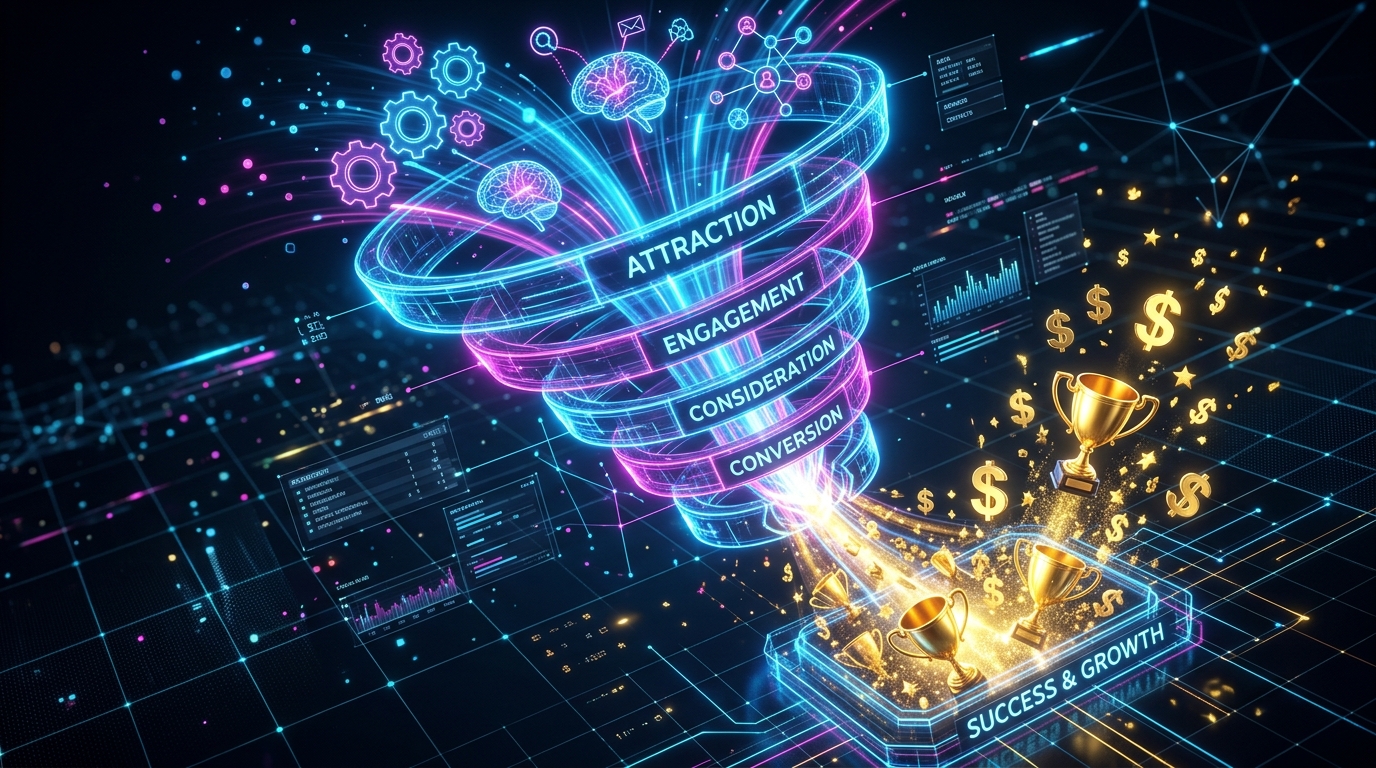
The average lead-to-customer conversion rate sits around 5%. Businesses running AI-driven lead scoring are converting at 8.3%, according to HubSpot’s 2026 State of Sales and Marketing Alignment Report — and those pairing automated nurture sequences with AI personalization are closing 41.2% more of their pipeline, 34.7% faster. That gap isn’t magic; it’s a funnel where every stage reacts to real buyer behavior instead of running on a fixed schedule. Here’s what an AI-powered sales funnel actually is, stage by stage, and where the data backs up the hype.
An AI-powered sales funnel uses machine learning at each stage — awareness, capture, scoring, nurturing, conversion, and retention — to personalize content, prioritize the right leads, and time follow-up automatically, instead of running every prospect through the same fixed sequence. The clearest data point: HubSpot’s 2026 research found AI-driven lead scoring lifts conversion from a 5% baseline to 8.3%, and Forrester Research found companies that nurture leads well generate 50% more sales-ready leads at 33% lower cost. The funnel isn’t replaced by AI — the timing, personalization, and prioritization inside it are.
A traditional sales funnel moves every prospect through the same fixed sequence: an ad or piece of content, a landing page, an email sequence, a sales call, a close. It works, but it treats a highly engaged prospect the same as a casual browser until a human sales rep sorts them out manually — usually too late to matter.
An AI-powered funnel replaces the fixed sequence with a responsive one. Machine learning models score leads based on real behavior rather than assumptions, trigger different nurture content depending on engagement signals, and flag high-intent prospects for a human the moment they’re ready — rather than at a scheduled follow-up three days later. HubSpot’s 2026 survey of 7,400 sales and marketing professionals across 22 industries found that businesses aligning CRM behavioral data with real-time intent signals see a further 2.1 percentage point conversion lift on top of the baseline gains from AI lead scoring alone.
AI-assisted content and ad targeting identify which messaging resonates with which audience segments, directing spend toward the channels actually producing engaged traffic rather than raw impressions.
Chatbots and smart forms qualify visitors in real time, asking follow-up questions a static form never would and routing genuinely interested prospects differently than casual browsers from the first interaction.
Predictive scoring ranks leads using both historical patterns and real-time signals instead of a manually assigned point system — improving qualification accuracy by a commonly cited 39% over static scoring rules.
AI determines the best send time, channel, and message for each prospect individually. Personalized emails see meaningfully higher click-through rates than generic sequences, and drip campaigns paired with AI personalization are linked to a 41.2% conversion improvement.
AI voice agents and scheduling assistants remove the friction of back-and-forth booking, often converting a ready prospect into a booked call within the same session rather than losing them to delay.
Deal-risk models flag stalling opportunities before a rep notices, and proposal or quoting assistance compresses the time between “interested” and “signed.”
Behavioral triggers identify at-risk accounts and upsell-ready customers, extending the funnel past the first sale instead of treating the close as the finish line.
| Funnel Stage | Reported Impact |
|---|---|
| Lead scoring | Conversion rate 8.3% vs. 5% baseline (HubSpot); qualification accuracy +39% |
| Personalized nurture | 2.1x higher funnel conversion vs. generic sequences |
| Automated follow-up timing | Leads contacted within the first hour convert far better; delays past 48 hours cut conversion by roughly 60% |
| AI-personalized drip + nurture | 41.2% higher conversion, 34.7% faster lead-to-close (HubSpot) |
| Lead generation overall | Up to 60% lower customer acquisition cost; 50% more sales-ready leads |
Figures compiled from 2026 cross-industry research. Actual results depend heavily on data quality, funnel scope, and how well AI outputs are integrated into existing sales workflows.
AI sales funnel tools generally range from $50-$200 per user monthly for basic automation up to $500-$2,000+ monthly for enterprise-grade predictive analytics. Most organizations report positive ROI within roughly 90 days, driven by the combination of higher conversion rates and reduced manual prospecting time — which is why starting with the single biggest bottleneck in your current funnel, rather than automating everything simultaneously, tends to produce faster, clearer results.
AI personalization amplifies whatever targeting logic you feed it — a poorly defined ideal customer profile just gets automated faster, not fixed.
Scoring models drift as buyer behavior changes. Models left unreviewed for months start ranking outdated signals as strong indicators of intent.
Leads left without follow-up for 48 or more hours convert roughly 60% less often — automation is only an advantage if it actually triggers the response faster than a human would.
A funnel that nurtures a genuinely ready buyer through another automated sequence instead of routing them to a person can cost the sale entirely — automation should accelerate the handoff, not replace it.
High Dreams LLC is a Colorado-based AI and digital growth agency that has shipped AI chatbots, voice agents, and workflow automations for 150+ clients worldwide — moving from idea to production in 1 to 4 weeks, built to plug into the exact funnel stages where AI actually moves the numbers.
Your current funnel and biggest conversion bottleneck are mapped before anything is built.
A working chatbot, voice agent, or workflow automation is tested against real lead data before full commitment.
Lead quality, response time, and conversion impact are tested against defined thresholds before scaling.
Relevant services include AI chatbot development, AI voice agents, and AI workflow agents for lead scoring, nurture, and follow-up automation.
Get a free consultation to identify the single biggest bottleneck in your funnel — and what to automate first.
It’s a sales funnel where AI personalizes content, scores and prioritizes leads based on real behavior, and times follow-up automatically at each stage, instead of moving every prospect through the same fixed sequence.
Yes. HubSpot’s 2026 research found AI-driven lead scoring lifts conversion to 8.3%, compared to a 5% industry baseline, with further gains when CRM data is aligned with real-time intent signals.
Tools generally range from $50-$200 per user monthly for basic automation up to $500-$2,000+ monthly for enterprise-grade platforms, with most organizations seeing positive ROI within about 90 days.
No. AI is most effective handling scoring, nurturing, and routine follow-up, while high-intent, complex, or high-value conversations still convert better with a human — a fast handoff at the right moment is more effective than full automation.
Automating before clearly defining the target customer profile. AI personalization amplifies whatever targeting logic it’s given, so a poorly defined audience just gets automated faster, not corrected.
Sources: HubSpot, “State of Sales and Marketing Alignment Report” (2026, 7,400 respondents across 22 industries) · Forrester Research, lead nurturing performance data cited via Salesgenie · Click Vision, “65+ AI Lead Generation Statistics (2026)” · Marketing LTB, “Sales Funnel Statistics 2026” · G2, “Lead Generation Statistics for 2026.”