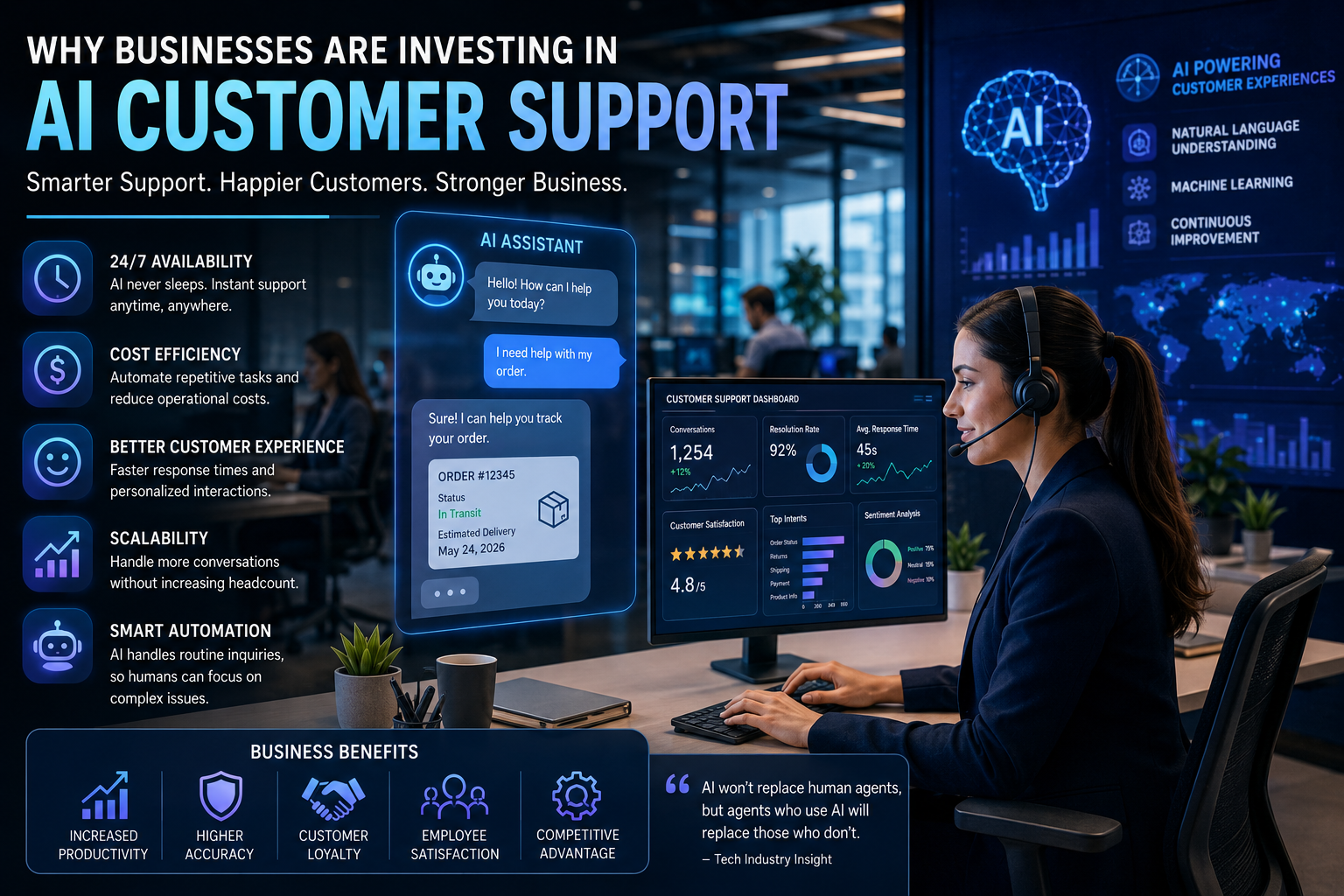
On a Friday afternoon, an online retailer launched an AI-powered customer support assistant to handle routine inquiries before the weekend. By Monday morning, more than 18,000 customer conversations had been processed without increasing the size of the support team. Shipping questions were answered instantly, return requests were initiated automatically, and multilingual customers received assistance in their preferred language within seconds.
The result wasn’t simply faster customer service. It was a measurable improvement in operational efficiency, customer satisfaction, and employee productivity.
This scenario reflects a growing shift across industries. Businesses are no longer viewing artificial intelligence as an experimental technology reserved for large enterprises. Instead, AI-powered customer support has become a strategic investment that helps organizations deliver faster, more consistent, and highly personalized service while controlling operational costs.
Customer expectations have changed dramatically over the past decade. Consumers expect immediate responses regardless of the time of day, seamless interactions across websites, mobile apps, social media, and messaging platforms, and support experiences that recognize their previous interactions. Meeting these expectations using traditional customer service models alone has become increasingly difficult and expensive.
Artificial intelligence addresses these challenges by automating repetitive tasks, assisting human agents with real-time recommendations, and providing customers with immediate access to information. Modern AI systems can understand natural language, retrieve relevant knowledge, summarize conversations, detect customer sentiment, and escalate complex issues to human representatives when necessary.
However, successful implementation requires more than deploying a chatbot. Organizations must design AI systems that align with business goals, integrate with existing customer relationship management platforms, protect sensitive data, and maintain transparency with users.
This article explores why businesses are investing heavily in AI customer support, how the technology is transforming customer experience, and what organizations should consider when building an AI-powered service strategy that delivers measurable business value.
Customer service has evolved from a cost center into one of the most significant drivers of customer loyalty and brand reputation. Every interaction influences whether customers continue purchasing, recommend a business to others, or choose a competitor.
Several factors are accelerating investment in AI customer support:
| Business Trend | Impact on Customer Support |
|---|---|
| Growth of e-commerce | Higher inquiry volumes requiring scalable support |
| Global customer bases | Need for multilingual, 24/7 assistance |
| Remote work | Increased demand for cloud-based support platforms |
| AI advancements | Improved automation, accuracy, and personalization |
| Customer experience competition | Faster, higher-quality support becomes a differentiator |
Organizations that effectively combine AI automation with human expertise are often able to reduce response times, improve customer satisfaction, and free support teams to focus on complex, high-value interactions.
AI customer support is not about replacing people—it is about enabling people to deliver faster, smarter, and more personalized customer experiences at scale.
Traditional customer service teams often struggle to keep pace with growing customer demand. Seasonal sales, product launches, and global expansion can generate inquiry volumes that exceed staffing capacity.⚠️ Risk Level: High
Long response times, inconsistent service quality, and agent burnout can negatively affect customer satisfaction and business performance.
Several factors contribute to these challenges:
Without scalable customer support, customer satisfaction declines, response times increase, support costs rise, employee turnover may increase, and businesses risk losing customers to competitors offering faster service.
AI customer support combines technologies such as natural language processing, machine learning, and generative AI to automate routine interactions while assisting human agents with more complex issues. Common capabilities include 24/7 conversational chatbots, automated ticket routing, real-time language translation, intelligent knowledge retrieval, AI-assisted email responses, voice-based virtual assistants, sentiment analysis, and personalized customer recommendations.
🧠 Expert Insight
The most successful AI customer support strategies do not aim to automate every interaction. Instead, they automate repetitive tasks while empowering human agents to focus on empathy, critical thinking, and complex problem-solving.
📦 Example
A subscription-based software company receives thousands of password reset requests each week. By implementing an AI-powered virtual assistant, password resets become fully automated, allowing support specialists to dedicate more time to technical troubleshooting and customer onboarding. The result is shorter wait times, improved employee productivity, and a better customer experience.
Artificial intelligence has moved beyond being a technology experiment. It is now a business strategy that directly impacts revenue, customer retention, and operational efficiency.
Customers expect assistance whenever they need it—not only during business hours. AI-powered virtual assistants provide continuous support across multiple channels, ensuring that common questions are answered instantly regardless of location or time zone.
📈 Trend Analysis: Businesses operating internationally increasingly rely on AI to serve customers outside traditional support hours without expanding overnight staffing.
Hiring, training, and retaining customer support teams requires significant investment. AI helps reduce operational costs by automating repetitive interactions, enabling existing teams to manage higher conversation volumes without proportional increases in staffing.
Fast responses significantly influence customer perception. AI systems can instantly answer FAQs, retrieve account information, recommend solutions, escalate urgent cases, and personalize conversations based on previous interactions. Customers benefit from shorter wait times and more consistent service experiences.
Modern AI platforms are designed to augment—not replace—customer support professionals. They assist agents by summarizing conversations, recommending responses, retrieving relevant documentation, suggesting next actions, and detecting customer sentiment. This enables agents to resolve issues more efficiently while maintaining high-quality interactions.
| Business Objective | Traditional Support | AI-Enhanced Support |
|---|---|---|
| Availability | Limited business hours | 24/7 availability |
| First Response Time | Minutes to hours | Seconds |
| Scalability | Staff-dependent | Highly scalable |
| Consistency | Varies by agent | Standardized responses |
| Cost Efficiency | Higher labor costs | Lower cost per interaction |
| Personalization | Manual | AI-driven recommendations |
Part 2: Implementation, AI Chatbots vs. AI Agents, Security, ROI & Best Practices
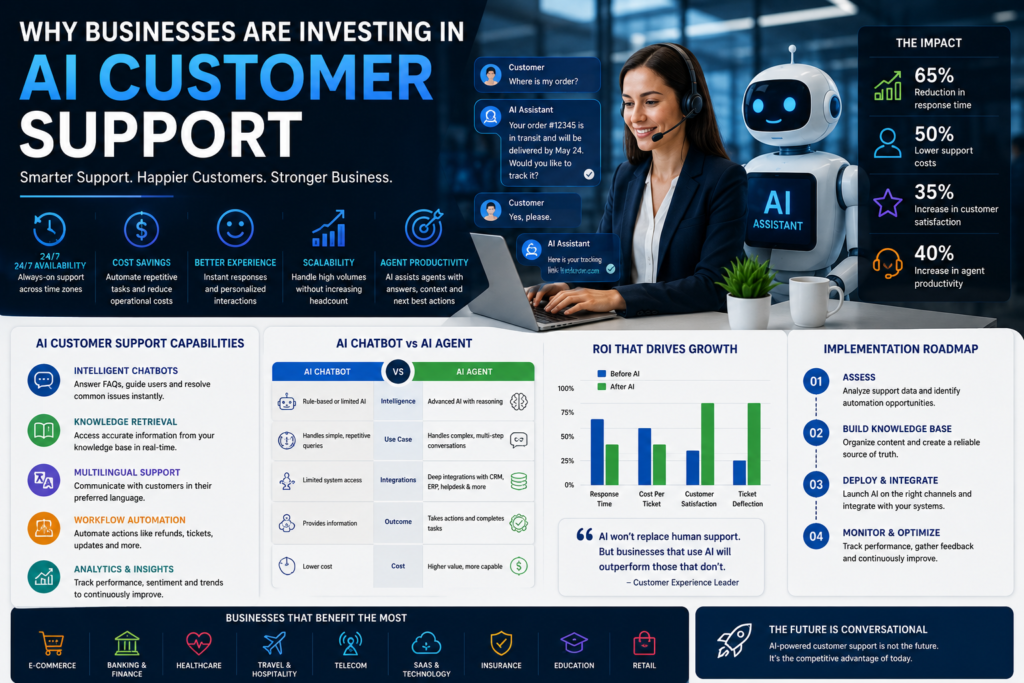
As artificial intelligence evolves, many organizations use the terms AI chatbot and AI agent interchangeably. While both improve customer support, they serve different purposes and offer different capabilities.
Businesses often invest in the wrong technology because they misunderstand what modern AI systems can actually do.⚠️ Risk Level: Medium
Deploying a basic chatbot when an AI agent is required—or vice versa—can lead to poor customer experiences and limited return on investment.
Earlier chatbots were primarily rule-based. They relied on predefined scripts and decision trees, making them suitable only for simple, repetitive questions. Modern AI agents, powered by large language models (LLMs), can reason through conversations, understand context, retrieve information from multiple systems, and complete tasks on behalf of customers.
Choosing the wrong solution can result in customer frustration, high escalation rates, increased operational costs, limited automation, and reduced customer satisfaction.
Evaluate your business requirements before selecting an AI platform.
✅ Best Practice
Use traditional chatbots for FAQs, order tracking, store hours, password resets, and appointment confirmations. Use AI agents for personalized recommendations, complex troubleshooting, account management, multi-step workflows, and intelligent decision-making.
| Feature | AI Chatbot | AI Agent |
|---|---|---|
| Conversational Ability | Scripted | Natural language understanding |
| Context Awareness | Limited | High |
| Personalization | Basic | Advanced |
| Multi-Step Reasoning | No | Yes |
| CRM Integration | Limited | Extensive |
| Workflow Automation | Basic | Advanced |
| Best Use Case | FAQs | End-to-end customer service |
🧠 Expert Insight
Organizations increasingly adopt hybrid strategies where AI chatbots handle repetitive interactions while AI agents assist with more sophisticated customer journeys.
Technology alone does not improve customer service. Success depends on aligning AI implementation with business goals.
Many organizations deploy AI tools without redesigning customer support processes.
Businesses focus on software selection while overlooking customer journey mapping, knowledge management, agent training, performance measurement, and governance.
Poor planning can lead to low adoption, incorrect AI responses, customer dissatisfaction, and poor return on investment.
Develop a structured implementation roadmap.
Analyze ticket volume, response times, customer satisfaction, common inquiries, and support channels.
Include product documentation, policies, FAQs, troubleshooting guides, and internal procedures.
Start with website chat, help center, and email automation. Expand later to voice assistants, social media, mobile applications, and CRM systems.
Monitor customer satisfaction, resolution rate, escalation rate, AI accuracy, and agent productivity.
The future of customer service is collaborative—not fully automated.
Some situations require emotional intelligence, negotiation, creative problem-solving, policy exceptions, and sensitive conversations. AI cannot fully replace these human capabilities.
This reduces repetitive work while allowing agents to focus on complex customer needs.
📦 Example
A telecommunications provider uses AI to summarize previous conversations before each customer call. Support representatives spend less time reviewing history and more time solving problems. The result: faster resolutions, higher customer satisfaction, and reduced average handling time.
Customer support often involves highly sensitive information. Organizations must ensure AI systems protect customer privacy while complying with regulatory requirements.
Poorly configured AI systems may expose confidential information or generate inaccurate responses.⚠️ Risk Level: High
Common causes include excessive data access, weak authentication, poor prompt controls, lack of monitoring, and inadequate employee training.
Potential consequences include data breaches, regulatory penalties, brand damage, customer distrust, and financial losses.
Organizations should implement role-based access controls, data encryption, human approval workflows, prompt filtering, audit logging, continuous monitoring, and regular AI testing.
✅ Best Practice
AI should only access the customer information necessary to complete the requested task. Following the principle of least privilege reduces security risks.
Executives increasingly expect measurable business outcomes from AI investments. The success of AI customer support should be evaluated using clearly defined performance indicators.
📦 Example ROI Calculation
Before AI: 20 support agents, 6-minute average response time, 8,000 monthly tickets. After AI: AI resolves 45% of repetitive inquiries, human agents focus on complex issues, average response time decreases to under one minute, customer satisfaction improves, operational costs decrease significantly.
📈 Trend Analysis: Organizations are increasingly measuring AI success through business outcomes rather than automation percentages alone. The most valuable metric is improved customer experience.
Selecting a platform requires balancing functionality, scalability, security, and integration capabilities.
| Evaluation Factor | Importance | Recommended Level |
|---|---|---|
| AI Accuracy | High | Excellent |
| CRM Integration | High | Native |
| Multilingual Support | Medium | Strong |
| Analytics | High | Advanced |
| Security | High | Enterprise-grade |
| Scalability | High | Cloud-native |
| Customization | Medium | Flexible |
| Automation | High | Extensive |
Risk Level: High
Description: Determine which customer interactions occur most frequently.
Implementation Guidance: Analyze historical support tickets.
If Ignored: AI delivers minimal business value.
Risk Level: High
Description: Ensure AI has access to accurate information.
Implementation Guidance: Maintain up-to-date documentation.
If Ignored: AI responses become unreliable.
Risk Level: Critical
Description: Implement strong governance and security controls.
Implementation Guidance: Encrypt sensitive information and restrict access.
If Ignored: Privacy violations and regulatory risks increase.
Risk Level: Medium
Description: Track business outcomes continuously.
Implementation Guidance: Monitor KPIs and customer feedback.
If Ignored: Optimization opportunities are missed.
Risk Level: Medium
Description: Allow human agents to review complex or sensitive cases.
Implementation Guidance: Create clear escalation procedures.
If Ignored: Customer trust may decline.
1 Initial Trigger: A manufacturing company announces a product recall. The knowledge base is updated, but the AI assistant continues referencing outdated documentation.
2 Escalation: Customers receive inconsistent guidance regarding return procedures. Confusion spreads across support channels.
3 Failure Point: Support agents assume the AI is providing accurate information. Incorrect instructions continue for several hours.
4 Consequences: Increased customer complaints, negative social media coverage, higher call volumes, reduced trust, additional operational costs.
5 Detection: Customer satisfaction scores decline sharply. Supervisors review AI conversations and identify outdated responses.
6 Recovery: The organization immediately updates the knowledge base, suspends affected AI workflows, reviews recent conversations, contacts impacted customers, and introduces stronger content approval processes.
The organizations achieving the greatest return from AI customer support are not replacing people—they are redesigning customer service around intelligent collaboration between humans and machines.— Editorial Research Team
Part 3: Industry Applications, Future Outlook, FAQs & SEO Assets
AI customer support is no longer limited to answering basic questions. Organizations across industries are integrating AI into their customer service operations to improve efficiency, personalize interactions, and deliver consistent support at scale.
Online retailers manage thousands of inquiries related to order tracking, returns and refunds, shipping updates, product recommendations, and payment issues. AI virtual assistants instantly answer common questions, recommend products, and escalate complex issues.
📊 Industry Impact: Faster response times, higher conversion rates, reduced cart abandonment, improved customer loyalty.
Banks and fintech companies use AI to verify customer identity, answer account questions, assist with loan applications, detect suspicious activities, and provide financial guidance.⚠️ Risk: High
Because financial information is highly sensitive, AI implementations require strong security controls, audit trails, encryption, and human oversight.
Healthcare organizations deploy AI to support appointment scheduling, prescription reminders, patient education, insurance inquiries, and general health information. Healthcare AI solutions should comply with applicable privacy regulations and ensure patient information remains protected.
Technology companies integrate AI into customer support to resolve technical issues, guide onboarding, recommend product features, summarize support tickets, and assist customer success teams.
📦 Example
A SaaS company introduces an AI assistant capable of answering configuration questions using its internal knowledge base. Support engineers now spend more time resolving advanced technical issues while the AI handles repetitive requests.
Providers automate service activation, billing inquiries, device troubleshooting, network outage updates, and plan recommendations, improving service consistency while reducing call center workloads.
✅ Best Practice 1: Define Clear Objectives
Determine whether AI should reduce costs, improve customer satisfaction, increase agent productivity, or support business growth.
✅ Best Practice 2: Maintain High-Quality Data
Regularly update product documentation, FAQs, policies, troubleshooting guides, and customer workflows.
✅ Best Practice 3: Keep Humans in the Loop
Provide seamless escalation paths for sensitive issues, legal matters, high-value customers, and emotional conversations.
✅ Best Practice 4: Continuously Monitor Performance
Review AI response quality, customer satisfaction, resolution rates, escalation trends, and business outcomes.

| Scenario | Without Controls | With Controls |
|---|---|---|
| Customer Data Access | Broad, unrestricted access | Role-based access and least-privilege permissions |
| AI Responses | Unverified answers | Knowledge-base validation and human review |
| Customer Privacy | Potential data exposure | Encryption and secure data handling |
| Compliance | Inconsistent governance | Regulatory compliance processes |
| Incident Response | Delayed detection | Continuous monitoring and audit logs |
| Customer Trust | Reduced confidence | Transparent AI usage and reliable support |
| Business Continuity | Higher operational risk | Structured governance and recovery plans |
| Overall Customer Experience | Inconsistent service | Personalized, secure, and efficient interactions |
Artificial intelligence will continue reshaping customer support over the next two years. Organizations are moving beyond simple automation toward intelligent systems capable of proactive engagement, deeper personalization, and stronger collaboration with human teams.
Artificial intelligence is transforming customer support from a reactive operational function into a strategic business capability. Organizations are investing in AI not simply to reduce costs, but to deliver faster, more personalized, and consistently high-quality customer experiences.
However, successful implementation requires more than deploying a chatbot. Businesses must align AI initiatives with customer needs, operational objectives, and governance frameworks. High-quality knowledge bases, secure data management, continuous monitoring, and effective collaboration between AI systems and human agents are essential.
The organizations leading this transformation understand that AI is most effective when it complements human expertise. By automating repetitive tasks and supporting customer service professionals with intelligent recommendations, businesses can improve efficiency while preserving empathy and judgment.
Ultimately, the question is no longer whether businesses should invest in AI customer support, but how they can implement it responsibly, securely, and effectively to create lasting value for both customers and employees.
1. Why are businesses investing in AI customer support?
Businesses invest in AI customer support to improve response times, reduce operational costs, enhance customer satisfaction, and provide 24/7 assistance.
2. Does AI replace human customer service agents?
No. AI is most effective when it automates repetitive tasks and supports human agents with recommendations, allowing them to focus on complex and sensitive interactions.
3. What industries benefit the most from AI customer support?
E-commerce, banking, healthcare, telecommunications, SaaS, travel, insurance, and retail are among the industries experiencing significant benefits.
4. What is the difference between an AI chatbot and an AI agent?
AI chatbots primarily handle predefined or repetitive inquiries, while AI agents can understand context, perform multi-step reasoning, integrate with enterprise systems, and complete more complex tasks.
5. Is AI customer support secure?
AI customer support can be secure when organizations implement encryption, access controls, governance policies, continuous monitoring, and human oversight.
6. How does AI improve customer experience?
AI provides faster responses, personalized recommendations, multilingual support, consistent service quality, and quicker issue resolution.
7. What metrics should organizations use to measure AI success?
Key metrics include Customer Satisfaction (CSAT), Net Promoter Score (NPS), First Response Time (FRT), First Contact Resolution, Cost Per Ticket, Resolution Time, and Return on Investment (ROI).
8. Can small businesses benefit from AI customer support?
Yes. Cloud-based AI platforms allow small businesses to automate common inquiries, improve service quality, and scale customer support without significantly increasing staffing.
9. What are the biggest implementation challenges?
Common challenges include poor data quality, inadequate planning, weak governance, lack of employee training, and insufficient integration with existing business systems.
10. What is the future of AI customer support?
The future includes autonomous AI agents, predictive customer service, enhanced voice AI, hyper-personalization, stronger governance, and closer collaboration between AI and human support teams.


How AI Voice Agents Improve Amazon Online Business in 2026 - highdreamsllc.com
July 8, 2026 at 9:20 am
“ […] Automation How AI Automation Is Reshaping Ecommerce Service in 2026 AI Customer Support Why Businesses Are Investing in AI Customer Support Amazon Management Amazon Private Label Business Guide: Build a Profitable Amazon Brand in 2026 […] “
10 Signs Your Business Needs an AI Voice Agent - highdreamsllc.com
July 9, 2026 at 7:41 am
“ […] When Hiring an AI Automation Agency: A Complete Decision-Maker’s Guide for 2026 AI Chatbot Why Businesses Are Investing in AI Customer Support AI Workflow Agents AI-Powered Sales Funnels Explained: How AI Is Rewriting Revenue Growth AI […] “
How AI is changing SEO strategy for ecommerce stores - highdreamsllc.com
July 9, 2026 at 9:13 am
“ […] Chatbot How AI Automation Is Reshaping Ecommerce Service in 2026 AI Chatbot Why Businesses Are Investing in AI Customer Support Amazon Management Amazon Private Label Business Guide, Build a Profitable Amazon Brand in 2026 […] “
How to Turn Social Media Followers into Paying Customers - highdreamsllc.com
July 11, 2026 at 8:35 am
“ […] Chatbot Why Businesses Are Investing in AI Customer Support AI and E-Commerce Chatbots for E-commerce Stores: The Future of Online Shopping in 2026 AI […] “
The Future of AI in eCommerce: Trends Every Seller Should Know - highdreamsllc.com
July 11, 2026 at 8:36 am
“ […] How AI is changing SEO strategy for ecommerce stores - highdreamsllc.com on Why Businesses Are Investing in AI Customer Support […] “
The ROI of Implementing AI Voice Agents: What the Data Actually Shows - highdreamsllc.com
July 11, 2026 at 4:43 pm
“ […] in 2026 AI Workflow Agents What to Expect When Hiring an AI Automation Agency: A 2026 Guide AI Chatbot Why Businesses Are Investing in AI Customer Support AI Chatbot How AI Automation Is Reshaping Ecommerce Service in 2026 AI Chatbot Why Every […] “
How to Select Best AI Solution Provider for your Business - highdreamsllc.com
July 11, 2026 at 6:00 pm
“ […] AI Voice AgentRead more → How AI Automation Is Reshaping Ecommerce Service in 2026Read more → Why Businesses Are Investing in AI Customer SupportRead more → Chatbots for E-commerce Stores: The Future of Online Shopping in 2026Read more […] “
AI voice agent in Healthcare Clinics - highdreamsllc.com
July 12, 2026 at 2:12 pm
“ […] an AI Voice AgentRead more → The Role of AI Voice Agents in Growing Your BusinessRead more → Why Businesses Are Investing in AI Customer SupportRead more → What to Expect When Hiring an AI Automation Agency: A Complete Decision-Maker’s Guide for […] “
How AI Can Increase Business Revenue - highdreamsllc.com
July 13, 2026 at 3:30 am
“ […] The ROI of AI Voice Agents and AI Content Writing: What the 2026 Numbers Actually ShowRead more → Why Businesses Are Investing in AI Customer SupportRead more → How AI Automation Is Reshaping Ecommerce Service in 2026Read more → What to Expect When Hiring an […] “
AI Chatbot for Educational Instituation - highdreamsllc.com
July 13, 2026 at 6:16 am
“ […] Why Every Business Needs an AI Chatbot in 2026: The Competitive Advantage Companies Can No Longer IgnoreRead more → How to Choose the Right AI Chatbot Development Company in 2026Read more → How AI Is Changing Customer Service ForeverRead more → AI Agents for Lead Generation: A Complete Guide to Autonomous Growth Systems in 2026Read more → AI Voice Agent in Healthcare ClinicsRead more → Why Businesses Are Investing in AI Customer SupportRead more → […] “
How AI Chatbot Help Reduce Support Costs - highdreamsllc.com
July 16, 2026 at 6:07 am
“ […] Why Businesses Are Investing in AI Customer Support How AI Is Changing Customer Service Forever How AI Automation Is Reshaping Ecommerce Service in 2026 Why Every Business Needs an AI Chatbot in 2026 AI Chatbot for Service Based Businesses How to Choose the Right AI Chatbot Development Company […] “