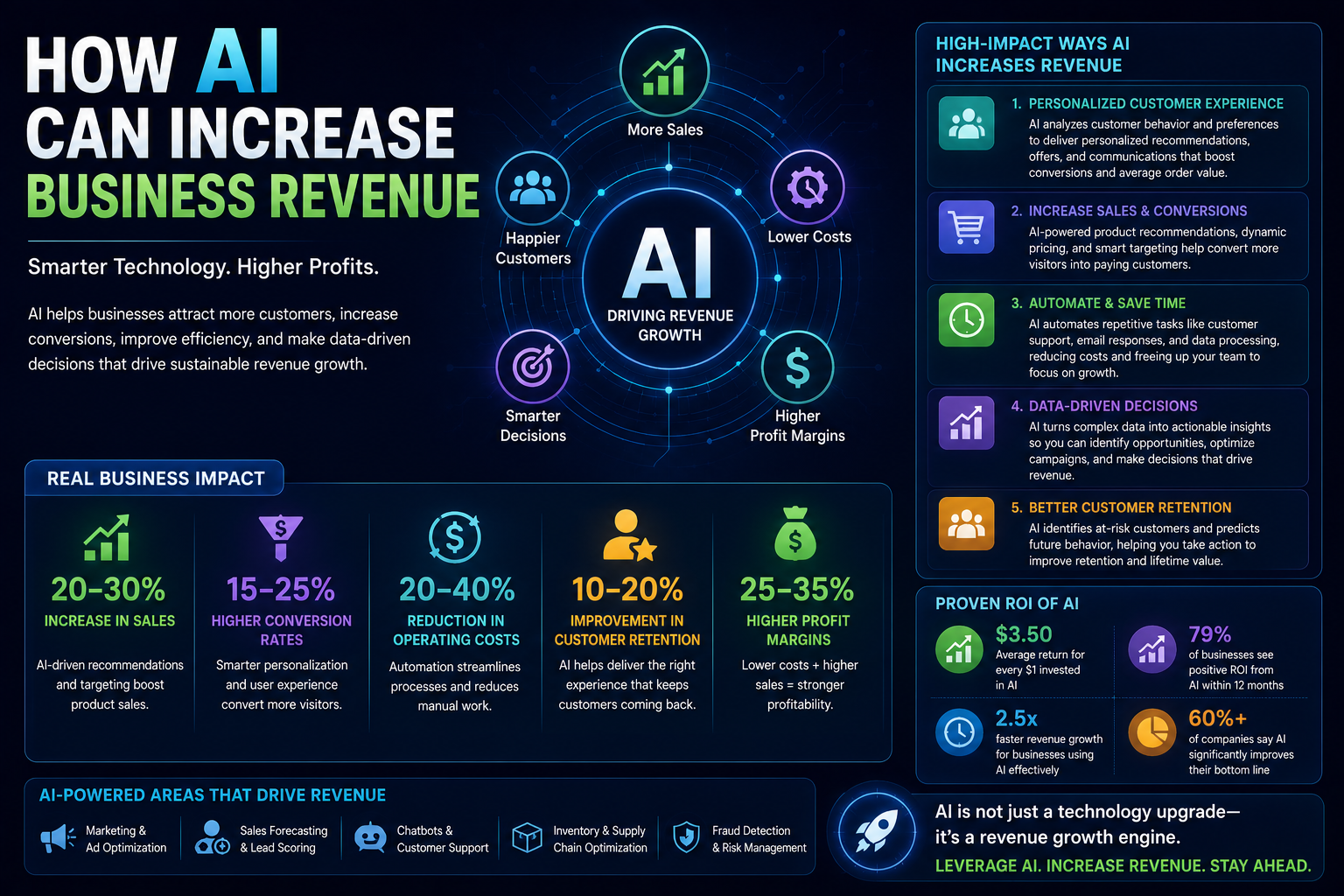
AI’s reputation is built on cost savings, but the bigger prize is on the other side of the ledger. NVIDIA’s 2026 State of AI survey found that 88% of enterprises say AI has increased their annual revenue, with nearly a third reporting gains above 10%. Yet PwC’s 2026 CEO survey found 56% of CEOs report no significant financial benefit from AI at all. The gap between those two numbers isn’t about the technology, it’s about how deliberately a business points AI at revenue rather than just efficiency. Here’s how the businesses actually growing top-line revenue with AI are doing it.
Most companies started their AI journey chasing cost savings: fewer support tickets, faster document processing, leaner operations. Those wins are real, but they cap out. Revenue growth doesn’t. Deloitte’s 2026 State of AI survey of over 3,200 leaders found that 74% of organizations want AI to grow revenue, but only 20% have actually seen it happen. The businesses in that 20% share one habit: they tied AI deployments to specific revenue KPIs from day one instead of hoping efficiency gains would eventually show up on the top line.
This article breaks down where AI is measurably increasing revenue right now, in personalization, sales, customer retention, and content velocity, along with the mistakes that keep most companies stuck reporting cost savings instead of growth.
Before looking at what works, it’s worth being honest about the baseline. AI adoption is now nearly universal, but revenue impact is not. PwC’s 2026 survey of over 4,000 CEOs across 95 countries found that only 33% report gains in either cost or revenue from AI, and just 12% report gains in both. Deloitte’s research shows a similar pattern: broad enthusiasm for AI as a growth lever, but a large gap between that ambition and measured results.
The businesses beating the odds aren’t using fundamentally different technology. They’re using it differently: with clear revenue KPIs set before deployment, workflows redesigned around the AI rather than AI bolted onto old workflows, and consistent executive sponsorship that keeps a project alive past the pilot stage. That distinction is the difference between AI as an expense and AI as a growth engine.
These are the use cases showing up most consistently across 2026 research as direct revenue drivers, not just efficiency plays.
Retailers using AI for personalized recommendations and demand forecasting report revenue growth roughly 20–30% higher than non-adopters, driven by showing the right product to the right shopper and keeping the right inventory in stock to capture that demand. This is one of the most direct, measurable revenue levers AI offers, because the output is a purchase, not just a productivity gain.
Every missed call or unanswered late-night website chat is a lead that may convert with a competitor instead. AI chatbots and voice agents answer immediately, qualify the lead, and either close simple transactions or hand off a warm prospect to a human, turning after-hours traffic into pipeline instead of lost opportunity.
AI-assisted content and creative workflows compress the time from idea to published asset, which means marketing teams can test more offers, more headlines, and more channels in the same budget window. Revenue follows from running more experiments, not just from writing faster.
AI tools that score leads, surface the right talking points, and automatically follow up with prospects keep deals moving instead of going cold in a rep’s inbox. Shortening the sales cycle doesn’t just save time, it directly increases how many deals close in a given quarter.
Every hour an employee spends on manual data entry or repetitive admin is an hour not spent on a customer conversation, a sales call, or a piece of content that could drive a sale. Automating the repetitive layer reallocates human time toward the activities that actually move revenue.
Faster, more consistent support reduces churn, and retained customers are almost always cheaper to keep than new customers are to acquire. Large-scale AI support deployments have demonstrated they can resolve billions of customer interactions a year with very high success rates, showing this isn’t a small-scale experiment anymore, it’s a proven lever for protecting existing revenue.
| Business function | Primary AI use case | Revenue mechanism |
|---|---|---|
| Marketing | Content generation, personalization, campaign testing | More campaigns shipped, higher relevance, better conversion rates |
| Sales | Lead scoring, follow-up automation, AI-assisted outreach | Shorter sales cycles, higher close rates, fewer leads going cold |
| Customer service | AI chatbots and voice agents | Faster resolution, reduced churn, after-hours lead capture |
| E-commerce and retail | Personalized recommendations, demand forecasting | Higher average order value, fewer stockouts and lost sales |
| Operations | Workflow automation, data processing | Reallocated staff time toward revenue-generating activities |
Each of the revenue levers above maps to a specific, deployable solution rather than an abstract strategy:
High Dreams LLC builds AI systems around the same principle this article argues for: define the revenue outcome first, then build toward it. The team has shipped production AI systems for more than 150 clients worldwide, typically in one to four weeks, with an evaluation dashboard that tracks accuracy, cost, and business outcomes from day one rather than after the fact.
Book a free consultation with High Dreams LLC to identify the highest-impact AI use case for your revenue goals and see what a working pilot could look like.
Both, but the revenue side gets less attention. NVIDIA’s 2026 survey found 88% of enterprises report AI has increased annual revenue, primarily through personalization, faster customer response, and higher conversion rates, not only through cost reduction.
Customer-facing use cases like chatbots and voice agents can show measurable impact, such as leads captured or resolution time, within weeks of launch. Broader revenue impact that shows up at the company-wide level typically takes multiple quarters of sustained deployment and refinement.
An AI chatbot or voice agent that captures leads outside business hours is usually the fastest path to a measurable result, since every missed inquiry is a directly lost opportunity, and the fix is straightforward to deploy.
The most common reason is deploying AI without a defined revenue KPI, then layering it onto an unchanged workflow. Companies that tie AI to specific outcomes from day one and redesign the workflow around it are significantly more likely to see real revenue growth.
Marketing, sales, and customer service tend to show revenue impact fastest because the AI is customer-facing and the outcome, a lead, a conversion, a retained customer, is easy to measure directly.
AI’s biggest impact on your business won’t come from the cheapest chatbot or the flashiest automation, it will come from pointing AI directly at revenue: personalization, faster lead response, shorter sales cycles, and stronger retention. The companies already seeing that impact aren’t smarter about the technology, they’re more disciplined about tying it to a KPI, redesigning the workflow around it, and sticking with it past the pilot. That discipline, more than the model itself, is what separates the 20% seeing real revenue growth from the majority still waiting for it to show up.


AI Agent for Sales Team - highdreamsllc.com
July 14, 2026 at 7:37 am
“ […] How AI Can Increase Business Revenue The ROI of Implementing AI Voice Agents AI Voice Agent: Increase Appointment Bookings The Role of AI Voice Agents in Growing Your Business 10 Signs Your Business Needs an AI Voice Agent How to Select the Best AI Solution Provider for Your Business […] “
AI Strategies that Save Time and Money - highdreamsllc.com
July 14, 2026 at 7:38 am
“ […] Chatbot for Service Based Businesses AI Voice Agent: Increase Appointment Bookings How AI Can Increase Business Revenue The ROI of Implementing AI Voice Agents The Role of AI Voice Agents in Growing Your Business Rapid […] “