
On a Monday morning, the operations manager of a fast-growing e-commerce company notices something unusual. Customer support tickets that once took hours to resolve are disappearing within minutes. Sales representatives are receiving qualified leads automatically, invoices are being processed without manual intervention, and marketing campaigns are launching based on customer behavior rather than fixed schedules.
None of these improvements came from hiring dozens of new employees. Instead, the company partnered with an AI automation agency that redesigned its workflows using artificial intelligence, intelligent automation, and system integrations.
Stories like this have become increasingly common. Businesses across industries are embracing AI not simply as a productivity tool but as a strategic capability. From automating repetitive administrative work to deploying AI-powered customer service agents, organizations are investing heavily in automation to reduce costs, improve operational efficiency, and gain competitive advantages.
However, success is far from guaranteed.
Many organizations approach AI automation with unrealistic expectations. Some expect immediate cost savings without investing in process redesign. Others purchase sophisticated AI solutions that fail because of poor data quality, inadequate employee training, or weak governance. In many cases, the problem isn’t the technology itself—it’s selecting the wrong implementation partner.
Hiring an AI automation agency is more than outsourcing a technical project. It is choosing a strategic advisor that will influence how your organization operates, how employees interact with technology, and how customers experience your brand.
The best agencies begin by understanding your business objectives before recommending technology. They evaluate existing workflows, identify bottlenecks, prioritize high-impact automation opportunities, and build scalable solutions that integrate with your existing systems. Their focus extends beyond deploying AI models; they create measurable business outcomes.
Poor agencies, by contrast, often lead with buzzwords. They promise rapid transformation without assessing operational readiness, underestimate integration challenges, and overlook critical issues such as security, compliance, governance, and change management. These shortcomings can result in delayed projects, budget overruns, and disappointing returns on investment.
This guide explains what businesses should realistically expect when hiring an AI automation agency in 2026. Whether you’re a startup exploring your first automation initiative or an enterprise modernizing complex operations, you’ll learn how to evaluate agencies, understand implementation phases, recognize common risks, and maximize long-term value from your AI investments.
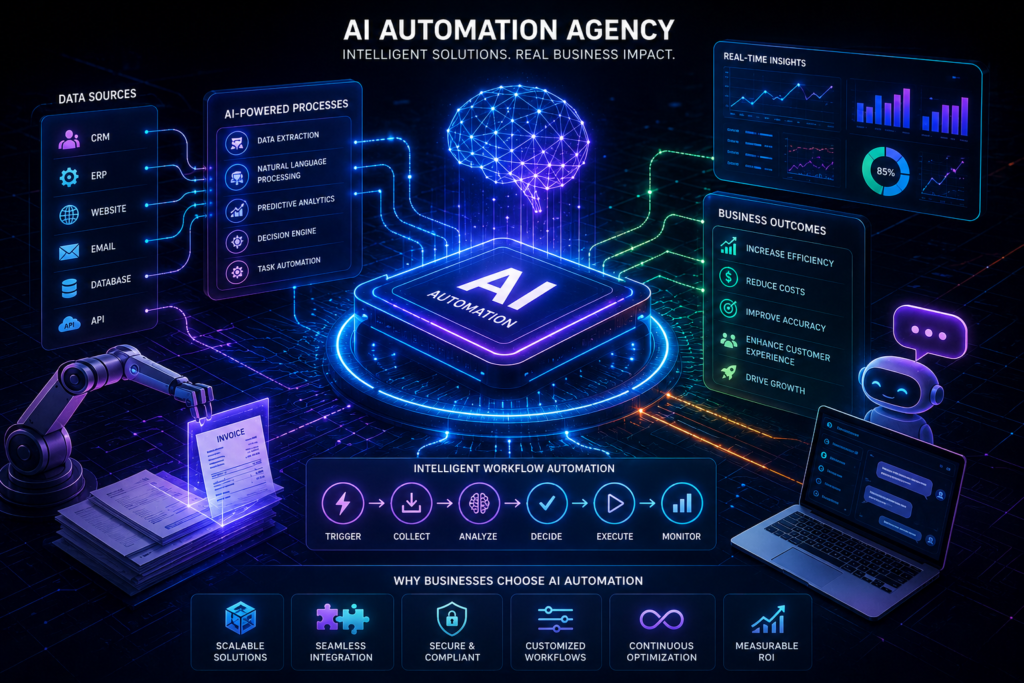
Artificial intelligence has shifted from experimental technology to essential business infrastructure. Organizations are no longer asking whether they should adopt AI—they are determining how quickly they can implement it responsibly and effectively.
Industry analysts estimate that global spending on AI software and intelligent automation continues to grow at double-digit annual rates as organizations prioritize operational efficiency, customer experience, and data-driven decision-making. Businesses that successfully integrate AI into core operations often report improvements in productivity, response times, and decision accuracy, while reducing manual workloads and operational costs.
🧠 Expert Insight
The greatest returns from AI rarely come from replacing employees. Instead, they emerge when AI augments human expertise by automating repetitive tasks, surfacing insights, and enabling faster, more informed decision-making.
⚠️ Risk: High
Organizations that rush into AI adoption without a clear automation strategy often encounter fragmented systems, inconsistent data, security vulnerabilities, and low employee adoption. Selecting the right AI automation agency is therefore a strategic decision—not merely a procurement exercise.
The Core Distinction: An AI automation agency doesn’t simply implement AI—it redesigns business processes so that artificial intelligence delivers measurable, secure, and sustainable business outcomes.
Many executives assume that AI automation agencies primarily develop chatbots or integrate large language models into existing software. This narrow perspective often leads to missed opportunities and unrealistic expectations.
The rapid rise of generative AI has dominated public attention, overshadowing the broader capabilities of intelligent automation. As a result, organizations frequently equate AI with conversational interfaces while overlooking workflow optimization, process orchestration, predictive analytics, and system integration.
⚠️ Risk Level: Medium
Limiting AI initiatives to isolated tools can create disconnected solutions that fail to address underlying operational inefficiencies. Businesses may invest in multiple standalone applications without achieving meaningful transformation.
A reputable AI automation agency begins with business objectives rather than technology preferences. Typical services include:
Successful agencies generally follow these steps:
A logistics company spends hundreds of hours manually processing shipment documentation. Rather than simply introducing an AI chatbot, the agency automates document ingestion, extracts relevant data using AI, validates information against enterprise systems, and routes exceptions to human specialists. The result is faster processing, fewer errors, and improved customer satisfaction.
Businesses often expect AI implementation to resemble traditional software deployment, with fixed requirements and predictable timelines. In reality, automation projects require iterative discovery and continuous refinement.
AI systems depend heavily on data quality, workflow complexity, and organizational readiness. Without a comprehensive discovery phase, agencies risk building solutions that do not align with operational realities.
⚠️ Risk Level: High
Skipping discovery can lead to misaligned objectives, budget overruns, delayed deployments, low employee adoption, inaccurate AI outputs, and poor ROI.
An experienced AI automation agency structures engagements into clearly defined phases:
| Project Phase | Primary Objective | Expected Outcome |
|---|---|---|
| Discovery | Understand business processes | Automation roadmap |
| Assessment | Evaluate systems and data | Technical feasibility |
| Design | Create automation architecture | Implementation blueprint |
| Development | Build AI solutions | Working automation |
| Testing | Validate performance | Reliable deployment |
| Optimization | Improve over time | Continuous ROI |
✅ Best Practice
Treat the discovery phase as the most valuable stage of the engagement. A thorough understanding of your business processes significantly increases the likelihood of successful automation.
Selecting an AI automation agency isn’t simply about choosing the company with the most impressive website or the lowest proposal. It is a strategic investment that can influence your organization’s operational efficiency, customer experience, and long-term competitive advantage. The right partner aligns technology with business objectives, while the wrong one can create costly delays, security concerns, and underperforming automation initiatives.
A structured evaluation process helps distinguish experienced implementation partners from vendors relying on marketing buzzwords.
Many organizations compare agencies based primarily on pricing, project timelines, or the number of AI tools they claim to support. While these factors matter, they rarely indicate whether an agency can successfully deliver measurable business outcomes.
Without a clear evaluation framework, businesses often select agencies that lack domain expertise, governance processes, or experience integrating AI into complex operational environments.
Artificial intelligence has become one of the fastest-growing technology sectors, attracting numerous agencies that have recently expanded into AI services. Some possess deep technical expertise, while others simply repackage existing software consulting offerings as AI solutions.
Because many business leaders are still unfamiliar with AI implementation methodologies, distinguishing between genuine expertise and persuasive marketing can be challenging.
⚠️ Risk: High
Choosing the wrong agency may result in failed automation projects, budget overruns, delayed implementation, security vulnerabilities, poor system integrations, low employee adoption, vendor lock-in, and limited scalability. Beyond financial losses, unsuccessful AI initiatives can reduce organizational confidence in future innovation efforts.
Evaluate potential agencies using both technical and business criteria rather than relying solely on sales presentations.
✅ Best Practice
Request demonstrations of completed projects that resemble your business challenges rather than generic AI product showcases.
A qualified AI automation agency should demonstrate expertise in:
Before signing a contract, conduct structured interviews with each shortlisted agency. Ask questions such as:
Agencies that answer these questions with specific examples and documented methodologies generally demonstrate greater maturity than those relying on broad promises.
A manufacturing company receives proposals from two AI automation agencies. The first promises to deploy AI across the organization within four weeks, emphasizing cutting-edge generative AI tools but providing little detail about integration or governance. The second begins with a six-week discovery phase, mapping operational workflows, assessing data quality, identifying high-impact automation opportunities, and presenting a phased implementation roadmap. Although the second proposal requires more planning, it is far more likely to produce sustainable business value because it addresses organizational readiness rather than focusing solely on technology.
One of the first questions executives ask is, “How much should AI automation cost?” The answer depends on the complexity of your business processes, existing technology stack, customization requirements, and long-term support needs.
Organizations often expect AI projects to have fixed pricing similar to purchasing traditional software. In reality, successful AI implementations involve discovery, integration, testing, optimization, and ongoing refinement.
Unlike off-the-shelf software, AI solutions interact with unique datasets, workflows, and business rules. This variability makes every implementation different.
| Pricing Model | Best For | Advantages | Considerations |
|---|---|---|---|
| Fixed Project | Clearly defined automation projects | Predictable budgeting | Less flexibility if scope changes |
| Time & Materials | Complex enterprise initiatives | Adaptable to evolving requirements | Costs may increase over time |
| Monthly Retainer | Continuous optimization | Long-term partnership and improvements | Requires ongoing budget commitment |
| Outcome-Based | ROI-focused engagements | Aligns incentives with business results | Metrics must be clearly defined |
🧠 Expert Insight
The lowest proposal is rarely the most cost-effective. Agencies that invest time in discovery, governance, testing, and employee training often deliver significantly higher long-term returns.
Not every agency advertising AI expertise possesses the experience necessary for enterprise automation. Recognizing warning signs early can prevent expensive mistakes.
⚠️ Risk: High
These warning signs often indicate an agency focused on selling technology rather than delivering measurable business outcomes.
Artificial intelligence introduces new operational risks that extend beyond traditional software development. An experienced AI automation agency treats governance as a foundational component of every implementation rather than an afterthought.
Many organizations focus exclusively on AI functionality while overlooking issues such as data privacy, access controls, regulatory compliance, and model monitoring.
A mature agency should implement:
A financial services company deploys an AI-powered document processing system. Instead of allowing AI to automatically approve financial records, the agency designs a human-in-the-loop workflow where AI performs extraction and classification while financial analysts review exceptions before approval. This approach combines automation efficiency with regulatory compliance and significantly reduces operational risk.
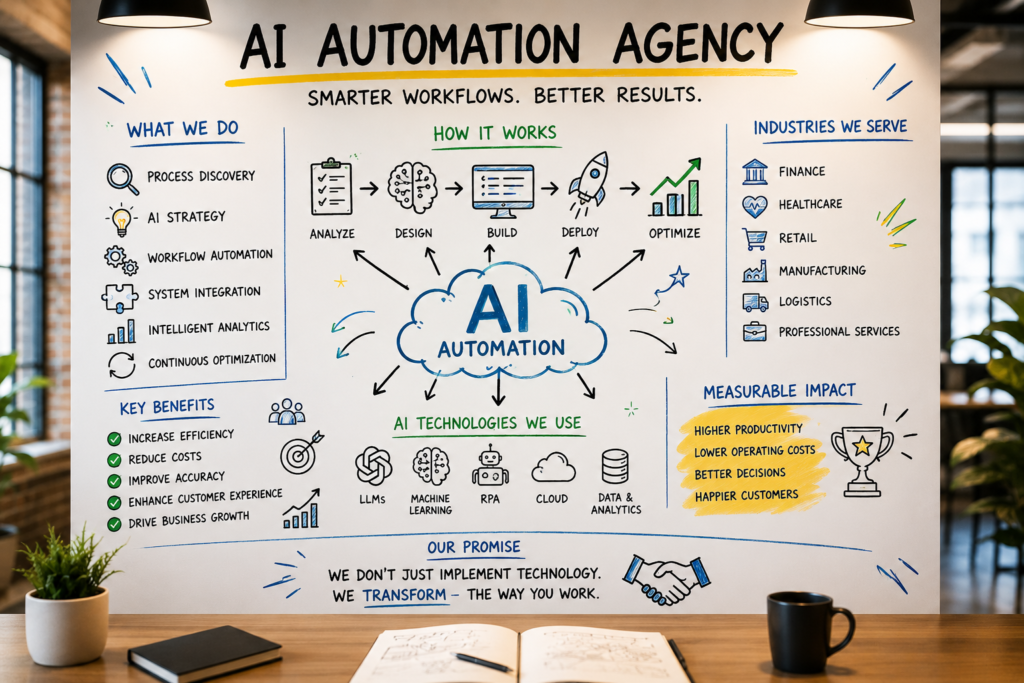
One of the biggest misconceptions about AI automation is that success is measured solely by cost reduction. While reducing operational expenses is important, the most successful organizations evaluate AI across productivity, customer experience, employee satisfaction, revenue growth, and risk reduction.
A mature AI automation agency defines measurable Key Performance Indicators (KPIs) before implementation begins and continuously monitors progress after deployment.
Many businesses deploy AI without establishing baseline metrics, making it difficult to determine whether the investment is delivering value.
Organizations often prioritize implementation speed over performance measurement. Without predefined success criteria, stakeholders rely on subjective opinions rather than data-driven insights.
⚠️ Risk Level: Medium
Without clear ROI metrics, executives struggle to justify continued investment, high-performing automations may go unnoticed, underperforming workflows remain in production, and budget decisions become reactive instead of strategic.
Track AI performance using measurable business outcomes.
| KPI | Before Automation | Target After Automation |
|---|---|---|
| Task Completion Time | 45 minutes | 10 minutes |
| Manual Data Entry | 100% | Less than 20% |
| Customer Response Time | 8 hours | Under 5 minutes |
| Operational Errors | 7% | Under 1% |
| Employee Productivity | Baseline | +25–40% |
| Customer Satisfaction (CSAT) | 82% | 92%+ |
✅ Best Practice
Review KPIs monthly during the first six months after deployment and use the insights to refine workflows, prompts, integrations, and business rules.
Successful AI adoption follows a structured roadmap rather than a single deployment event.
Objective: Understand current processes.
Activities: Process mapping, stakeholder interviews, pain-point analysis, opportunity assessment.
Deliverable: An AI automation roadmap prioritized by business impact.
Objective: Design scalable automation.
Activities: Workflow architecture, security planning, integration mapping, governance framework, KPI definition.
Deliverable: Technical implementation blueprint.
Objective: Build and integrate AI solutions.
Activities: API integrations, AI model configuration, workflow development, user interface creation, testing.
Deliverable: Working AI automation solution.
Objective: Launch safely.
Activities: Pilot rollout, user training, performance monitoring, issue resolution.
Deliverable: Production-ready AI system.
Objective: Improve long-term performance.
Activities: KPI reviews, prompt optimization, workflow enhancements, model updates, user feedback analysis.
Deliverable: Continuous business improvement.
Organizations rarely become AI-first overnight. Most progress through predictable stages of maturity.
| Maturity Level | Characteristics | Next Step |
|---|---|---|
| Level 1 – Manual | Processes rely heavily on human effort | Identify repetitive tasks |
| Level 2 – Basic Automation | Simple rule-based automation | Integrate AI capabilities |
| Level 3 – Intelligent Automation | AI supports workflows and decisions | Expand cross-functional automation |
| Level 4 – AI-Driven Operations | AI manages multiple business processes | Strengthen governance and analytics |
| Level 5 – Autonomous Enterprise | AI continuously optimizes operations with human oversight | Focus on innovation and strategic growth |
01.
Risk Level: Low
Description: Establish measurable goals before selecting technology.
If Ignored: Projects lack direction and measurable outcomes.
02.
Risk Level: Medium
Description: Identify repetitive, high-value workflows.
If Ignored: AI automates inefficient processes.
03.
Risk Level: High
Description: AI depends on accurate, consistent data.
If Ignored: AI outputs become unreliable.
04.
Risk Level: High
Description: Protect sensitive business information.
If Ignored: Increased exposure to data breaches and compliance issues.
05.
Risk Level: High
Description: Define policies for AI usage.
If Ignored: Uncontrolled AI adoption increases operational risk.
06.
Risk Level: Medium
Description: Ensure staff understand new workflows.
If Ignored: Low adoption and reduced productivity gains.
07.
Risk Level: Medium
Description: Track business outcomes continuously.
If Ignored: Performance issues remain hidden.
08.
Risk Level: Low
Description: AI requires ongoing optimization.
If Ignored: Automation performance stagnates over time.
1. Initial Trigger
A retail company launches an AI-powered order processing workflow without thoroughly testing integrations with its inventory management system.
2. Escalation
The AI continues accepting customer orders even after several products become out of stock because inventory data is delayed.
3. Failure Point
Customers receive confirmation emails for unavailable products, overwhelming customer support and delaying refunds.
4. Consequences
Customer dissatisfaction increases. Order cancellations rise. Negative online reviews damage brand reputation. Support teams become overloaded. Revenue declines due to lost trust.
5. Detection
Monitoring dashboards identify a sudden increase in inventory discrepancies and customer complaints. Audit logs trace the issue to a synchronization failure between the AI workflow and the inventory system.
6. Recovery
The agency temporarily disables automated order confirmation, restores real-time inventory synchronization, implements validation checks, and introduces human approval for inventory exceptions before reactivating the workflow.
Lesson: Effective AI automation requires continuous monitoring, fallback procedures, and human oversight—not just initial deployment.
“The most successful AI automation projects don’t begin with artificial intelligence—they begin with a deep understanding of how the business creates value. Technology should improve processes, not simply automate existing inefficiencies.”
— Editorial Research Team
| Scenario | Without Controls | With Controls |
|---|---|---|
| Customer Data | Broad access permissions | Role-based access and encryption |
| AI Decisions | Fully autonomous | Human approval for critical actions |
| Integrations | Minimal testing | Validated APIs and continuous monitoring |
| Compliance | Reactive audits | Governance built into workflows |
| AI Outputs | Unverified responses | Automated validation and quality checks |
| Incident Response | Manual investigation | Real-time monitoring and alerting |
The next two years will redefine how organizations use AI automation. Instead of isolated AI tools, businesses will increasingly adopt integrated AI ecosystems capable of orchestrating complex workflows across departments.
Key trends include:
Organizations that invest in scalable architectures, high-quality data, and continuous optimization will be better positioned to adapt as AI technologies evolve.
Hiring an AI automation agency is not simply a technology purchase—it is a strategic partnership that can reshape how your organization operates. The right agency brings more than technical expertise; it provides a structured approach to process analysis, solution design, implementation, governance, and ongoing optimization.
Successful AI automation starts with clearly defined business objectives, a thorough understanding of existing workflows, and a commitment to measurable outcomes. Organizations that prioritize discovery, data quality, security, employee training, and continuous improvement are far more likely to realize sustainable returns on their AI investments.
Conversely, rushing into automation without proper planning can lead to fragmented systems, security risks, poor user adoption, and disappointing ROI. Evaluating agencies carefully, asking the right questions, and insisting on transparent methodologies will help you avoid these pitfalls.
As AI capabilities continue to mature, businesses that treat automation as an ongoing transformation rather than a one-time project will gain the greatest competitive advantage. By selecting the right implementation partner and maintaining a focus on governance, scalability, and business value, organizations can unlock significant improvements in efficiency, customer experience, and long-term growth.
Ready to begin your AI automation journey?
A thoughtful approach today can position your business for sustained success in the AI-driven economy of tomorrow.
1. What does an AI automation agency do?
An AI automation agency analyzes business processes, designs intelligent workflows, integrates AI with existing systems, and provides ongoing optimization to improve efficiency and business performance.
2. How do I choose the right AI automation agency?
Evaluate agencies based on industry experience, technical expertise, security practices, governance frameworks, integration capabilities, client references, and post-deployment support.
3. How long does an AI automation project take?
Project timelines vary depending on complexity. Small initiatives may take a few weeks, while enterprise-wide implementations often span several months.
4. What industries benefit most from AI automation?
Retail, finance, healthcare, manufacturing, logistics, professional services, customer support, and e-commerce are among the industries seeing significant benefits.
5. Is AI automation only for large enterprises?
No. Small and medium-sized businesses can also benefit by automating repetitive tasks, improving customer service, and increasing operational efficiency.
6. What are the biggest risks of AI automation?
Common risks include poor data quality, inadequate governance, security vulnerabilities, integration challenges, and low employee adoption.
7. How is AI automation different from traditional automation?
Traditional automation follows predefined rules, while AI automation can analyze data, recognize patterns, and make context-aware recommendations or decisions.
8. What should be included in an AI automation contract?
The agreement should define project scope, deliverables, timelines, KPIs, security responsibilities, governance requirements, support services, and ownership of data and intellectual property.
9. How do businesses measure AI automation ROI?
ROI is measured through improvements in productivity, cost savings, response times, customer satisfaction, error reduction, revenue growth, and operational efficiency.
10. What should I expect after deployment?
Expect continuous monitoring, model updates, workflow optimization, employee training, performance reporting, and periodic governance reviews to ensure long-term success.


- highdreamsllc.com
July 7, 2026 at 4:07 pm
“ […] What to Expect When Hiring an AI Automation Agency: A Complete Decision-Maker’s Guide for 2026 […] “
10 Signs Your Business Needs an AI Voice Agent - highdreamsllc.com
July 9, 2026 at 7:38 am
“ […] Voice Agents How AI Voice Agents Improve Amazon Online Business in 2026 AI Workflow Agents What to Expect When Hiring an AI Automation Agency: A Complete Decision-Maker’s Guide for 2026 AI Chatbot Why Businesses Are Investing in AI Customer Support AI Workflow Agents AI-Powered Sales […] “
The ROI of Implementing AI Voice Agents: What the Data Actually Shows - highdreamsllc.com
July 11, 2026 at 3:53 pm
“ […] an AI Voice Agent AI Voice Agents How AI Voice Agents Improve Amazon Online Business in 2026 AI Workflow Agents What to Expect When Hiring an AI Automation Agency: A 2026 Guide AI Chatbot Why Businesses Are Investing in AI Customer Support AI Chatbot How AI Automation Is […] “
How to Select Best AI Solution Provider for your Business - highdreamsllc.com
July 11, 2026 at 6:00 pm
“ […] What to Expect When Hiring an AI Automation Agency: A Complete Decision-Maker’s Guide for 2026… The ROI of Implementing AI Voice Agents: What the Data Actually ShowsRead more → 10 Signs Your Business Needs an AI Voice AgentRead more → How AI Automation Is Reshaping Ecommerce Service in 2026Read more → Why Businesses Are Investing in AI Customer SupportRead more → Chatbots for E-commerce Stores: The Future of Online Shopping in 2026Read more → […] “
How AI Can Increase Business Revenue - highdreamsllc.com
July 12, 2026 at 2:13 pm
“ […] Customer SupportRead more → How AI Automation Is Reshaping Ecommerce Service in 2026Read more → What to Expect When Hiring an AI Automation Agency: A Complete Decision-Maker’s Guide for 2026… How to Select Best AI Solution Provider for Your BusinessRead more […] “