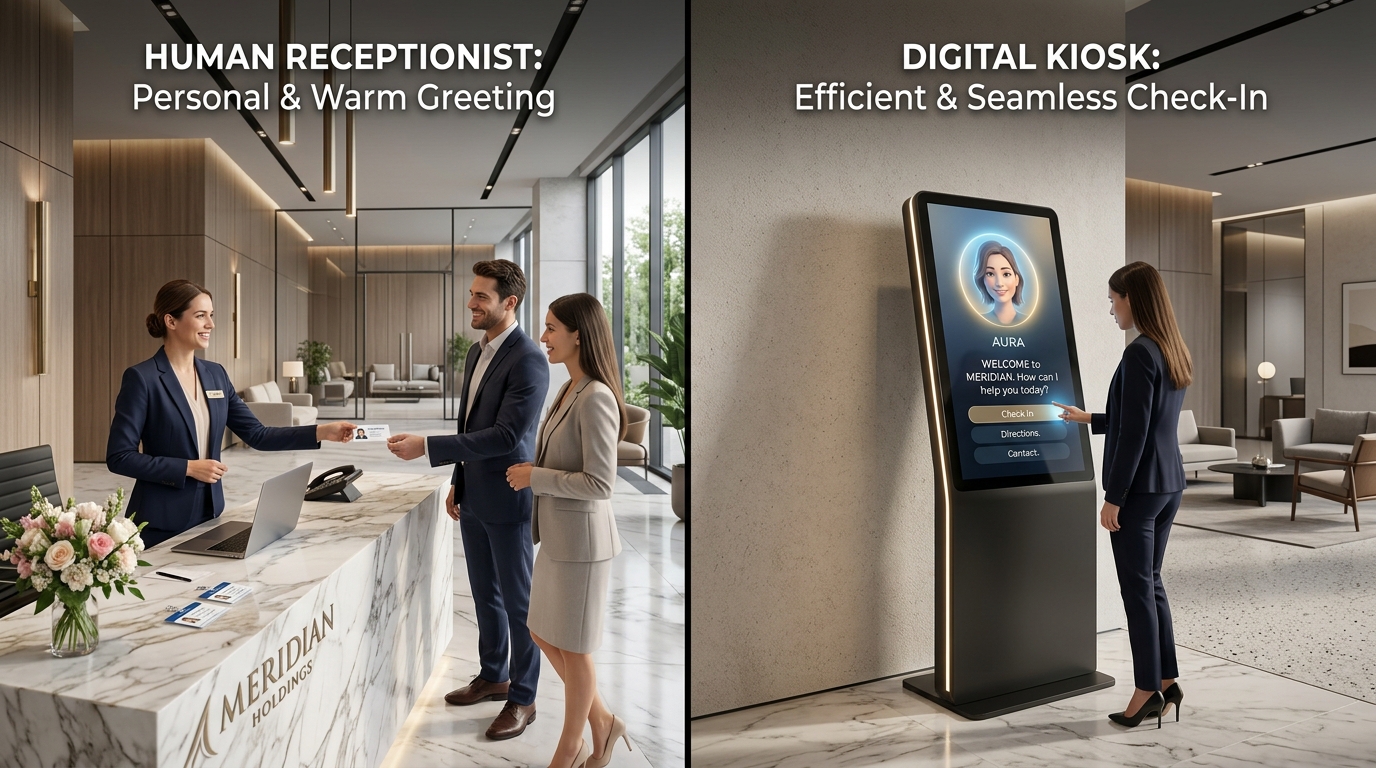
A single front-desk hire covers about 23% of the hours in a year. The other 77% — evenings, weekends, lunch breaks, sick days — is when calls quietly go to voicemail. A widely cited MIT-led study found that businesses responding to a lead within 5 minutes are 100 times more likely to make contact than those that wait 30 minutes. That gap between “covered” and “always answered” is the entire argument for AI voice agents, and it’s worth examining honestly against what a human receptionist still does better.
A full-time human receptionist costs $45,000 to $70,000 a year once salary, benefits, payroll taxes, and turnover are factored in — and covers roughly 40 hours a week. An AI voice agent typically costs $30 to $500 a month and answers every call, 24/7, with no coverage gaps. The honest comparison isn’t close on cost or availability. Where a human receptionist still wins is the in-person welcome, complex or emotionally sensitive requests, and the judgment calls a script can’t anticipate — which is why most businesses that adopt AI keep a person for exactly those moments rather than eliminating the front desk entirely.
The job posting number is never the real number. The U.S. Bureau of Labor Statistics puts the median receptionist salary at $37,230 a year as of May 2024. But BLS compensation data also shows private-sector employers pay roughly 29.7% on top of wages in benefits alone — pushing that same role closer to $50,000-$53,000 once health insurance, payroll taxes, and paid time off are included. Add recruiting and training: SHRM estimates the average cost-per-hire at roughly $4,700, and replacing an employee typically runs 33% to 200% of their annual salary depending on the role. With median receptionist tenure sitting around 2.4 years, that replacement cost recurs regularly, not as a rare event.
Then there’s the coverage math. A single full-time employee covers about 2,000 hours a year — roughly 23% of the 8,760 hours in a calendar year. Achieving true 24/7 phone coverage with human staff requires 4 to 5 full-time-equivalent employees across shifts, which several cost analyses put at $220,000 to $345,000 annually — a number that puts round-the-clock human coverage out of reach for most small businesses entirely, not just an expensive option.
AI receptionist pricing generally falls into three tiers: entry-level plans around $25-$100 a month for a few hundred minutes, mid-tier plans around $100-$300 a month for higher call volume, and higher-usage plans up to roughly $500-$600 a month for busy multi-line offices. Even at the top of that range, a year of 24/7 AI coverage costs a small fraction of a single part-time hire — before counting the missed-call revenue it recovers.
| Factor | Human Receptionist | AI Voice Agent |
|---|---|---|
| Annual cost (fully loaded) | $45,000–$70,000 | $360–$6,000 |
| Coverage | ~40 hrs/week, one person | 24/7/365 |
| Simultaneous calls | One at a time | Unlimited |
| Turnover / replacement risk | Median tenure ~2.4 years; recurring hiring cost | None |
| Setup time | Weeks (recruit, hire, train) | Days to a couple of weeks |
| In-person presence | Yes | No |
| Complex/emotional calls | Strong | Limited; best handed off to a human |
Coverage gaps aren’t just an inconvenience — they’re a direct revenue leak, and the research on how much is fairly consistent across small business studies. Estimates vary by source, but several independent analyses put missed-call losses for a typical small business somewhere between $26,000 and $126,000 a year, with the wide range driven by call volume, average deal size, and industry. The pattern shows up hardest in specific sectors: Clio’s Legal Trends Report finds law firms miss roughly 35% of incoming calls, and home service businesses — plumbers, HVAC techs, electricians — routinely miss 27% to 62% because staff are physically on job sites when the phone rings.
Speed compounds the problem. In a widely cited study led by MIT researcher James Oldroyd analyzing more than 15,000 leads and 100,000 call attempts, businesses that responded to a new lead within 5 minutes were roughly 100 times more likely to make contact, and 21 times more likely to qualify that lead, compared to waiting 30 minutes. A receptionist on lunch or a second line at capacity isn’t just missing a call — they’re handing a measurable advantage to whichever competitor answers first.
No lunch breaks, no sick days, no second line ringing while the first is in use — every call gets an immediate answer.
Evening and weekend calls, which routinely go to voicemail with human-only staffing, get answered and often booked in real time.
A busy Wednesday afternoon with three calls at once is handled exactly like a quiet Tuesday morning — no caller waits in queue.
A flat monthly fee replaces a five-figure annual salary plus benefits, taxes, and the recurring cost of turnover.
For businesses where someone greets clients walking through the door, no phone system replaces the physical front-desk presence.
A distressed patient, an upset client, or a sensitive cancellation still calls for a person who can read tone and respond with real judgment.
Regular clients who value being remembered and known by name get something from a familiar human voice that a script can’t fully replicate.
High Dreams LLC is a Colorado-based AI and digital growth agency that has shipped AI voice agents for 150+ clients worldwide — moving from idea to production in 1 to 4 weeks, built around the hybrid front-desk model rather than a wholesale replacement of your team.
Your current call patterns, missed-call rate, and busiest hours are mapped before anything is built.
A working voice agent is tested against your real call scenarios, including the handoff to your front-desk staff.
Booking accuracy, call quality, and escalation handling are tested against defined thresholds before launch.
Relevant services include AI voice agent development, AI workflow agents, and AI chatbots for web-based inquiries.
Get a free consultation to see what a 24/7 AI voice agent would cost for your actual call volume.
Yes, substantially. A full-time human receptionist typically costs $45,000 to $70,000 a year fully loaded, while AI voice agent plans generally run $30 to $500 a month — even the high end of AI pricing sits far below a single receptionist’s salary alone.
For phone coverage, often yes for routine calls. For businesses with an in-person front desk, or those handling frequent complex and emotionally sensitive calls, most successful setups keep a human for those specific situations while AI covers volume and after-hours calls.
Estimates vary by industry and call volume, but independent studies put typical annual losses somewhere between $26,000 and $126,000, with law firms and home service businesses among the hardest hit due to high missed-call rates.
A widely cited study analyzing over 15,000 sales leads found that responding within 5 minutes made a business 100 times more likely to make contact than waiting 30 minutes — speed is one of the strongest predictors of whether a lead converts at all.
Basic deployments for routine call handling and appointment booking can go live in days to a couple of weeks. More complex integrations with scheduling systems or CRMs typically take a few weeks longer.
Sources: U.S. Bureau of Labor Statistics, Occupational Outlook Handbook and Employer Costs for Employee Compensation (ECEC) data · SHRM, “The Real Costs of Recruitment” · Clio, Legal Trends Report · MIT/James Oldroyd lead-response-time research (widely cited via Harvard Business Review coverage) · Cross-referenced 2026 receptionist and AI voice agent cost analyses from BLS-grounded industry sources.


AI Voice Agents for Home Service Businesses
August 4, 2026 at 6:55 am
“ […] Retention AI Voice AgentsThe Future of AI Voice Technology: What’s Coming Next AI Voice AgentsAI Voice Agent vs Human Receptionists AI Voice AgentsHow AI Voice Agents Increase Appointment […] “