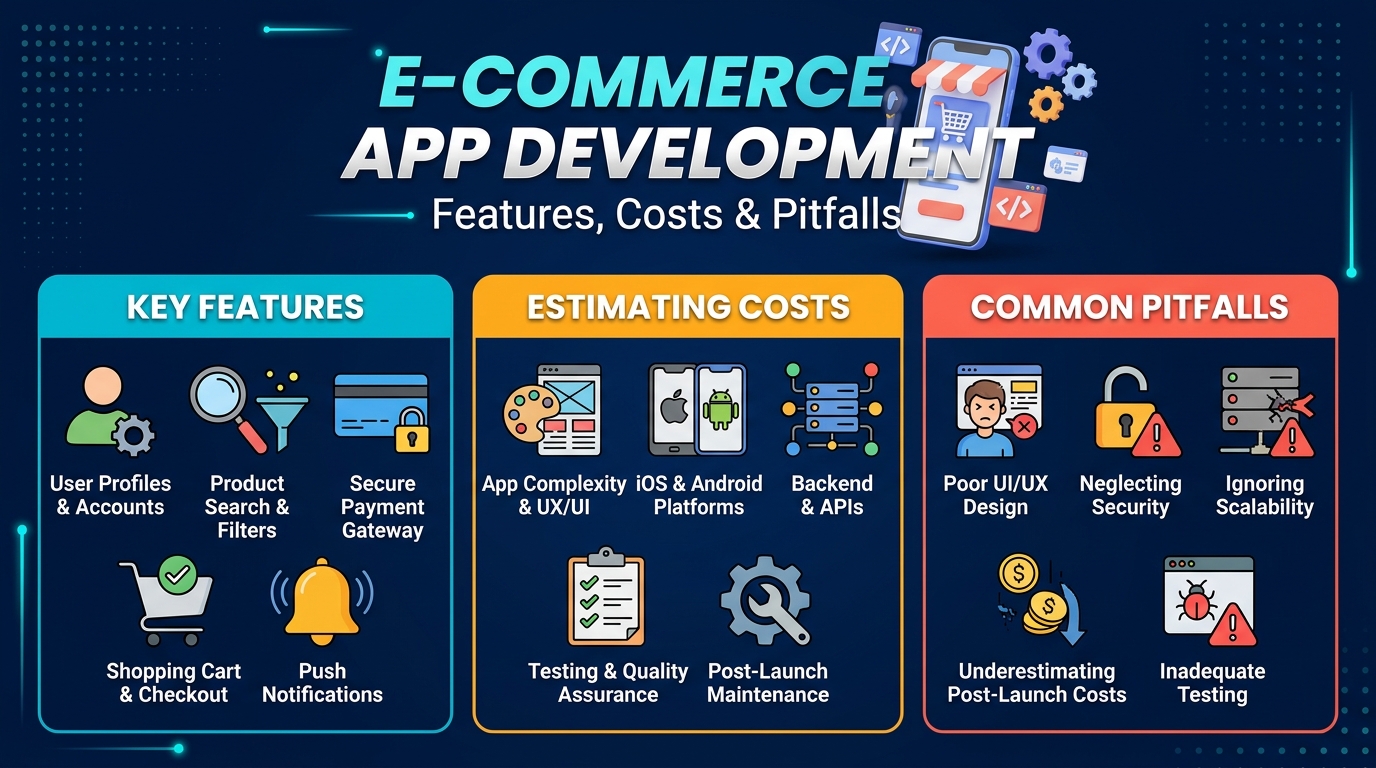
More shoppers browse and buy on their phones, and many online stores wonder whether they need an app. Done well, e-commerce app development can increase repeat purchases and build loyalty. Done badly, it can burn budget on a product nobody installs. This guide covers the features that matter, how to build, what drives cost, and the pitfalls to avoid.
E-commerce app development is the process of designing, building, launching and maintaining a shopping app that lets customers browse, buy and track orders on their phones, while giving your team tools to manage products, inventory and orders. The essentials are fast search, a smooth checkout, secure payments and reliable order updates. Cost depends on features, platforms, integrations and security, so start with a minimum viable product and grow from real usage.
Before you invest in e-commerce app development, check whether an app solves a real problem. A fast, mobile-friendly website is cheaper, easier to find through search and works for first-time visitors who will not download anything.
An app tends to make sense when you have repeat customers, products people reorder, a loyalty program, or a need for push notifications, camera access or offline features. If most of your traffic is new visitors, invest in your website first. Our guide to app development for businesses explains the app versus website decision in more detail.
“People install apps for stores they already trust. An app rewards loyalty. It rarely creates it.”
Good e-commerce app development begins with a short list of essentials. Add advanced features only after you see how customers use the basics.
| Feature | Why it matters | Priority |
|---|---|---|
| Product catalog with search and filters | Shoppers must find items quickly | MVP |
| Product pages (images, details, reviews) | Drive buying confidence | MVP |
| Cart and fast checkout | Biggest influence on conversion | MVP |
| Secure payments and wallets | Trust and speed at purchase | MVP |
| Customer accounts and order history | Enables reorders and support | MVP |
| Order tracking and notifications | Reduces “where is my order” contacts | MVP |
| Wishlists and saved carts | Brings shoppers back | Soon after launch |
| Loyalty and promotions | Encourages repeat purchases | Later |
| Personalization and recommendations | Surfaces relevant products | Later |
| AI assistant or voice search | Faster answers and discovery | Later |
| Subscriptions and reorder tools | Recurring revenue for consumables | Later |
| Approach | Best for | Trade-offs |
|---|---|---|
| Platform-based app (built on your store platform’s tools or a mobile app builder) | Fast launch for standard stores | Limited customization and ongoing plan fees |
| Cross-platform custom app | Custom experience on iOS and Android with shared code | Some limits on advanced device features |
| Native custom app | Top performance and deep device features | Higher effort for each platform |
| Headless commerce plus custom front end | Brands wanting full control over the experience | More complex architecture and upkeep |
| Progressive web app (PWA) | App-like experience without store distribution | Feature support varies by device |
Platform features and plans change often. Verify current capabilities and pricing before you choose.
There is no honest one-size price. Instead of chasing generic ranges, understand what moves the budget.
| Cost driver | How it affects budget |
|---|---|
| Number and complexity of features | Each feature adds design, build and testing |
| Platforms (iOS, Android, both) | More platforms mean more work unless code is shared |
| Design and branding | Custom interfaces take longer than templates |
| Integrations | Inventory, ERP, shipping, tax and marketplaces add scope |
| Security and compliance | Payments and customer data require careful handling |
| Team model | In-house, agency or freelancer changes price and control |
| Maintenance and marketing | Updates, hosting, support and promotion continue after launch |
Ask each vendor for an itemized estimate based on the same written scope. That makes quotes comparable and exposes hidden extras.
Store rules, fees and laws change often. This is general information, not legal or financial advice.
AI can make a shopping app more helpful once the basics work. Examples include an in-app assistant that answers order and product questions, smarter search, and automation that keeps inventory and orders in sync. See our guide on how to add AI to your app for a safe approach.
| Pitfall | What goes wrong | Better approach |
|---|---|---|
| Building every feature at once | Cost and delay balloon | Launch an MVP and iterate |
| Slow or clumsy checkout | Abandoned carts | Minimize steps, support guest checkout and wallets |
| Weak search | Shoppers cannot find products | Invest in filters, typo tolerance and good product data |
| Inventory out of sync | Overselling and cancellations | Connect the app to a single inventory source |
| Ignoring the mobile website | Lost search traffic and new customers | Keep the site fast and the app complementary |
| Overusing push notifications | Users mute or uninstall | Send relevant, limited, opt-in messages |
| No plan to get installs | A finished app nobody downloads | Promote to existing customers and use app store optimization |
| Skipping analytics | Decisions based on guesses | Track funnels, retention and crashes from day one |
| Underestimating maintenance | Bugs and OS updates break the app | Budget for ongoing updates and support |
HighDreamsLLC is a Colorado-based AI and digital growth agency. We provide web and app development, build AI chatbots, voice agents and workflow automation, and manage e-commerce across Amazon, Walmart, Etsy and eBay. If you are considering e-commerce app development, we can help you decide whether an app makes sense, define a focused first version and connect it to your inventory and orders.
E-commerce app development is the process of designing, building, launching and maintaining a shopping app, usually for iOS and Android, that lets customers browse products, check out securely and track orders, while giving the business tools to manage catalog, inventory and orders.
Core features include a product catalog with search and filters, product pages, cart and checkout, secure payments, customer accounts, order tracking and notifications. Later additions can include personalization, loyalty, an AI assistant and subscriptions.
Cost depends on features, platforms, design effort, integrations, security needs, team model and ongoing maintenance. Get itemized quotes for a defined scope, and plan for usage and upkeep costs after launch.
Not always. A fast, mobile-friendly store may be enough, especially early on. An app can make sense when you have repeat customers, want push notifications and loyalty features, or need device capabilities a website cannot provide.
Apple’s rules generally treat physical goods and services consumed outside the app differently from digital goods. Rules and fees change, so review Apple’s current App Store Review Guidelines or consult a professional before you plan your payments.
Successful e-commerce app development starts with a clear reason for the app, a lean first version and a relentless focus on search, checkout and trust. Connect it to your inventory, protect customer data, measure what shoppers actually do and improve in small steps. Treat the app as a long-term channel, not a one-time project, and it can become a loyal customer base you own.
Sources and further reading: PCI Security Standards Council, Apple App Store Review Guidelines, Google Play Console, OWASP Mobile Top 10. Platform rules, fees and regulations change often; verify current details with the original sources.