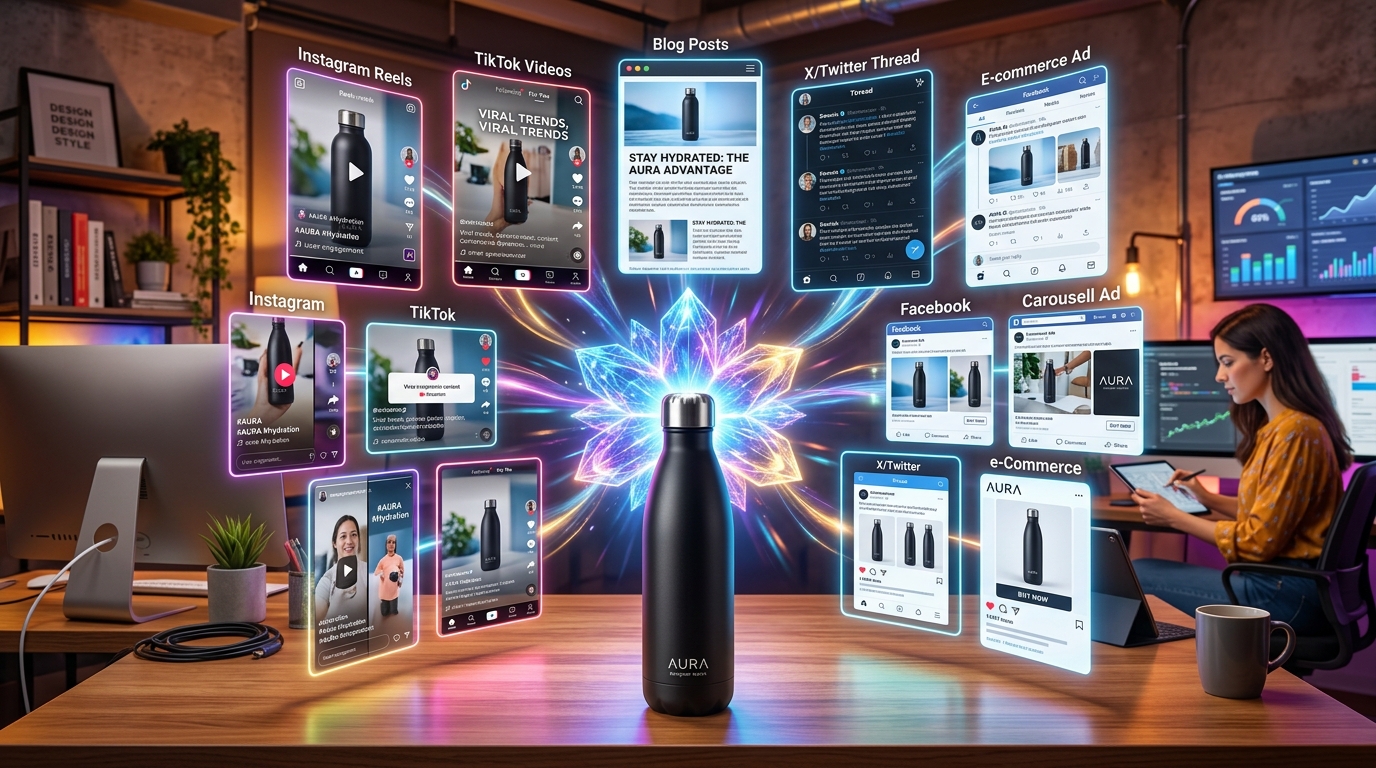
You turn one product into 30 days of marketing content with AI by first breaking that single product into a dozen distinct angles — features, benefits, use cases, objections, and stories — then using AI to map those angles onto a content calendar, batch-write the captions and scripts for each platform, and repurpose every piece into two or three formats. One product, viewed from enough angles, easily fills a month of daily posts without repeating yourself.
Most small businesses treat their product as a single talking point: here’s what it is, here’s the price, buy now. That’s one angle out of dozens available. A single product actually contains a features list, a set of customer pain points it solves, an origin story, a manufacturing or creation process, common objections, before-and-after outcomes, seasonal use cases, and the words real customers use to describe it. Each of those is its own content thread.
AI is well suited to this problem specifically because its strength is enumeration and reformatting — quickly generating a long list of angles and then rewriting the same core idea in different tones, lengths, and formats. The work you still have to do is deciding which angles are true to your brand and editing the output so it doesn’t sound like everyone else’s AI-generated content.
Sit down with AI and go feature by feature. For each feature, ask it to generate the underlying benefit, a common objection someone might raise about it, and a specific scenario where it matters. Do the same with materials or ingredients, the creation process, seasonal relevance, and any before-and-after outcome your product creates. By the end of this step you should have 15–25 distinct angles, not five.
Group everything into four pillars so the month doesn’t feel repetitive:
A simple ratio that avoids feeling like a constant sales pitch is roughly 40% educate, 30% prove, 20% entertain, 10% promote.
Feed your angle list and pillar ratios into an AI assistant and ask it to lay out a 30-day calendar, assigning one angle and one pillar per day, and noting the best format for each (short video, carousel, single image, written post, email). Ask it to avoid placing two similar angles back to back so the feed doesn’t feel monotonous.
Rather than writing day-by-day, batch by pillar. Generate all the “educate” captions in one pass, all the “prove” captions in another. This keeps the tone consistent within each pillar and is dramatically faster than switching context 30 times. Always treat AI output here as a first draft — rewrite in your own voice, cut anything that sounds generic, and add specific details AI wouldn’t know (a real customer’s name, an exact number, a specific moment).
Every time you create one substantial piece — a demo video, a blog post, a customer interview — have AI help you break it into a short-form video script, a carousel outline, a text-only post, and an email snippet. One recording or one write-up can realistically become four to five separate posts across the month.
Paste anonymized reviews, DMs, or support messages into an AI tool and ask it to pull out recurring phrases, objections, and praise. Content built from a customer’s actual words consistently reads as more authentic than content built purely from your own internal description of the product.
Once the month is scheduled, track which pillar and which angle actually performs. Feed that back into your next AI session: “here are the three posts that got the most engagement — generate 10 more angles similar to these.” Over time this turns your content calendar into a feedback loop instead of a guess.
AI can fill a calendar in an afternoon. It can’t tell whether a joke lands for your specific audience or whether a claim about your product is actually accurate. Read every piece before it’s scheduled — both for voice and for accuracy.
| Week | Primary Pillar Focus | Example Angles | Suggested Formats |
|---|---|---|---|
| Week 1 | Educate | How it’s made, how to use it, what makes it different | Short video, carousel |
| Week 2 | Prove | Testimonials, before/after, behind-the-scenes quality | Video, single image, story |
| Week 3 | Entertain | Relatable problem moments, trend tie-ins, humor | Short video, meme-style image |
| Week 4 | Promote | Bundles, urgency, restock, seasonal offer | Carousel, email, direct offer post |
Batching a month of content is only useful if it’s actually built, scheduled, and connected to the rest of your marketing and sales workflow. High Dreams LLC helps businesses turn this kind of content system into something that runs with far less manual effort.
Yes, as long as you first break the product into enough distinct angles — features, benefits, objections, use cases, and customer stories. AI is good at expanding an angle list into a full calendar; it’s not good at generating those angles out of nothing without your input.
It can, if you post the first draft as-is. Editing every piece for your specific voice, adding real details AI wouldn’t know, and mining real customer language are what keep the content from sounding like everyone else’s AI output.
The biggest time savings come from batching by pillar instead of writing post by post, and from repurposing one core asset into multiple formats instead of creating each piece from scratch. Exact time savings will vary by workflow and tools used.
A useful starting ratio is roughly 40% educational content, 30% proof (reviews, before/after), 20% entertaining or relatable content, and 10% direct promotion — then adjust based on what actually performs for your audience.
AI is best used to plan and draft the calendar’s content; you’ll still want a scheduling tool to actually queue and publish posts across platforms.
High Dreams LLC builds the AI workflows and automation that take a single product and keep a full month of marketing content moving without the manual grind.