AI Voice Agent · June 2026 · 12 Min Read
On a chaotic Tuesday afternoon at a rapidly scaling e-commerce logistics enterprise, the customer experience team faced an unexpected crisis. A localized shipping delay triggered an unprecedented 400% surge in inbound telephone inquiries. Under traditional operational models, this scenario guarantees a cascading failure: holding queues skyrocket past forty minutes, abandoned call rates climb into double digits, and overwhelmed human agents struggle through repetitive status updates while high-value escalation tickets sit completely unaddressed.
Yet, on this particular afternoon, the company’s secondary phone lines remained completely silent. Behind the scenes, an engineered cluster of conversational artificial intelligence voice agents quietly intercepted the massive spike in calls. Operating simultaneously without a single second of latency, the digital systems engaged thousands of frantic callers in fluid, natural spoken English. By safely connecting to the company’s central logistics database via secure webhooks, the system authenticated customer identities, parsed conversational intent, explained the shipping delay, and updated delivery windows on live order profiles—all within a unified, two-minute dialogue per customer.
This is the paradigm shift occurring across the modern corporate landscape. For decades, telephone automation was defined by the frustrating, rigid parameters of Interactive Voice Response (IVR) systems—the mechanical “press 1 for sales, press 2 for support” loops that customers explicitly detour. Today, the convergence of advanced Large Language Models (LLMs), sub-second Latency Orchestration, and hyper-realistic Text-to-Speech (TTS) neural synthesizers has birthed a brand-new asset class: autonomous AI Voice Agents.
These cognitive platforms do not rely on pre-recorded static decision trees. Instead, they dynamically listen, interpret intent, make contextual decisions, and execute complex business logic within live application ecosystems. For organizations seeking sustainable operational leverage, understanding the architectural framework and commercial utility of these voice agents has transitioned from an innovative luxury into an absolute core strategic necessity.
The voice channel has long been the most expensive, yet arguably most critical, point of contact within an enterprise ecosystem. According to traditional operational benchmarks, human-operated contact centers incur substantial financial overhead, with the average cost per customer interaction ranging between $\$5.00$ and $\$9.00$. When scaled across millions of inquiries annually, the financial strain becomes immense, often leading to restricted operational hours and degraded service quality.
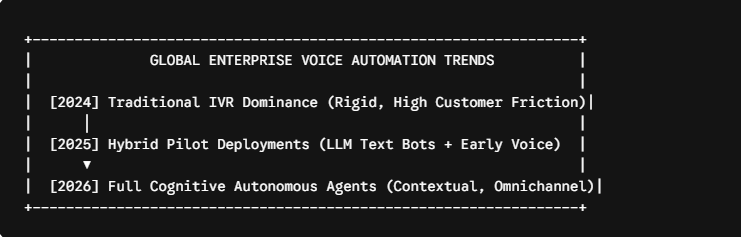
Furthermore, market shifts indicate an undeniable trend: consumers increasingly demand immediate resolution. Standard asynchronous text options like email or web chatbots often fail to deliver the nuance required for high-stakes problem solving, forcing users back to the phone lines. Modern AI voice systems solve this structural mismatch by offering the cost efficiency of digital automation paired with the high-fidelity throughput of a live, spoken conversation. By containing upwards of 70% of routine inbound traffic, enterprises can redirect their human capital toward complex enterprise problem solving, high-value sales qualification, and deep customer relationship retention.
The Core Distinction
Traditional IVR systems force a human to speak like a computer to navigate a menu. Modern AI Voice Agents train a computer to speak like a human to execute a business workflow.
Traditional voice automation relies heavily on keywords or explicit dial tones. If a customer deviates from the rigid pre-programmed vocabulary—say, stating “My package hasn’t arrived yet” instead of choosing “Track an existing order”—the system stumbles, creating circular frustration loops and forcing manual human intervention.
Legacy systems lack semantic understanding. They operate on deterministic, hard-coded logic paths rather than probabilistically analyzing the contextual meaning of human speech patterns.
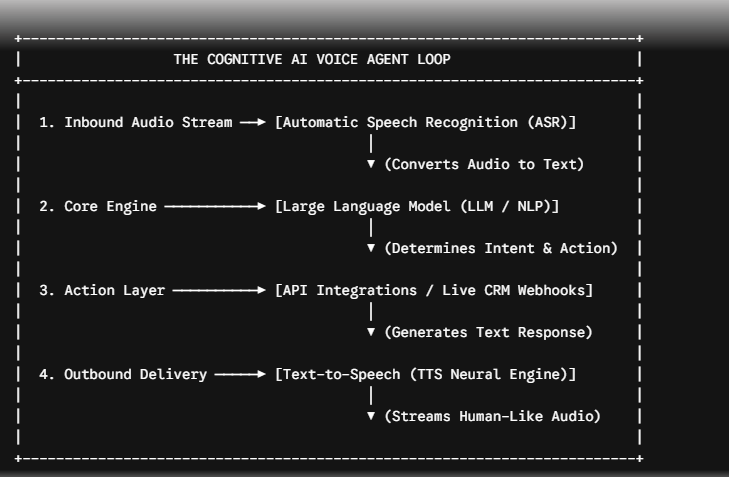
Deploy a fully decoupled, multi-layered cognitive voice stack that mirrors human cognitive processing in real time. Rather than treating a phone call as a single audio stream, modern architectures break the interaction down into four distinct, lightning-fast stages.
To achieve fluid, sub-second latency that mimics natural human conversation, enterprises must orchestrate a modular voice infrastructure consisting of four core technical layers:
A banking client calls to report a misplaced credit card. The system handles the entire interaction autonomously:
 Expert Insight: “By ensuring the entire round-trip processing time between ASR, LLM reasoning, and TTS synthesis stays strictly below 800 milliseconds, companies can prevent conversational overlaps and preserve natural human verbal rhythms.” — Editorial Research Team
When a customer speaks to a traditional call center agent or legacy system, the unstructured conversational data generated during that call is completely lost to the rest of the enterprise. Sales pipelines, marketing engines, and customer success dashboards remain entirely unaware of the specific issues, questions, or buying signals expressed over the phone.
Voice data has historically been siloed inside isolated telephony storage platforms as massive, un-indexed audio logs (WAV or MP3 files) that are incredibly difficult to parse, analyze, or actions at scale.
Integrate the conversational AI agent directly into the central enterprise CRM and data warehouse architecture. Treat every spoken word as a structured data point that triggers automated downstream workflows across your sales and marketing pipelines.
A prospective client calls a B2B SaaS company inquiring about enterprise pricing tiers:
 Industry Impact: Moving from un-indexed voice logs to fully structured, CRM-integrated transcripts allows marketing teams to deploy hyper-personalized email follow-ups within minutes of a phone interaction, increasing lead conversion rates by over 35%.
Deploying automated conversational systems into production requires rigorous design controls. The table below highlights the vast operational differences between an unstructured, unsecured deployment and an engineered, enterprise-grade AI voice architecture.
| Core Operational Scenario | Without Guardrails (High Risk) | With Enterprise Guardrails (Secured) |
| Pricing Inquiries | The model may hallucinate a discount, creating legal liabilities. | The model references a strict, read-only pricing database through secure APIs. |
| Identity Verification | The system accepts verbal claims without verification, risking data leaks. | The system sends a one-time passcode (OTP) to the customer’s phone before displaying account data. |
| Irrelevant Customer Prompts | The bot engages in off-topic discussions, driving up cloud computing costs. | Guardrails intercept off-topic prompts and politely guide the user back to business features. |
| Integration Failure | The system drops the call entirely when a backend database times out. | Fallback logic smoothly transfers the caller to a live human queue during system downtimes. |
To understand how these systems accelerate enterprise revenue and scale operations, review this comprehensive tool and capability matrix:
| Core Business Use Case | Primary Operational Value | Automation Potential | Key Software Integrations |
| 24/7 Inbound Customer Support | Eliminates wait times entirely, handles infinite simultaneous calls, and resolves routine tier-1 FAQs automatically. | 75% – 85% | Zendesk, Salesforce Service Cloud, Intercom |
| Automated Lead Qualification | Vets incoming marketing leads on the fly by asking key budget, authority, and timeline questions. | 80% – 90% | HubSpot CRM, GoHighLevel, ActiveCampaign |
| Instant Calendar Booking | Connects callers straight to open sales rep calendars to lock in product demos during peak interest. | 90% | Calendly, Google Calendar, Outlook Calendar |
| Proactive Outbound Follow-Up | Reactivates cold databases, checks in on abandoned shopping carts, and confirms event registrations. | 65% – 75% | Twilio API, Stripe, WooCommerce, Shopify |
To clearly visualize how an AI Voice Agent functions under extreme stress, consider this sequential breakdown of a high-volume operational event.
1. Initial Trigger Event
A severe unexpected winter storm halts regional delivery trucks, causing unpredicted delays for over 1,200 premium client orders. This instantly sparks an intense wave of urgent inbound phone calls from anxious customers.
2. Conversational Ingestion & Processing
The conversational AI engine answers the calls on the first ring. The internal ASR system transcribes speech instantly, allowing the processing core to extract user credentials, tracking IDs, and customer sentiments.
3. Core System Integration
The voice agent connects to the central shipping database using secure REST API endpoints. It instantly references the customer’s delivery file without forcing a human worker to manually look up tracking logs.
4. Transactional Action & Confirmation
The agent explains the weather delay conversationally, offers an updated delivery window, saves the confirmation to the customer’s account profile, and fires off a summary SMS text directly to the caller’s phone.
5. Failure Fallback & Intelligent Routing
If a customer presents an edge-case scenario—such as an urgent medicine delivery need—the voice agent detects the high emotional stakes and immediately routes the caller to an advanced human support queue, sending a complete text transcript along with it.
6. Full System Recovery & Post-Event Analysis
The system successfully wraps up thousands of baseline calls without a single drop of customer service quality. It saves structured logs into the enterprise dashboard, allowing management to review conversational metrics and continually refine prompt guidelines.
Use this structured tactical checklist to audit your technical setup before rolling out an enterprise conversational AI deployment.
 High High
 Medium
 Low
LowThe conversational voice landscape is evolving rapidly. Over the next 12 to 24 months, the market will shift entirely away from standalone voice apps toward completely unified multi-agent systems. Future voice solutions will feature advanced native multimodal architectures, processing voice directly without translating it back and forth from text first. This structural change will drop conversational latency to a blazing-fast 300 milliseconds, fully matching human speech responses.
Furthermore, as ambient computing expands into cars, smart home arrays, and office hardware, voice agents will become a persistent, natural touchpoint for customer engagement. Enterprises that build rich, secure, and deeply integrated voice systems today will capture enormous operational leverage, leaving legacy competitors behind in an increasingly automated business world.
Transitioning from rigid legacy IVR setups to intelligent, conversational AI voice agents marks a massive turning point for modern enterprise growth. By blending natural speech tech with secure back-end business integrations, companies can eliminate telephone support backlogs, slash manual labor costs, and capture valuable customer insights directly into their CRM platforms.
However, building a scalable voice agent demands strict engineering discipline, robust data guardrails, and seamless handoffs to human staff. As voice tech continues to accelerate over the next few years, the economic benefits will grow heavily in favor of automated systems. Leaders should audit their current phone workflows, launch focused pilot projects on simple use cases, and confidently scale their voice setups to unlock massive growth while they sleep.
Ready to transform your business communication and scale your sales workflows on autopilot? Download our Comprehensive 2026 Enterprise AI Voice Implementation Guide today, or schedule a 15-minute technical discovery call with our architecture team to design a custom voice solution optimized for your corporate niche.
Traditional IVR relies on static menu trees and dial-pad inputs. An AI Voice Agent uses an advanced conversational stack (ASR, LLMs, and TTS) to listen to natural human speech, understand intent, and hold fluid conversations while handling complex business tasks in real time.
We use strict retrieval-augmented generation (RAG) frameworks. The AI is restricted to referencing an enclosed, read-only enterprise database or specific product documentation, ensuring it never speaks outside approved parameters.
Yes. Modern speech-to-text engines are trained on massive global acoustic datasets, enabling them to interpret varied local accents, regional dialects, and switch smoothly between multiple languages on the fly.
An enterprise-grade voice architecture achieves a total round-trip processing time of 700 to 900 milliseconds. This ultra-fast response speed keeps conversations natural and prevents awkward overlaps.
When the system flags a complex edge case or detects high customer frustration, it uses a standard SIP transfer to route the call to your human team, instantly passing along the text transcript so the customer doesn’t have to repeat themselves.
Absolutely. Through secure API webhooks, the voice agent can instantly log new leads, update customer statuses, write text notes, and adjust scores inside HubSpot, Salesforce, GoHighLevel, and other systems.
While the initial setup involves development costs, the ongoing operational expenses are significantly lower than a human-run contact center. It can slash per-call transaction costs by up to 70% or more.
High-volume consumer sectors see the highest ROI. Real estate, e-commerce support, medical scheduling, financial services, and outbound B2B sales development represent the strongest growth niches.