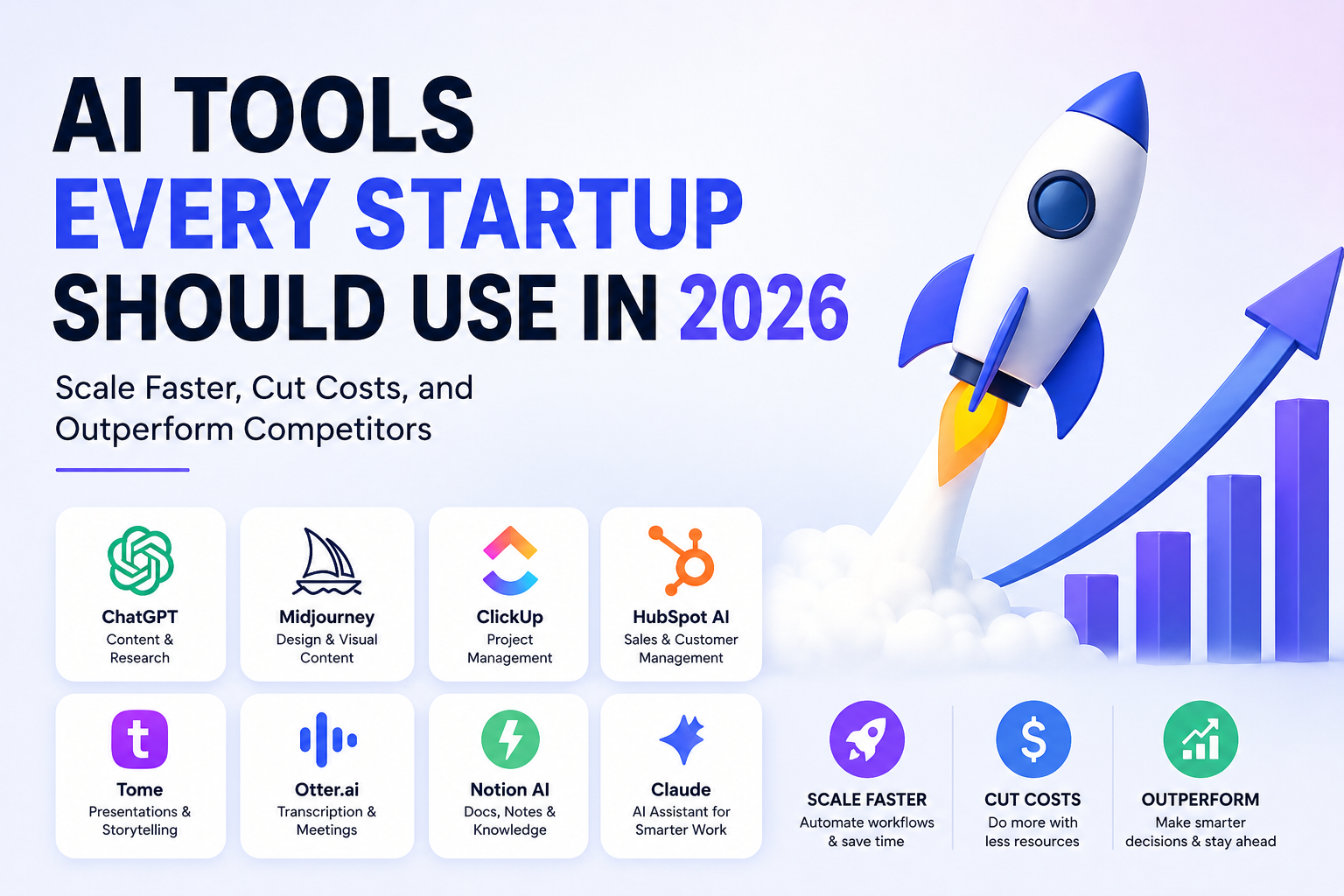
Friday afternoon. A three-person startup is drowning in work. The founder is replying to customer emails. The marketing lead is trying to publish social media posts, optimize SEO, and design ad creatives at the same time. The engineer is fixing bugs while handling product documentation and support tickets.
By Monday morning, something changes. Customer support is automated. Marketing content is drafted in minutes. Product analytics produce actionable insights without manual reporting. Meeting notes summarize themselves. Code reviews accelerate.
The team didn’t hire ten new employees. They deployed AI.
This is the defining advantage of modern startups: leverage. Historically, startups competed through speed, innovation, and risk tolerance. In 2026, another variable has become equally decisive—AI infrastructure. The startups scaling fastest are not merely “using AI.” They are embedding AI into workflows, operations, marketing, customer success, engineering, and decision-making.

The AI software market is expanding at historic speed. Industry analysts project enterprise AI spending to surpass hundreds of billions of dollars within the next few years, driven by generative AI, autonomous AI agents, AI copilots, predictive analytics, workflow automation, and AI cybersecurity systems.
Market Impact: AI reduces operational cost per employee.
Competitive Impact: AI-enabled startups move faster than traditional teams.
Revenue Impact: AI improves lead generation, conversion rates, customer retention, and upselling.
Operational Impact: AI automates repetitive tasks.
Real-world example: A SaaS startup with five employees can now operate with output comparable to a 20-person company from just a few years ago. That changes fundraising, scaling, and hiring economics.
The Core Distinction
“The best AI tools do not replace teams—they eliminate bottlenecks.”
| Category | Main Purpose | ROI Potential | Priority |
| AI Chatbots | Support & engagement | Very High | Critical |
| AI Writing | Content creation | High | High |
| AI Analytics | Decision making | Very High | Critical |
| AI Design | Branding & visuals | Medium | High |
| AI Coding | Engineering acceleration | Very High | Critical |
| AI Security | Threat detection | High | High |
Problem: Startups struggle to deliver 24/7 support. Delayed support leads to churn, refunds, negative reviews. ⚠️ Risk: High
Solution: Deploy AI chatbots. Recommended tools: ChatGPT, Intercom, Zendesk. 🛡 Security Control: Human escalation for sensitive tickets.
Implementation: Train chatbot on FAQs, connect knowledge base, set escalation triggers, monitor conversation quality.
Example: A fintech startup receives 1,000 support requests weekly. AI resolves 70%. Human team handles only complex cases. Support costs drop dramatically. ✅ Best Practice: Keep humans in the loop.
Problem: Content production is slow. Blog posts, landing pages, email sequences all demand writing.
Solution: Use AI writing assistants. Recommended: Jasper, Copy.ai, Grammarly.
Implementation: AI should assist—not fully replace strategy. Use for drafting, ideation, SEO outlines, repurposing. Human role: fact checking, brand voice, editorial polish.
Example: A startup publishes 12 SEO blogs monthly instead of 2. Traffic grows 300%.
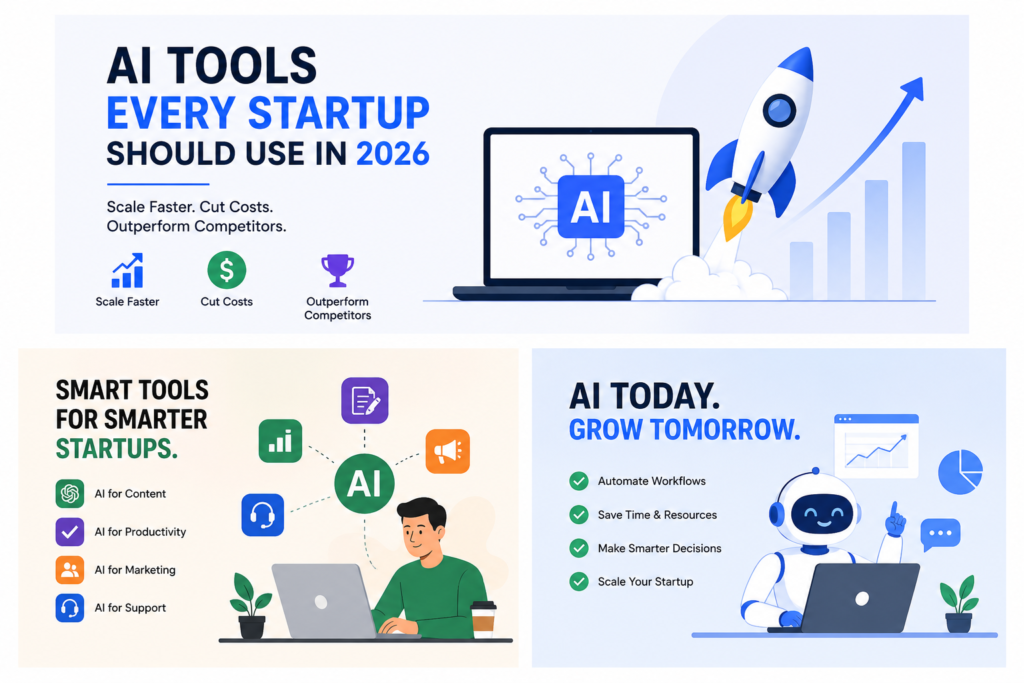
Problem: Design is expensive. Hiring full creative teams early is difficult.
Solution: Use AI design tools. Recommended: Canva, Adobe Firefly, Midjourney. 🎯 Trend Analysis: AI design lowers creative costs dramatically.
Implementation: Use AI for ads, presentations, social graphics, product visuals.
Example: Seed-stage startup creates investor deck internally. No agency needed.
Problem: Video drives engagement but production is expensive.
Solution: Use AI video tools. Recommended: CapCut, Synthesia, Pictory.
Example: Founder turns blog into video in 15 minutes. Reach multiplies across platforms.
Problem: Meetings consume productivity. Documentation gets ignored.
Solution: Recommended: Notion AI, Otter.ai, Slack. 🧠 Expert Insight: Productivity gains compound over time.
Implementation: Automate notes, action items, task creation, summaries.
Problem: Engineering bottlenecks slow shipping.
Solution: Use coding copilots. Recommended: GitHub Copilot, Cursor, Replit.
Implementation: Use AI for boilerplate, debugging, refactoring, documentation.
Example: Developer ships MVP in 4 weeks instead of 10. ⚠️ Risk: AI-generated code may include vulnerabilities. Always review code.
Problem: Founders drown in data but lack insights.
Solution: AI analytics tools detect patterns. Examples: churn prediction, conversion forecasting, funnel analysis. Recommended: Tableau, Mixpanel, Amplitude.
| Tool | Best For | Ease | Cost |
| ChatGPT | General AI | Easy | Low |
| Copilot | Coding | Easy | Medium |
| Canva | Design | Very Easy | Low |
| Mixpanel | Analytics | Medium | Medium |
| Intercom | Support | Medium | High |
1. Initial trigger: Employee clicks phishing email.
2. Escalation: Attacker steals credentials.
3. Failure point: No MFA enabled.
4. Consequences: Customer data exposed.
5. Detection: AI security system flags unusual access.
6. Recovery: Access revoked, systems patched.
01
Choose High–ROI Use Cases – Identify biggest bottlenecks. Risk: Medium. Ignored: wasted AI spending.
02
Protect Sensitive Data – Never expose customer data to unsafe tools. Risk: Critical. Ignored: compliance violations.
03
Keep Human Oversight – Review outputs. Risk: High. Ignored: errors propagate.
04
Measure ROI – Track time saved, cost saved, revenue impact. Risk: Medium.
05
Train Teams – AI adoption fails without education. Risk: Medium.
“The startups winning with AI are not the ones using the most tools—they are the ones integrating the right tools into repeatable systems.” — Editorial Research Team
| Scenario | Without Controls | With Controls |
| Customer Support | Wrong responses | Escalation workflows |
| Coding | Vulnerable code | Code review |
| Analytics | Misleading insights | Validation layers |
| Security | Late breach detection | Real-time alerts |
The next 24 months will redefine startup operations. Expect growth in AI agents (autonomous systems executing workflows), vertical AI (industry-specific copilots), AI governance (regulatory pressure), and multimodal AI (text, voice, image, video convergence). Future best practices: AI governance frameworks, security-first deployment, human oversight, workflow orchestration.
The startup playbook has changed. AI is no longer experimental infrastructure. It is core infrastructure. The question is no longer “Should we use AI?” The real question is “Where does AI create the highest leverage in our business?” Blindly subscribing to dozens of AI tools creates complexity, cost, and security risks. Winning startups follow a better approach: identify bottlenecks, choose targeted tools, implement guardrails, measure ROI, scale what works. The future belongs to lean, AI-augmented teams. A small startup equipped with the right AI stack can now compete with organizations many times larger.
1. What is the best AI tool for startups?
ChatGPT is one of the most versatile tools for startups.
2. Are AI tools expensive?
Many offer free or affordable starter plans.
3. Can AI replace employees?
Usually no. It augments productivity.
4. Which AI tool helps with coding?
GitHub Copilot and Cursor.
5. Is AI secure for business?
Only with strong security controls.
6. Can AI improve SEO?
Yes – through content optimization and keyword research.
7. Should small startups invest in AI?
Yes, especially for automation.
8. What AI tool helps with design?
Canva and Adobe Firefly.
9. How many AI tools should a startup use?
Start with 3–5 core tools.
10. What is the biggest AI risk?
Security and hallucinated outputs.