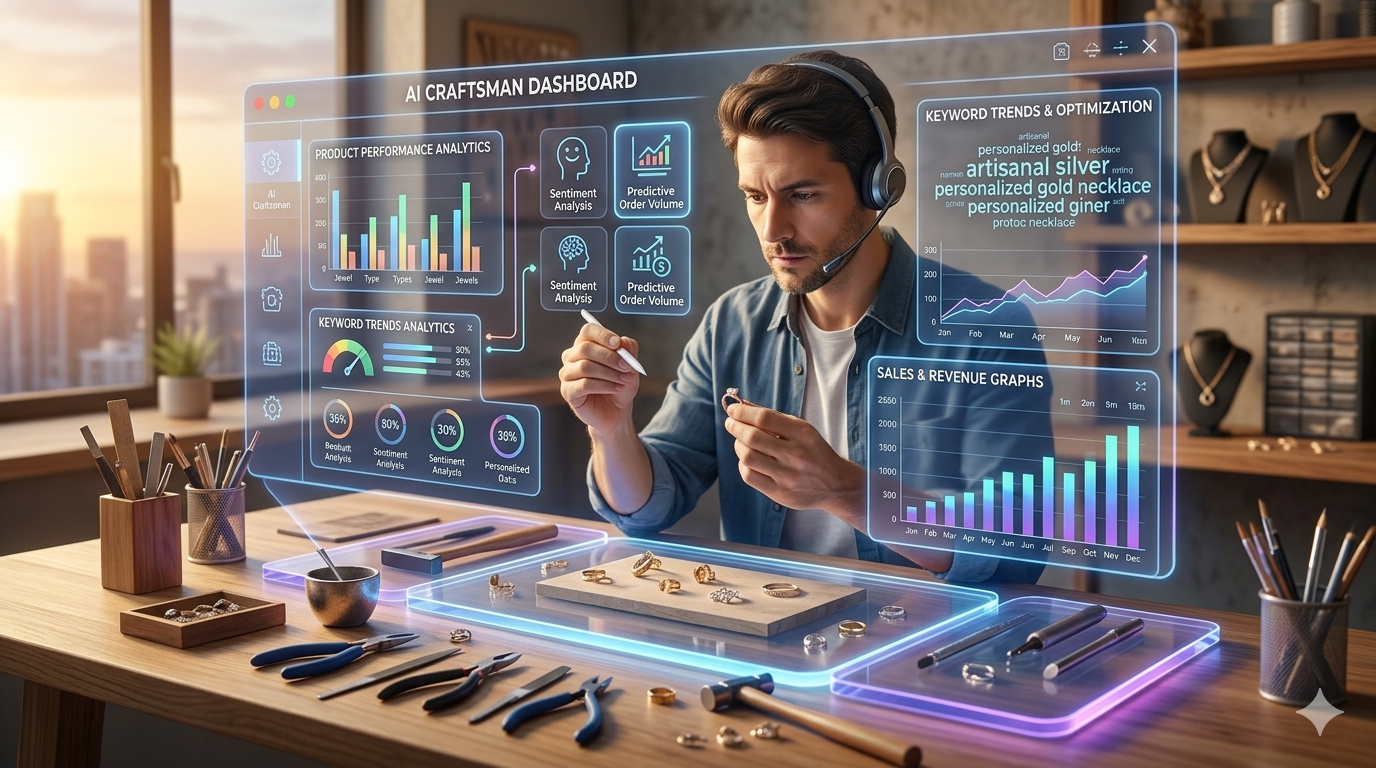
On a quiet Tuesday morning, an Etsy seller notices something unusual. Their handmade ceramic candle holders—normally steady in sales—have suddenly dropped in visibility. No changes were made to pricing. No updates to listings. No shift in customer demand that they can identify.
But something has changed.
Behind the scenes, Etsy’s ranking algorithm has reweighted keyword relevance, competitors have optimized their tags using AI tools overnight, and new listings—auto-generated with predictive SEO systems—are flooding the same niche. By the end of the week, the seller’s organic traffic has fallen by 42%.
This is not an isolated case. It is the new normal of AI-accelerated marketplaces.
Etsy, once defined by craftsmanship and human storytelling, is now shaped by a dual-layer system: human creativity on the surface, and machine intelligence underneath. Sellers who adapt are scaling faster than ever—automating product research, predicting trends before they peak, and optimizing listings in real time. Those who don’t are slowly becoming invisible.
The uncomfortable truth is this: Etsy growth is no longer just about making better products. It is about building a smarter system around those products.
Artificial intelligence is now embedded in nearly every stage of the Etsy seller journey—from ideation and SEO optimization to pricing strategy, customer messaging, and demand forecasting. Yet most sellers are still using it in fragmented, experimental ways, not as a unified growth engine.
This article breaks down exactly how AI can transform Etsy stores into scalable, data-driven businesses. Not as hype, but as a practical operating model—covering automation workflows, SEO engineering, competitive intelligence, and real-world implementation strategies that are already reshaping the platform.
“Etsy success in 2026 is no longer about what you create—but how intelligently your store adapts to what buyers are already searching for.”— Editorial Research Team
The Etsy marketplace has entered a phase of algorithmic competition.
In 2026, Etsy is no longer just a creative marketplace—it is a search-optimized commerce engine influenced heavily by machine learning systems that evaluate:
📊 Trend Analysis
According to ecommerce automation benchmarks, AI-assisted listings can improve visibility by30–70%compared to manually optimized listings in competitive niches.
📈 Market Impact
🧠 Expert Insight
Ecommerce strategist behavior now mirrors algorithmic trading—sellers are no longer competing on craftsmanship alone but on data responsiveness and optimization speed.
The implication is clear: Etsy is becoming a hybrid ecosystem where creativity meets machine learning optimization.
Most Etsy sellers rely on intuition or trend guessing when choosing products.
⚠️ Risk: High
AI-driven product discovery tools analyze:
A seller planning “minimalist jewelry” discovers via AI clustering that “dainty gold constellation necklaces” have 3.4x higher conversion potential and lower competition.
Etsy SEO is highly competitive and constantly shifting.
⚠️ Risk: High
AI models optimize:
📊 Industry Impact
AI-optimized listings can increase organic impressions by up to 2.5x in competitive categories.
Instead of:
“Handmade Ceramic Mug”
AI optimizes to:
“Handmade Minimalist Ceramic Coffee Mug | Rustic Stoneware Cup | Gift for Coffee Lovers”
Pricing is often static and emotionally driven.
⚠️ Risk: Medium–High
AI models evaluate:
| Factor | AI Input | Output |
|---|---|---|
| Competitor pricing | Marketplace scraping | Optimal price range |
| Demand trend | Search velocity | Price elasticity |
| Conversion rate | Listing analytics | Price adjustment trigger |
An AI model increases product pricing by 12% during peak seasonal demand while maintaining conversion rate stability.
Customer messaging consumes significant seller time.
⚠️ Risk: Medium
AI chat assistants handle:
🔒 Security Control
A buyer asks about customization options. AI responds instantly with structured options while escalating complex requests to the seller.
High-quality visuals are expensive and time-consuming.
⚠️ Risk: Medium
AI generates:
📈 Trend Analysis
Listings with AI-enhanced visuals show significantly higher engagement in visual-first niches like home decor and fashion accessories.
A handmade candle is placed in AI-generated cozy winter scenes increasing seasonal appeal.
Sellers rarely track competitor evolution in real time.
⚠️ Risk: High
AI monitors:
A seller notices competitors shifting toward “eco-friendly packaging” keywords and adapts within 48 hours.
| Tool Type | Function | Strength | Limitation |
|---|---|---|---|
| AI SEO Tools | Keyword optimization | High ranking improvement | Requires tuning |
| AI Image Tools | Visual generation | Fast content creation | May lack authenticity |
| AI Pricing Tools | Dynamic pricing | Revenue optimization | Needs data accuracy |
| AI Chatbots | Customer service | Instant response | Limited nuance handling |
| AI Trend Tools | Market prediction | Early trend detection | Forecast uncertainty |
01
Risk: High
Use AI to validate demand before creating products.
If ignored: wasted inventory and low sales velocity.
02
Risk: High
Automate keyword clustering and listing updates.
If ignored: ranking decline in competitive niches.
03
Risk: Medium
Use AI to adjust pricing dynamically.
If ignored: lost margin opportunities.
04
Risk: Medium
Deploy AI for FAQs and order support.
If ignored: slower response times and lower ratings.
05
Risk: Medium
Use AI-generated lifestyle images.
If ignored: reduced click-through rates.
A competitor launches AI-optimized listings targeting a trending keyword cluster.
Their listings begin ranking above established sellers within 72 hours.
Traditional sellers fail to update SEO metadata.
Organic traffic drops by 30–50%.
Analytics tools show declining impressions and CTR.
AI tools restructure listings, update keywords, and relaunch optimized content within 24 hours.
“Etsy is no longer a marketplace of products—it is a marketplace of continuously optimized data systems.”— Editorial Research Team
| Scenario | Without Controls | With Controls |
|---|---|---|
| Product research | Guesswork-based | AI demand forecasting |
| SEO optimization | Static keywords | Dynamic semantic clustering |
| Pricing | Fixed pricing | Adaptive pricing models |
| Customer service | Manual replies | AI-assisted automation |
| Competitor tracking | Occasional checks | Continuous monitoring |
The next wave of Etsy evolution will be defined by:
🧠 Expert Insight
Within 24 months, top-performing Etsy stores will operate more like “AI-managed micro-enterprises” than traditional handmade shops.
📊 Trend Analysis
Search-based marketplaces are moving toward intent prediction rather than keyword matching.
⚠️ Challenge
Increased competition from AI-generated product ecosystems may compress margins in saturated niches.
AI is fundamentally reshaping Etsy from a creative marketplace into a data-optimized commerce ecosystem. Sellers who continue to rely solely on intuition will find themselves competing against hybrid systems that combine creativity with machine intelligence.
The shift is not optional—it is structural.
What matters now is not just what you sell, but how quickly your store learns, adapts, and optimizes itself in response to marketplace signals. AI enables Etsy sellers to compress weeks of research into minutes, automate repetitive operational tasks, and unlock insights that were previously inaccessible without large teams.
However, the most important takeaway is balance. AI should amplify creativity, not replace it. The most successful Etsy sellers in 2026 will be those who combine handcrafted authenticity with algorithmic precision.
To stay competitive:
The future belongs to sellers who can think like creators and systems engineers simultaneously.
Start by implementing one automation layer—SEO, pricing, or product research—and expand systematically.Start your AI-powered Etsy growth →
Can AI really help Etsy sellers grow faster?
Yes. AI improves SEO, pricing, product research, and customer service efficiency.
Is AI allowed on Etsy?
Yes, as long as listings follow Etsy’s originality and policy guidelines.
What is the best AI tool for Etsy SEO?
Tools that use NLP-based keyword clustering and listing optimization models.
Can AI create Etsy product descriptions?
Yes, but they should be reviewed for authenticity and accuracy.
Does AI improve Etsy rankings?
Indirectly—by improving CTR, relevance, and engagement metrics.
Is AI expensive for small sellers?
Many tools offer low-cost or freemium models suitable for beginners.
Can AI replace Etsy sellers?
No. AI enhances operations but cannot replace craftsmanship.
What is the biggest risk of using AI?
Over-automation without human oversight, leading to generic listings.
How often should Etsy listings be optimized?
Every 30–60 days using updated keyword data.
Can AI predict Etsy trends?
It can forecast patterns, but predictions are probabilistic, not guaranteed.
Do AI-generated images perform well on Etsy?
They can improve engagement if used ethically and aligned with product authenticity.


Your Etsy Shop Deserves a Smarter Assistant - highdreamsllc.com
June 26, 2026 at 4:35 pm
“ […] AI Tools Best AI Tools for Small Business Owners in 2025 Etsy Growth Chatbots for E-commerce Stores: The Future of Online Shopping in 2026 Automation How to Choose the Right AI Chatbot Development Company in 2026 Traffic How AI Can Help Etsy Sellers Grow Faster: The Autonomous Growth Stack for Handmade Commerce… […] “
How to Create High-Converting eBay Listing - highdreamsllc.com
July 14, 2026 at 8:28 am
“ […] Selling on Amazon in 2026Read more → How to Find Profitable Etsy Niches in 2026Read more → How AI Can Help Etsy Sellers Grow Faster: The Autonomous Growth Stack for Handmade CommerceRead more… How to Start Selling on Walmart Marketplace: The Complete 2026 Seller GuideRead more → How AI Is […] “
Best Digital Products to Sell on Etsy - highdreamsllc.com
July 15, 2026 at 6:02 am
“ […] Etsy Shop Deserves a Smarter Assistant How AI Can Help Etsy Sellers Grow Faster How to Find Profitable Etsy Niches in 2026 The Future of AI in eCommerce: Trends Every Seller […] “
Amazon Account Management Best Practices - highdreamsllc.com
July 17, 2026 at 7:02 am
“ […] Amazon Private Label Business Guide: Build a Profitable Amazon Brand in 2026Amazon Management The Algorithmic Marketplace: How to Start Selling on Amazon in 2026Amazon Management How AI Voice Agents Improve Amazon Online Business in 2026AI Voice Agents How to Start Selling on Walmart Marketplace: The Complete 2026 Seller GuideWalmart Management How to Create a High-Converting eBay ListingeBay Management How AI Can Help Etsy Sellers Grow FasterEtsy Management […] “
Common Ebay Seller Mistakes - highdreamsllc.com
July 20, 2026 at 6:15 am
“ […] How to Create a High-Converting eBay Listing Walmart Advertising Strategies That Work Amazon PPC Guide for Beginners How AI Is Changing SEO Strategy for E-Commerce Stores The Algorithmic Marketplace: How to Start Selling on Amazon How AI Can Help Etsy Sellers Grow Faster […] “
AI Mockup Tools for Etsy Sellers - highdreamsllc.com
July 22, 2026 at 6:46 am
“ […] Best Digital Products to Sell on Etsy Etsy SEO Guide for More Sales How to Find Profitable Etsy Niches in 2026 Etsy vs Amazon Handmade: Which Platform Wins? Your Etsy Shop Deserves a Smarter Assistant How AI Can Help Etsy Sellers Grow Faster […] “