


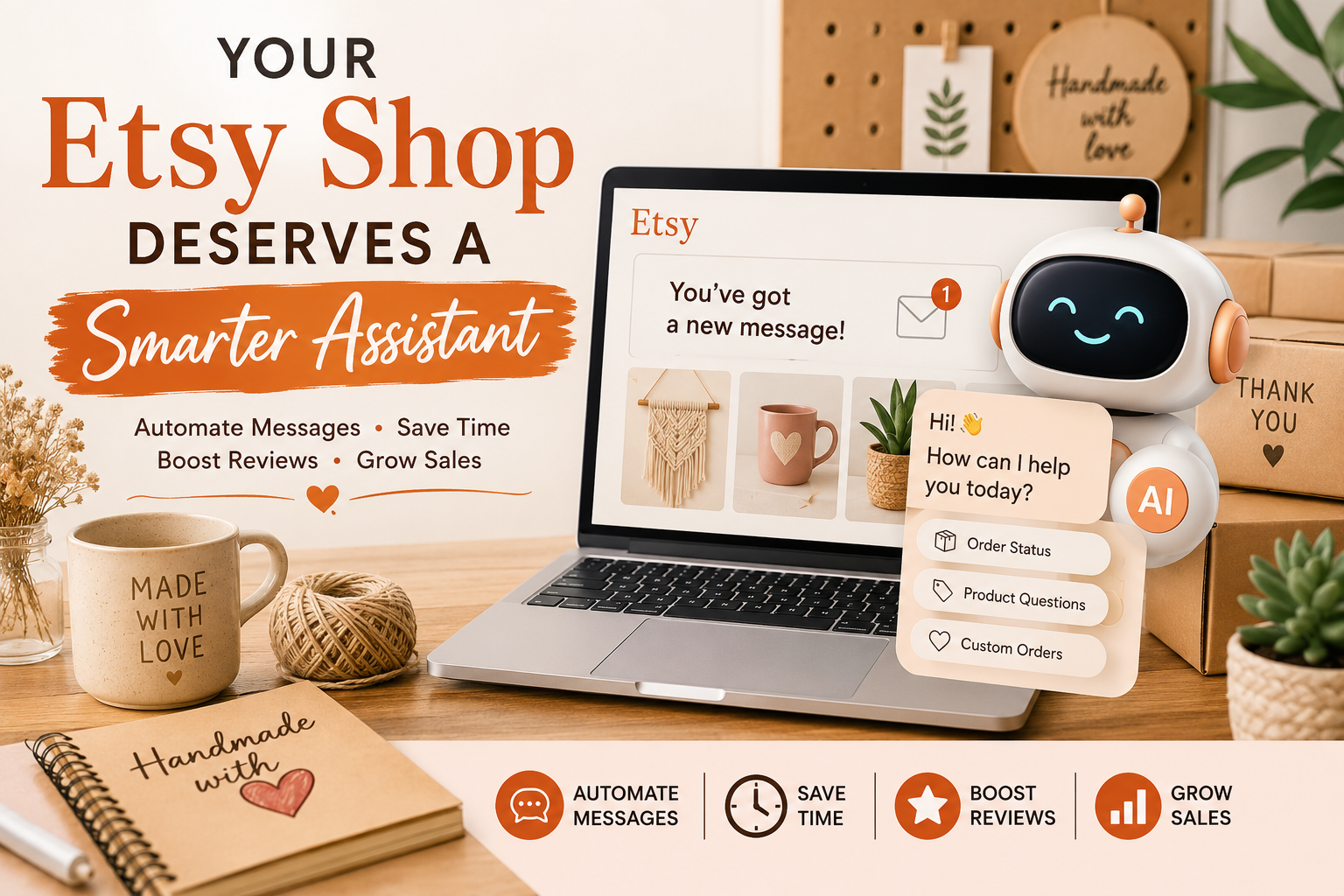
- AI chatbots can handle a significant share of routine Etsy customer messages without the seller lifting a finger.
- Automated tools assist with listing optimization, helping products rank higher in Etsy search results.
- Chatbots trained on shop policies reduce refund disputes by giving buyers accurate answers before problems escalate.
- Review generation prompts sent at the right time meaningfully increase the number of five star ratings a shop earns.
- AI does not replace the personal touch that makes Etsy special but it frees sellers to spend more time on the work that genuinely needs a human.
- The best results come from sellers who treat AI as a trained assistant, not a replacement for their voice and brand identity.
The Real Workload Behind a Successful Etsy Shop
Most buyers see the finished product. They see a beautifully photographed ceramic bowl or a hand lettered wedding sign and they click add to cart. What they do not see is the seller who spent forty minutes that morning answering nearly identical questions about shipping timelines, custom order slots, and whether the shop ships internationally.
Research from the independent seller community consistently shows that customer communication eats between two and five hours per day for shops doing more than fifty orders a month. Add listing maintenance, keyword research, inventory updates, and chasing reviews, and the “creative business” starts to feel less creative by the hour.
That context matters because it frames exactly what AI chatbots are solving. They are not trying to make Etsy feel like Amazon. They are trying to give a one person operation the bandwidth that a ten person team would have.
What an AI Chatbot Actually Does for Etsy Sellers
Answering Customer Questions Around the Clock
The most immediate win is response time. Etsy’s algorithm genuinely rewards shops with fast message response rates, and buyers who get quick answers convert at a higher rate. An AI chatbot integrated with an Etsy shop through tools like Tidio, ManyChat, or a custom GPT powered widget can handle the top thirty or forty most common questions automatically.
Think about what those questions actually are. When will my order ship? Can I customize the color? Do you offer rush processing? What is your return policy? A well configured chatbot answers all of these correctly every time, at three in the morning on a holiday weekend, without any typos and without sounding exhausted.
The seller sets the answers once. The chatbot serves them indefinitely. That is not a small thing when you are running a shop alone.
Shops that reduce their average response time below one hour report measurably higher conversion rates on Etsy. AI chatbots make sub-hour responses possible even for solo sellers with full time day jobs outside their shop.
Drafting and Optimizing Listings
Listing copy is one of those tasks that sounds simple until you are staring at a blank description box for your forty-seventh product variation. AI tools built specifically for Etsy sellers (like EverBee’s writing assistant or the listing optimizer inside Sale Samurai) analyze current top-performing listings in a given category and help generate descriptions that include the right keyword density, the right structure, and the right emotional hooks.
This is not about producing robotic keyword-stuffed text. The better tools generate a solid draft that the seller then personalizes. The result is a listing that both ranks and reads well, which is genuinely hard to achieve manually at scale.
Keyword research is also an area where AI assistance compounds over time. Tools like Marmalead and Erank use machine learning to surface search terms that are rising before they peak, giving sellers a window to optimize listings ahead of seasonal demand rather than chasing it.
Managing Order Updates and Shipping Notifications
Buyers on Etsy are often emotionally invested in their purchase. It might be a personalized gift or a one-of-a-kind piece they have been saving for. That emotional investment means they want updates and silence creates anxiety.
AI-powered automation can send proactive order confirmation messages, processing updates, and shipping notifications without requiring the seller to touch anything. Platforms like Vela and Outfy let sellers build message sequences that trigger automatically based on order status changes in Etsy’s system.
The impact on review rates is measurable. When buyers feel informed and cared for throughout the order journey, they are more likely to leave a review and more likely to leave a positive one.
“The chatbot does not replace my personality. It handles the logistics so my personality has somewhere to show up.”A full-time Etsy seller with over 4,000 sales
AI for Listing SEO and Shop Visibility
Etsy’s search algorithm, Cassini, weighs a complicated mix of factors including recency of the listing, conversion rate, customer and market experience score, and how well the listing text matches buyer search queries. Optimizing all of these simultaneously is more than most sellers can manage manually while also making the actual products.
AI tools have gotten quite good at reverse engineering what Cassini tends to reward. By analyzing large datasets of successful listings across categories, they can surface patterns that a single seller would never notice by browsing competitors manually.
The table below gives a practical comparison of what manual optimization looks like versus an AI-assisted approach across three common tasks.
| Task | Manual Approach | AI-Assisted Approach | Time Saved |
|---|---|---|---|
| Keyword research for one listing | 45 to 90 minutes of competitor browsing | 5 minutes with a tool like Marmalead | Up to 85% |
| Writing listing description | 30 to 60 minutes per product | AI draft in under 5 min, seller edits in 10 | 60 to 75% |
| Answering 20 customer messages | 60 to 90 minutes daily | Chatbot handles 70%+ automatically | 50 to 70% |
| Review follow-up messages | Rarely done consistently | Automated sequence sent to every buyer | Near 100% |
Review Generation Without Feeling Pushy
Reviews are oxygen for an Etsy shop. New buyers use them to judge trust, Etsy’s algorithm uses them as a signal of quality, and competitors use the absence of reviews to beat you on social proof. The problem is that asking for reviews manually feels awkward and sellers rarely do it consistently.
AI-assisted messaging solves this by timing the ask perfectly. Instead of a generic “please leave a review” message, a well-written automated follow-up arrives about a week after delivery, acknowledges the specific product the buyer purchased, asks if everything arrived safely, and then naturally invites them to share their experience.
The framing matters enormously. “Did your custom sign arrive safely? We would love to see it in its new home” performs very differently than “Please rate us five stars.” Sellers who implement thoughtful automated follow-up sequences typically see their review rate climb from below ten percent of buyers to twenty-five or thirty percent within a few months.
Etsy shops that maintain an average rating above 4.8 stars earn significantly more placement in Etsy’s search results compared to shops with the same sales volume but lower ratings. Automating the follow-up process is one of the most direct levers a seller has on that number.
Handling Refunds, Disputes, and Difficult Conversations
This is the part of Etsy management nobody talks about in the “I left my corporate job to sell candles” success stories. Difficult conversations happen. Packages go missing. Custom orders do not meet expectations. Sometimes buyers are just having a terrible day and your shop is where they aim it.
AI chatbots cannot and should not handle genuine disputes autonomously. But they can do something extremely valuable in those moments. They can acknowledge the problem immediately, provide the relevant policy information calmly and accurately, and create a paper trail that shows the shop acted in good faith.
A message that arrives within minutes saying “We are so sorry to hear your order arrived damaged. Here is our policy on this and here is exactly what we will do to make it right” changes the emotional temperature of a dispute dramatically. Many buyers who would have escalated to an Etsy case will accept a resolution from the seller when they feel heard quickly.
The seller still steps in to finalize any resolution. But the chatbot buys time, sets expectations, and diffuses anger before the seller even opens the message. That is not a small thing when you are running a shop and also trying to live your life.
Social Media and Content Scheduling
Driving traffic to an Etsy shop from outside the platform is increasingly important as internal Etsy search becomes more competitive. Sellers who build audiences on Instagram, Pinterest, or TikTok see measurable boosts in sales, but consistent content creation is yet another job on top of the actual product making.
AI tools like Canva’s Magic Studio, Buffer’s AI assistant, and even Claude or ChatGPT used deliberately can dramatically speed up content production. A seller can describe a new product, upload a photo, and have a platform-appropriate caption with relevant hashtags ready in under two minutes. A batch of thirty days of social content that would have taken a full weekend now takes a focused afternoon.
Pinterest is worth singling out here because it functions more like a search engine than a social network, and its audience overlaps heavily with Etsy’s buyer demographic. AI tools that analyze which Pinterest keywords are trending in craft and home decor categories let Etsy sellers pin strategically rather than randomly, compounding traffic over time rather than chasing viral moments.
Inventory Forecasting and Reorder Planning
Running out of materials mid-peak season is a painful experience that costs real money. Running the opposite problem (buying too much of the wrong thing) ties up cash that a small shop does not have to spare. AI tools connected to Etsy’s sales data can analyze historical order patterns, flag approaching seasonal demand spikes, and surface which materials need reordering before the seller even thinks to check.
Tools like Craftybase and Airtable-connected automations have been doing versions of this for a few years. As large language models become more accessible, more sophisticated natural language forecasting is starting to appear in seller tools, letting a shop owner ask in plain English “what should I make more of before the holiday season” and get a data-grounded answer.
Where AI Falls Short (and It Does Fall Short)
None of this is magic. AI chatbots trained on generic data will give generic answers, and on Etsy, generic is the enemy of a brand. A chatbot that responds to “can you make this in blue” with the same tone as “can you make this in blue” for every shop regardless of whether that shop sells whimsical quirky pieces or minimal luxury goods is actively hurting the brand.
The quality of AI output is directly proportional to the quality of the training and customization the seller puts in. Setting it up properly takes real time upfront. Shops that deploy an AI tool for thirty minutes and expect it to run perfectly are usually disappointed.
AI also struggles with genuinely novel or emotionally complex situations. A buyer who is crying because her mother’s memorial jewelry arrived broken needs a human. No chatbot should be the last line of communication there.
And finally, Etsy’s terms of service prohibit certain forms of automation on the platform itself. Sellers need to work within those boundaries, using integrations and off-platform tools rather than bots that directly simulate human actions on the Etsy interface.
How to Start Without Overwhelming Yourself
The single biggest mistake sellers make is trying to automate everything at once. The result is a shop that feels robotic and a seller who is more stressed than before because now they have new tools to manage on top of the original workload.
A smarter approach is to start with the single most painful repetitive task. For most shops, that is customer messages. Set up a chatbot that handles only the top five most common questions and measure the time it saves over thirty days. Once that is running smoothly, layer in automated order updates. Then listing optimization. Build the infrastructure slowly enough that each piece is working before the next one goes in.
The shops that use AI most effectively are the ones where the seller’s voice still comes through everywhere. The chatbot answers “when will my order ship” but the confirmation message, the thank you note, and the packaging insert are unmistakably human. That combination is what creates loyalty, and loyalty on Etsy means repeat buyers who bring friends.
Conclusion
There is a version of Etsy success that looks like burning out at four in the morning answering the same message for the fifteenth time that week. And there is a version that looks like having enough headspace to actually design new products, experiment with photography, and enjoy the creative work that started the shop in the first place. AI chatbots and automation tools are what separate those two versions for a growing number of sellers.
The shift happening in the handmade economy is not about replacing artisans with algorithms. The products on Etsy that sell because they carry a human story, a hand, a personality, a set of values, those products will always need a person behind them. What AI is changing is the ratio of that person’s time spent creating versus administrating.
The most successful Etsy sellers of the next five years will almost certainly be people who treat AI as a capable, tireless assistant trained in the voice and values of their shop. Not a replacement. Not a shortcut around quality. A tool that handles the repetition so the human can handle the things that actually require a human.
Getting there is not instantaneous. It requires honest assessment of where time is actually going, deliberate configuration of the tools that address those specific drains, and ongoing adjustment as the shop grows and the customer questions evolve. But the ceiling for what a solo Etsy seller can sustainably run has shifted meaningfully, and AI is the reason why.
The handmade economy was built on the idea that small producers could reach buyers directly without needing corporate infrastructure. AI is extending that idea further than it has ever gone. A one-person candle shop can now offer response times and consistency that would have required a customer service team a decade ago. That is worth paying attention to.
Frequently Asked Questions
Can I use an AI chatbot directly on my Etsy shop page?
Etsy does not allow third-party chatbots to be embedded directly on the platform. However, sellers can use AI tools to generate auto-reply message templates within Etsy’s own messaging system, or run AI-powered chat widgets on their own websites or social media pages that drive traffic to their Etsy shop.
Will buyers know they are talking to an AI?
This depends on how the seller configures the tool and whether they disclose it. Many sellers use AI to draft responses that they then review and send personally, so the buyer interacts with the seller throughout. For fully automated flows, transparency builds trust and Etsy’s broader community values authenticity.
What AI tools work best for small Etsy shops with fewer than 100 monthly orders?
Shops at that scale benefit most from tools focused on listing optimization and keyword research rather than full customer service automation. Marmalead, Erank, and Sale Samurai offer good value. For message drafting, using a general purpose AI writing tool to prepare template responses is a practical and low-cost starting point.
How much time does it actually take to set up an AI system for an Etsy shop?
A realistic estimate for a basic setup covering the top customer questions, automated order updates, and a review follow-up sequence is four to eight hours of initial configuration. That investment typically pays back within two to three weeks for shops handling twenty or more orders per month.
Does using AI for listing optimization violate Etsy’s terms of service?
Using AI to research keywords and draft listing copy is entirely permitted. What Etsy prohibits is automated manipulation of views, clicks, or purchase behavior. Generating well-written listing text with AI assistance and then posting it manually falls well within the rules.
Can AI help with managing multiple Etsy shops at once?
Yes, and this is one area where the time savings compound quickly. Sellers running two or more shops can use AI to maintain consistent response quality across all of them, generate listing variations efficiently, and keep track of each shop’s performance data in one consolidated view through third-party management tools.
Ready to Take Back Your Time?
You started your Etsy shop to make things, not to answer the same five questions on repeat. Explore how AI tools can handle the admin so you can get back to the work that actually matters.
Explore AI Tools for Sellers Read More Growth GuidesThis article represents independent editorial analysis from the team at highdreamsllc.com. No seller tools or platforms mentioned provided compensation for inclusion. All time-saving estimates are based on aggregated community data and individual results will vary.
Nerds
July 4, 2026 at 8:11 am
“ So , Informative post. very impressive style , really love it. “
Best Digital Products to Sell on Etsy - highdreamsllc.com
July 14, 2026 at 12:39 pm
“ […] Your Etsy Shop Deserves a Smarter Assistant How AI Can Help Etsy Sellers Grow Faster How to Find Profitable Etsy Niches in 2026 The Future of AI in eCommerce: Trends Every Seller Should Know How AI Is Changing SEO Strategy for E-Commerce Stores How to Create a High-Converting eBay Listing […] “
Etsy SEO Guide for More Sales - highdreamsllc.com
July 17, 2026 at 7:09 am
“ […] Your Etsy Shop Deserves a Smarter Assistant How AI Can Help Etsy Sellers Grow Faster How to Find Profitable Etsy Niches in 2026 How AI Is Changing SEO Strategy for E-Commerce Stores The Future of AI in eCommerce: Trends Every Seller Should Know How to Create a High-Converting eBay Listing […] “
Etsy vs Amazon Handmade: Which Platform Wins? - highdreamsllc.com
July 20, 2026 at 6:27 am
“ […] Niches in 2026 Amazon Account Management Best Practices Step-by-Step Amazon Product Research Guide Your Etsy Shop Deserves a Smarter Assistant How to Optimize Amazon Product […] “