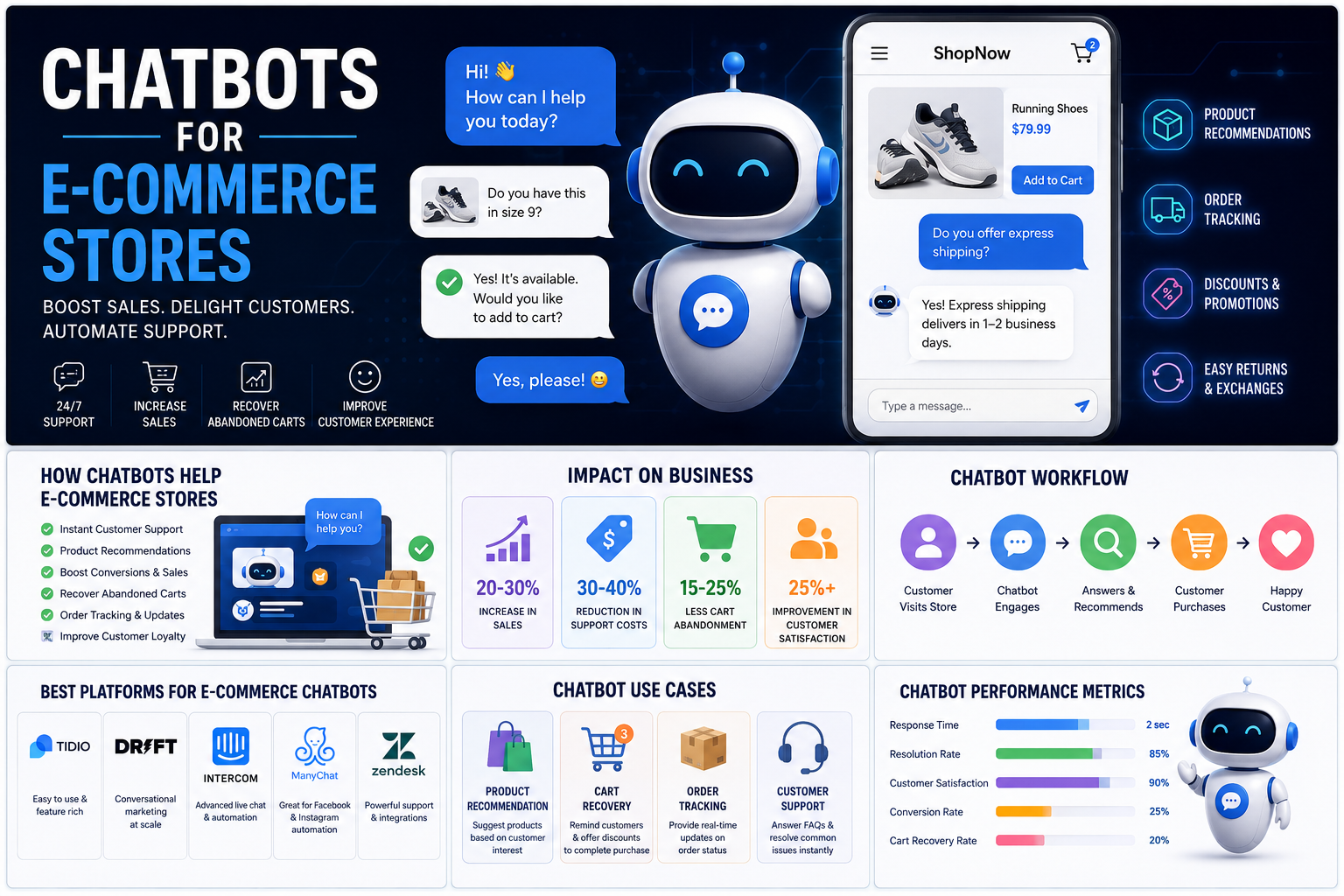
A customer visits an online store at 2:13 AM.
They browse three products, add one to cart, then hesitate.
Questions appear in their mind:
Is this available in another color?
How long is shipping?
Can I return it?
Is there a discount code?
No human agent is online.
Thirty seconds later, the customer leaves.
Cart abandoned.
Sale lost.
This scenario happens millions of times every day across global e-commerce stores. The harsh reality is simple: online shoppers expect instant answers. They do not wait for email replies. They do not want to fill contact forms. They want immediate assistance.
This is where AI chatbots are changing e-commerce.
Chatbots for e-commerce stores are no longer simple FAQ bots that reply with robotic scripts. Modern AI-powered chatbots function as digital sales assistants, customer service agents, recommendation engines, and conversion optimization tools.
In 2026, leading online retailers use chatbots to:
Answer customer questions instantly
Recommend products
Recover abandoned carts
Track orders
Handle returns
Personalize shopping journeys
Increase conversion rates
For e-commerce businesses, the impact is massive.
Chatbots reduce customer friction.
And in online selling, reducing friction means increasing revenue.
The biggest shift is not technological—it is behavioral.
Customers now expect conversational commerce.
They want to ask before they buy.
Stores that fail to provide this experience risk losing customers to faster competitors.
This article explores the role of chatbots in e-commerce, how they drive conversions, implementation best practices, security risks, and what the future holds for AI-powered shopping.
E-commerce competition has intensified.
Thousands of stores sell similar products.
Differentiation increasingly depends on customer experience.
Today’s customers expect:
24/7 support
Instant answers
Personalized experiences
Fast order resolution
Chatbots deliver these at scale.
| Trend | Impact |
|---|---|
| Mobile shopping | Faster buying decisions |
| Rising CAC | Better conversion required |
| Global competition | Superior CX matters |
| AI adoption | Automation advantage |
📊 Industry Impact
Stores using chatbot automation often improve:
Response speed
Lead qualification
Conversion rates
Customer satisfaction
“Traditional support waits for problems. AI chatbots actively prevent lost sales.”
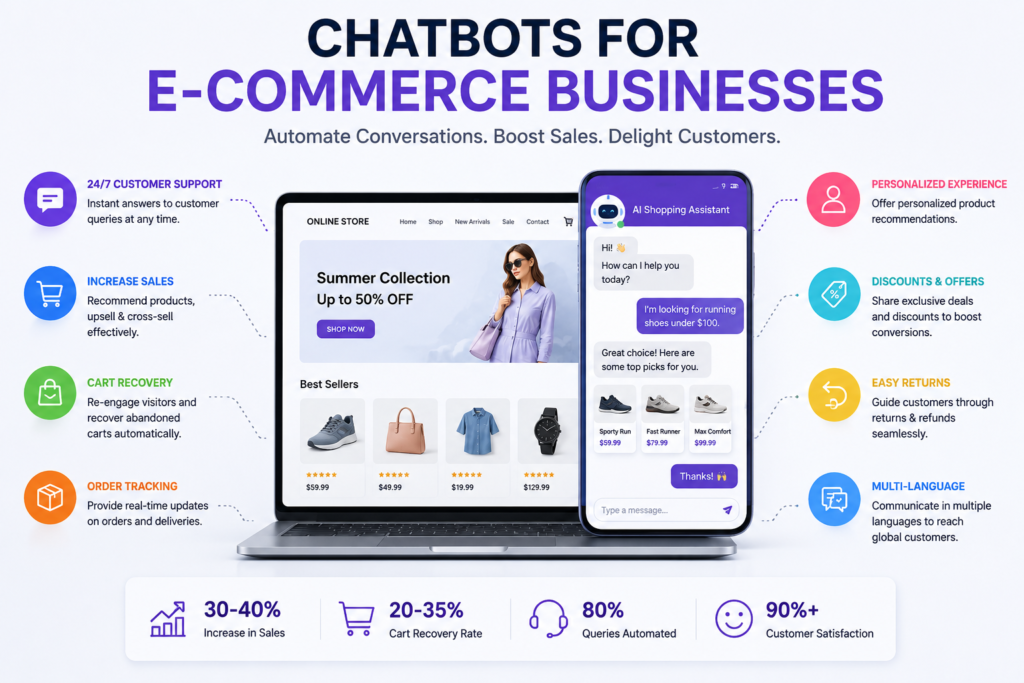
Customer support teams cannot handle every inquiry instantly.
Common questions:
Where is my order?
Do you ship internationally?
What size should I buy?
Human support is expensive and limited.
⚠️ Risk: High
Delayed replies
Lost trust
Cart abandonment
Deploy AI chatbots.
They handle repetitive inquiries automatically.
Identify common FAQs
Train chatbot database
Add escalation to humans
Monitor accuracy
A clothing store automates 80% of support tickets.
Support costs drop.
Customer satisfaction rises.
Visitors hesitate before buying.
Unanswered questions create doubt.
Lower conversion
Higher bounce rate
Lost revenue
Use chatbot-driven sales assistance.
Chatbots can:
Recommend products
Upsell bundles
Offer coupons
Handle objections
Customer asks for running shoes.
Chatbot recommends:
Shoe
Socks
Cleaner kit
Average order value increases.
📈 Trend Analysis:
Conversational selling boosts AOV.
| Feature | Without Chatbot | With Chatbot |
|---|---|---|
| Response Time | Hours | Seconds |
| Cart Recovery | Manual | Automated |
| Support Cost | High | Lower |
| Conversion Rate | Lower | Higher |
Most carts never convert.
Buyers hesitate.
Reasons:
Price concerns
Shipping uncertainty
Checkout friction
⚠️ High
Revenue loss.
AI-powered recovery.
Chatbots trigger messages like:
“Still interested? Here’s 10% off.”
Use triggers:
Exit intent
Inactivity
Abandoned checkout
Store reduces cart abandonment by 18%.
Too many choices overwhelm buyers.
Large catalogs create decision fatigue.
No purchase
Analysis paralysis
AI recommendations.
Recommend based on:
Browsing behavior
Purchase history
Interests
🧠 Expert Insight:
Personalization increases purchase probability.
Poorly configured bots can expose sensitive customer data and become vectors for fraud.
Chatbots often operate with broad data access, and without proper safeguards they can be manipulated. Common attack vectors include prompt injection (where a malicious user tricks the bot into revealing system prompts or internal data), data exfiltration through chat transcripts, and lack of input sanitization leading to cross‑site scripting or account takeover. Additionally, many e‑commerce bots store full conversation logs that may inadvertently contain payment details, violating PCI DSS compliance if not handled with extreme care.
⚠️ Very High
Data leakage of PII and payment info
Fraudulent transactions
Account compromise
Fake support scams mimicking the brand
Prompt injection and LLM jailbreaking
A security‑first implementation combined with ongoing monitoring. Key measures include strict data minimization (never log full credit card numbers or CVV), encryption in transit and at rest, robust authentication for administrative access, and AI guardrails that prevent the model from following malicious instructions. All chatbot‑handled transactions should be funneled through a secure, PCI‑compliant payment gateway, and chat logs must be treated as sensitive data stores with defined retention and audit policies.
🔒 Security Control
Use:
End‑to‑end encryption
Strong authentication and access controls
Input/output sanitization
Regular penetration testing and audit logs
LLM guardrails and content filters
A bot configured with proper guardrails detects an attempt to inject a prompt that asks for stored credit card numbers. The request is blocked, the session flagged, and the security team alerted automatically. No data is exposed.
| Type | Best For | Complexity |
|---|---|---|
| Rule-Based | FAQs | Low |
| Hybrid | Sales + Support | Medium |
| AI Chatbot | Personalization | High |
| Agentic AI | Autonomous actions | Very High |
1.Initial TriggerStore launches chatbot.
2.EscalationBot misinterprets return policy.
3.Failure PointCustomers receive wrong refund details.
4.ConsequencesComplaints · Refund disputes · Negative reviews
5.DetectionSupport tickets spike.
6.RecoveryKnowledge base updated. Human review added.
“The best e-commerce chatbots do more than answer questions—they remove hesitation from the buying journey.”
— Editorial Research Team
| Scenario | Without Controls | With Controls |
|---|---|---|
| Customer Data | Vulnerable | Protected |
| Responses | Inaccurate | Reliable |
| Cart Recovery | Weak | Automated |
| Conversions | Lower | Higher |
Chatbots are evolving fast.
Future capabilities include:
Customers buy through voice.
Bots compare products autonomously.
Real-time product customization.
Bots handle refunds and returns.
📊 Industry Impact:
Chatbots are moving from support tools to revenue engines.
Chatbots for e-commerce stores have become one of the most impactful AI solutions in modern digital retail.
Their role extends far beyond answering FAQs. Today’s advanced chatbots function as sales assistants, support agents, recommendation engines, and conversion optimization tools—all operating 24/7.
That matters because online shopping is driven by convenience.
Customers want answers instantly.
They want personalized recommendations.
They want seamless buying experiences.
Every delay introduces friction.
Every unanswered question increases abandonment risk.
Chatbots reduce that friction.
They guide buyers through the customer journey—from discovery to purchase and even post-sale support.
For e-commerce brands, this creates measurable business impact:
Higher conversions
Lower support costs
Better retention
Improved customer satisfaction
However, implementation quality matters.
Poorly trained bots create frustration.
Weak security creates risk.
Successful stores treat chatbot deployment strategically:
Clear goals
Strong training data
Human escalation
Continuous optimization
In the next 24 months, conversational commerce will likely become standard.
The question is no longer whether chatbots belong in e-commerce.
The real question is:
Can your store afford not to use them?
1. What are chatbots for e-commerce stores/
AI-powered virtual assistants that help customers shop and get support.
2. Do chatbots increase sales?
Yes, by reducing hesitation and improving conversions.
3. Can chatbots recover abandoned carts?
Yes, through automated reminders and incentives.
4. Are chatbots expensive?
Many affordable solutions exist.
5. Can chatbots replace support teams?
Usually no; they assist human teams.
6. Are AI chatbots secure?
They can be if implemented with strong security controls.
7. What chatbot is best for e-commerce?
AI-powered hybrid chatbots offer strong ROI.
8. How quickly do chatbots show ROI?
Often within 1–6 months.


Your Etsy Shop Deserves a Smarter Assistant - highdreamsllc.com
June 26, 2026 at 4:33 pm
“ […] Tools Best AI Tools for Small Business Owners in 2025 Etsy Growth Chatbots for E-commerce Stores: The Future of Online Shopping in 2026 Automation How to Choose the Right AI Chatbot Development Company in 2026 Traffic How AI Can […] “
- highdreamsllc.com
July 7, 2026 at 5:46 pm
“ […] Chatbots for E-commerce Stores: The Future of Online Shopping in 2026 […] “
How AI is changing SEO strategy for ecommerce stores - highdreamsllc.com
July 9, 2026 at 9:13 am
“ […] Workflow Agents AI Powered Sales Funnels Explained, How AI Is Rewriting Revenue Growth AI Chatbot Chatbots for E-commerce Stores, The Future of Online Shopping in 2026 AI Chatbot The Role of AI Solutions for Small Business Owners, Competing Smarter in […] “
The Future of AI in eCommerce: Trends Every Seller Should Know - highdreamsllc.com
July 10, 2026 at 11:09 am
“ […] How AI is changing SEO strategy for ecommerce stores - highdreamsllc.com on Chatbots for E-commerce Stores: The Future of Online Shopping in 2026 […] “
How to Turn Social Media Followers into Paying Customers - highdreamsllc.com
July 11, 2026 at 8:43 am
“ […] Chatbot Why Businesses Are Investing in AI Customer Support AI and E-Commerce Chatbots for E-commerce Stores: The Future of Online Shopping in 2026 AI Chatbot Why Every Business Needs an AI Chatbot in 2026 AI and E-Commerce How AI Is Changing […] “
How Website Speed Impacts SEO, User Experience, and Sales - highdreamsllc.com
July 12, 2026 at 10:42 am
“ […] Every Seller Should Know AI Workflow AgentsWhat to Expect When Hiring an AI Automation Agency AI ChatbotChatbots for E-commerce Stores: The Future of Online Shopping AI & E-CommerceHow AI Automation Is Reshaping Ecommerce Service in […] “
How to Select Best AI Solution Provider for your Business - highdreamsllc.com
July 12, 2026 at 10:46 am
“ […] What to Expect When Hiring an AI Automation Agency: A Complete Decision-Maker’s Guide for 2026Read more → The ROI of Implementing AI Voice Agents: What the Data Actually ShowsRead more → 10 Signs Your Business Needs an AI Voice AgentRead more → How AI Automation Is Reshaping Ecommerce Service in 2026Read more → Why Businesses Are Investing in AI Customer SupportRead more → Chatbots for E-commerce Stores: The Future of Online Shopping in 2026Read more → […] “