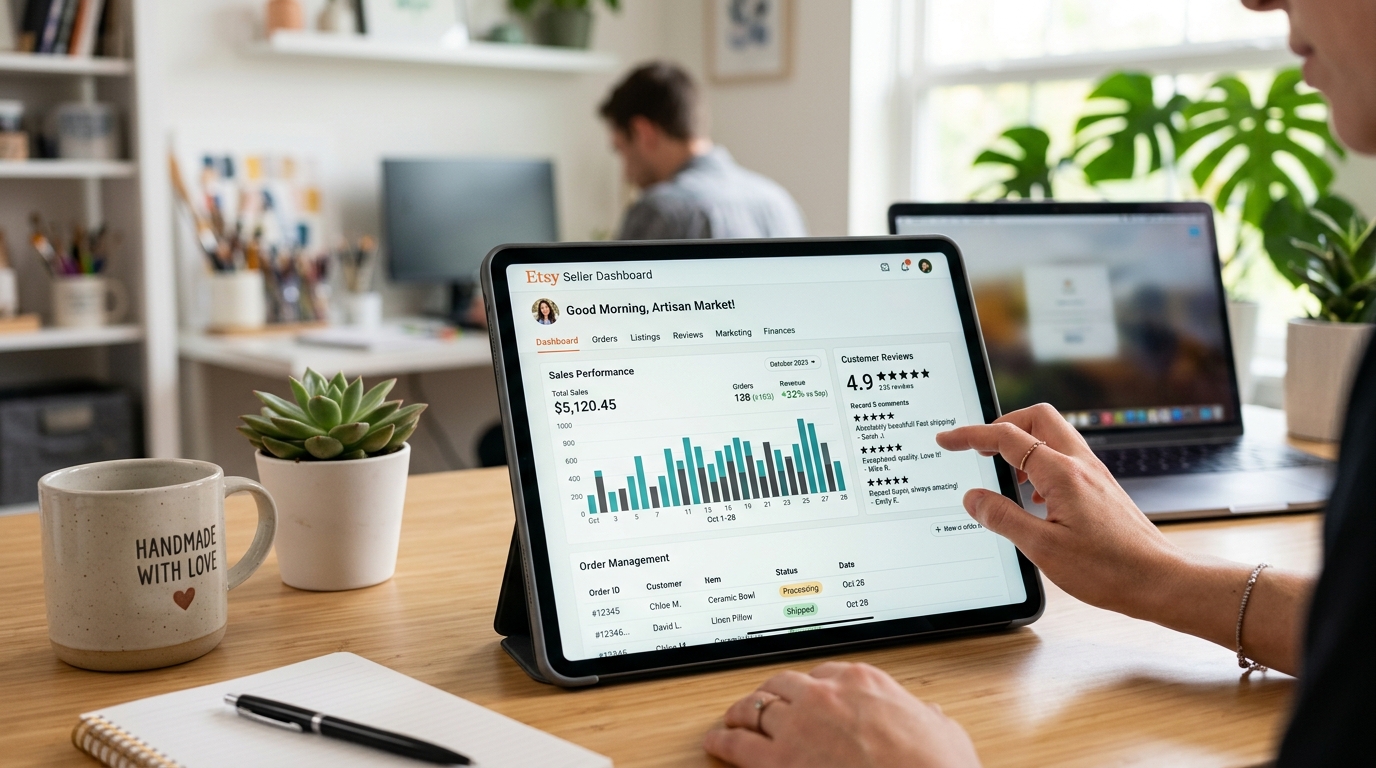
Print-on-demand is the reason someone can open an Etsy shop on a Tuesday and have a t-shirt, mug, or wall print listed by Wednesday — no inventory, no warehouse, no upfront production run sitting in a closet. That low barrier is exactly why so many new sellers jump in without reading the fine print, and it’s exactly the fine print — production partner disclosure, original design requirements, the real fee math — that determines whether a POD shop turns into a business or a suspended account.
Etsy fully allows print-on-demand as long as you designed the artwork yourself and disclose your production partner (Printify, Printful, Gelato, etc.) by name, location, and role on every applicable listing. After Etsy’s $0.20 listing fee, 6.5% transaction fee, and payment processing, a typical $28.99 t-shirt with $17 in production costs nets a seller around $13.30 per direct sale — or roughly $8.20 if the sale came through Etsy’s Offsite Ads program.
Print-on-demand (POD) means you design a product — a graphic, a phrase, an illustration — and a third-party production partner manufactures and ships it only after a customer orders. You never hold inventory or touch a physical product. Your investment is in design time, listing fees, and marketing, not warehousing. That low overhead is the appeal, but “low cost to start” isn’t the same as “low effort to succeed” — sellers who treat it like keyword research, niche validation, and quality control still matter tend to be the ones who build something sustainable.
Yes, explicitly — with conditions. Etsy’s policy permits POD as long as the seller is the original designer of the artwork and discloses the production partner responsible for manufacturing. What isn’t allowed is reselling someone else’s already-finished products (that’s dropshipping, a separate and prohibited category) or using purchased templates, stock clip art, or someone else’s designs and presenting them as your own — a commercial-use license doesn’t make a purchased design “yours” under Etsy’s Creativity Standards. If your design process involved generative AI tools, that also needs to be disclosed, with the listing’s “Who made it?” designation set to “Designed by a seller” rather than “I did.”
| Provider | Known For | Typical Production Time |
|---|---|---|
| Printify | Widest product catalog (900+ items), network of providers, lower base costs, quality varies by provider | Varies by provider in network |
| Printful | Owns its own facilities, most consistent print quality, higher production cost | 2–5 business days |
| Gelato | Local/regional production network for faster international shipping | Varies by region |
| SPOD | Fast turnaround specialist | ~95% of orders under 48 hours |
A practical rule several experienced sellers apply: start with Printify’s free plan for the broadest, lowest-cost testing ground, then move quality-sensitive products to Printful once you know what’s actually selling. Many established shops run more than one provider simultaneously, matching each product category to whichever partner handles it best.
As of July 9, 2026, Etsy requires every order shipped to a US buyer to arrive with customs duties, tariffs, and import fees prepaid through a Delivered Duty Paid (DDP) service. Orders shipped without prepaid duties lose Etsy’s Purchase Protection coverage, and if a carrier collects fees from the buyer at delivery instead, Etsy may deduct that amount from the seller’s account. For POD sellers, the practical workaround many are adopting is routing US-bound orders to a US-based print provider so packages ship domestically and never cross a customs border in the first place — worth checking directly with your provider’s routing options if a meaningful share of your buyers are in the US.
Using a commonly cited example — a $28.99 t-shirt with $4.99 shipping and $17.00 in production cost — here’s what the fee stack looks like after Etsy’s $0.20 listing fee, 6.5% transaction fee, and roughly 3% + $0.25 payment processing:
| Scenario | Approximate Net Profit |
|---|---|
| Direct sale (organic or Etsy Ads) | ~$13.30 |
| Sale attributed to Offsite Ads (15% fee tier) | ~$8.20 |
Figures are an illustrative example based on published Etsy fee rates and typical POD production costs; your actual margin depends on your specific product, provider pricing, and shipping settings.
That gap between direct and Offsite-Ads-attributed sales is the number most new POD sellers never model before pricing their first listing — and it’s the reason pricing with zero buffer for fees quietly turns a “successful” sale into a break-even one.
Etsy’s search algorithm needs enough listings to have signal to work with. Sellers commonly report that shops with fewer than 10 listings barely register in search, while 30–50 listings within a focused niche gives the algorithm enough surface area to start matching products with buyer searches. Shops that scale to 100+ listings in a tight niche often see compounding returns as Etsy’s recommendation engine kicks in more fully — though this is a directional pattern reported by experienced sellers, not an official Etsy-published threshold.
Getting a POD shop live is the easy part — staying compliant, priced correctly, and visible in search as Etsy’s rules keep shifting is the ongoing work. High Dreams LLC helps sellers set that foundation up right the first time.
Production partner and AI disclosure built into every listing, so shops don’t discover a compliance gap after a suspension notice.
Pricing that accounts for Etsy’s full fee stack and Offsite Ads exposure, not just production cost plus a guessed margin.
Listings built to the volume and keyword depth Etsy’s search algorithm actually needs to start ranking a new shop.
Explore related services: full e-commerce management for Etsy, Amazon, Walmart, and eBay shops, and AI workflow agents for automating listing and order operations.
Get a free consultation on provider selection, compliant listing setup, and pricing that actually accounts for Etsy’s fees.
Get Hired View Our ServicesDoes Etsy allow print-on-demand shops?
Yes. Etsy explicitly permits print-on-demand as long as the seller designed the original artwork and discloses their production partner’s name, location, and role on applicable listings. Reselling someone else’s already-finished products or using purchased templates as your own design is not allowed.
What happens if I don’t disclose my production partner?
Non-disclosure is one of the more common causes of listing removal or shop suspension under Etsy’s transparency requirements, which took effect with a June 2025 policy update. Disclosure needs to be visible on the listing itself, not just referenced in shop policies.
Which print-on-demand provider is best for Etsy — Printify or Printful?
Both are widely used. Printify generally offers a wider product catalog and lower base costs through its provider network, while Printful owns its own production facilities and is generally considered more consistent on print quality, at a higher cost. Many sellers use both, matching each to different product categories.
How much profit can you actually make with Etsy print-on-demand?
It depends heavily on product, pricing, and whether the sale came through Offsite Ads. On a commonly cited example — a $28.99 t-shirt with $17 in production costs — sellers typically net around $13.30 on a direct sale after Etsy’s fees, dropping to roughly $8.20 if the sale is attributed to Offsite Ads.
Do I need a business license to sell print-on-demand on Etsy?
Not to get started, though it’s generally recommended once a shop becomes profitable. An LLC can protect personal assets, and a tax ID (EIN) simplifies taxes and banking; requirements for a local business license vary by city and state.
Sources: Printify, “How to start a print-on-demand business on Etsy (2026)” · Marmalead, “Etsy Print on Demand in 2026: What Actually Works Now” · PODtomatic, “Etsy Print on Demand Setup: Complete Guide for 2026” · Insight Agent, “Does Etsy Allow Print on Demand? Complete 2026 Rules Guide” and “Does Etsy Have Print on Demand? 2026 Guide” · Listybox, “Etsy Print on Demand & AI Art Policy 2026: Key Changes” · merchOne, “How to Set Up Print on Demand on Etsy 2026.”