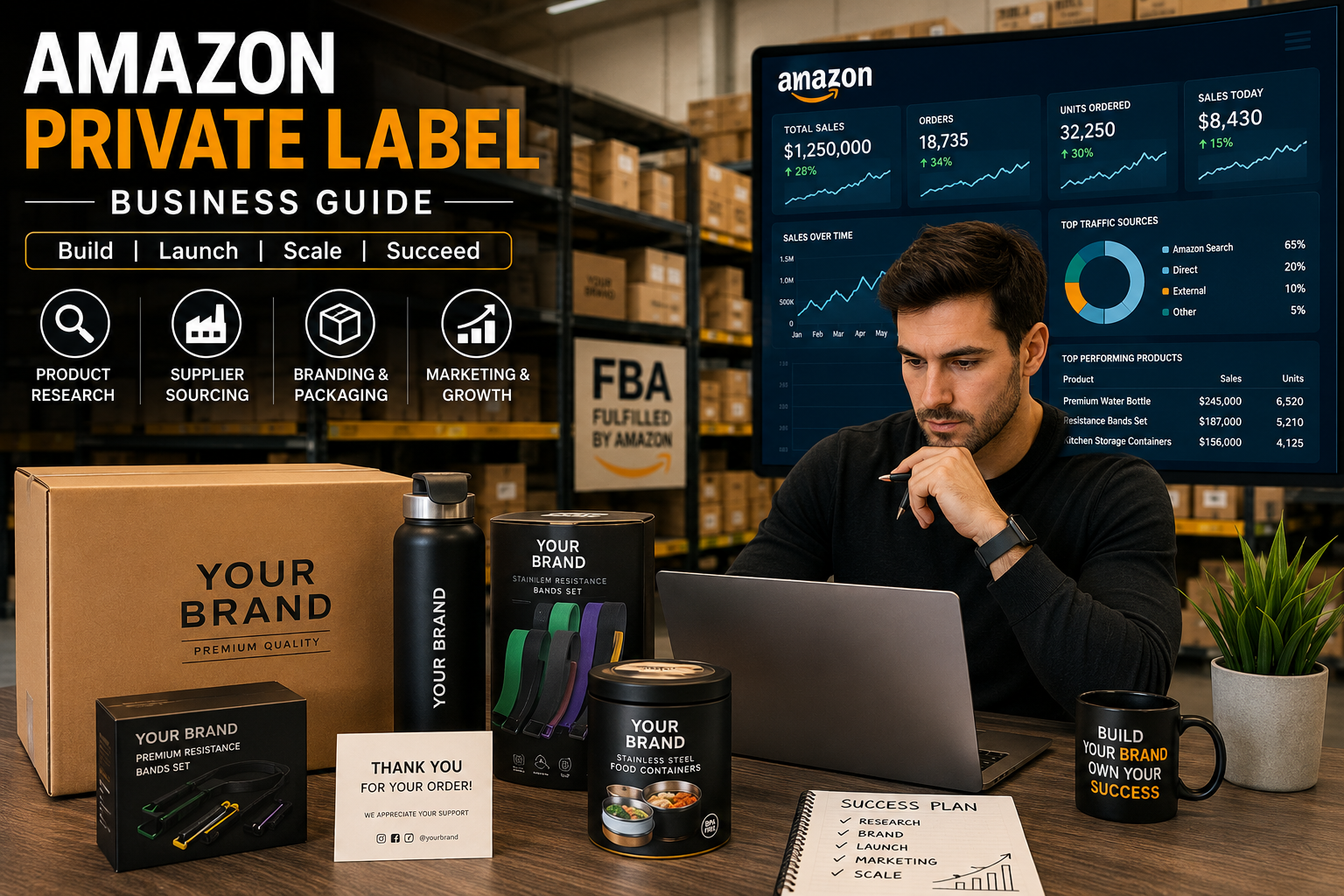
A first-time Amazon seller launched a simple kitchen accessory after months of researching customer reviews, comparing competitors, and negotiating with manufacturers. The product wasn’t revolutionary. It wasn’t protected by patents or backed by a multinational corporation. Yet within a year, the brand generated six figures in annual revenue, expanded into multiple product categories, and attracted acquisition offers from larger e-commerce companies.
Stories like this continue to fuel interest in Amazon private label businesses. However, behind every success story are countless failed product launches, inventory write-offs, suspended seller accounts, and advertising budgets that disappeared without generating sustainable sales.
The difference between profitable sellers and those who abandon the marketplace rarely comes down to luck. It is usually the result of disciplined research, strong branding, efficient supply chain management, and data-driven decision-making. Selling on Amazon has become significantly more competitive over the past decade. Low barriers to entry have attracted millions of entrepreneurs, while sophisticated advertising tools and analytics have raised the standard for success.
Launching a private label business today requires more than simply finding a trending product and placing a logo on generic packaging. Consumers expect premium experiences, fast shipping, reliable quality, and trustworthy brands. At the same time, Amazon’s algorithms increasingly reward listings that deliver excellent customer satisfaction, competitive pricing, and consistent inventory availability.
This Amazon Private Label Business Guide explores every major component required to build a sustainable Amazon brand. From product research and supplier selection to branding, fulfillment, advertising, and long-term growth strategies, the guide is designed for entrepreneurs who want to create an asset rather than chase short-lived marketplace trends.
Whether you are launching your first product or expanding an existing e-commerce portfolio, understanding how successful private label businesses operate can reduce costly mistakes while improving the likelihood of building a profitable and scalable Amazon brand.
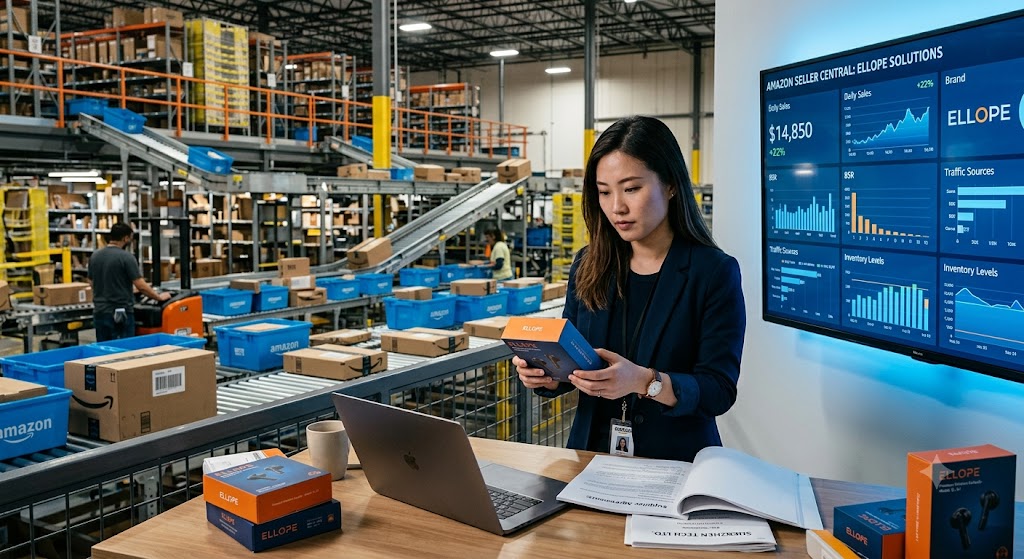
The global e-commerce industry continues to expand as consumers increasingly prefer online shopping for convenience, competitive pricing, and rapid delivery. Amazon remains one of the largest online marketplaces, providing entrepreneurs with access to hundreds of millions of active customers without the need to build their own logistics network.
Several factors have made private labeling particularly attractive:
| Market Trend | Business Impact |
|---|---|
| Growing online shopping | Larger customer base |
| Faster shipping expectations | Increased importance of FBA |
| Rising advertising competition | Better keyword research required |
| AI-powered analytics | Improved product validation |
| Brand-focused purchasing | Greater emphasis on packaging and customer experience |
Consumers increasingly purchase products based on reviews, branding, and perceived quality rather than manufacturer recognition alone. This shift allows smaller businesses to compete effectively against established companies by creating compelling product experiences.
For entrepreneurs, private labeling represents an opportunity to build long-term brand equity rather than relying solely on arbitrage or wholesale margins.
A successful Amazon private label business is not built by selling products—it is built by creating a brand customers choose over identical alternatives.
Many new sellers misunderstand private labeling. They assume it involves inventing a completely new product or competing solely on price. As a result, they enter oversaturated markets or launch products with little differentiation.⚠️ Risk Level: Medium
Without a clear understanding of the business model, sellers often struggle to build customer loyalty, achieve healthy profit margins, or defend against competitors who quickly copy successful listings.
The availability of low-cost manufacturers and online marketplaces creates the impression that anyone can succeed simply by sourcing an existing product and adding a custom logo. While technically true, this approach rarely leads to lasting success.
Common misconceptions include:
Launching without a strategy can lead to poor conversion rates, excess inventory, negative customer reviews, reduced visibility in Amazon search results, and low return on advertising spend.
A private label business should focus on delivering measurable improvements over competing products. These improvements may include better materials, improved packaging, enhanced durability, additional accessories, superior customer support, educational inserts, and longer warranties. Even modest enhancements can significantly increase perceived value and justify premium pricing.
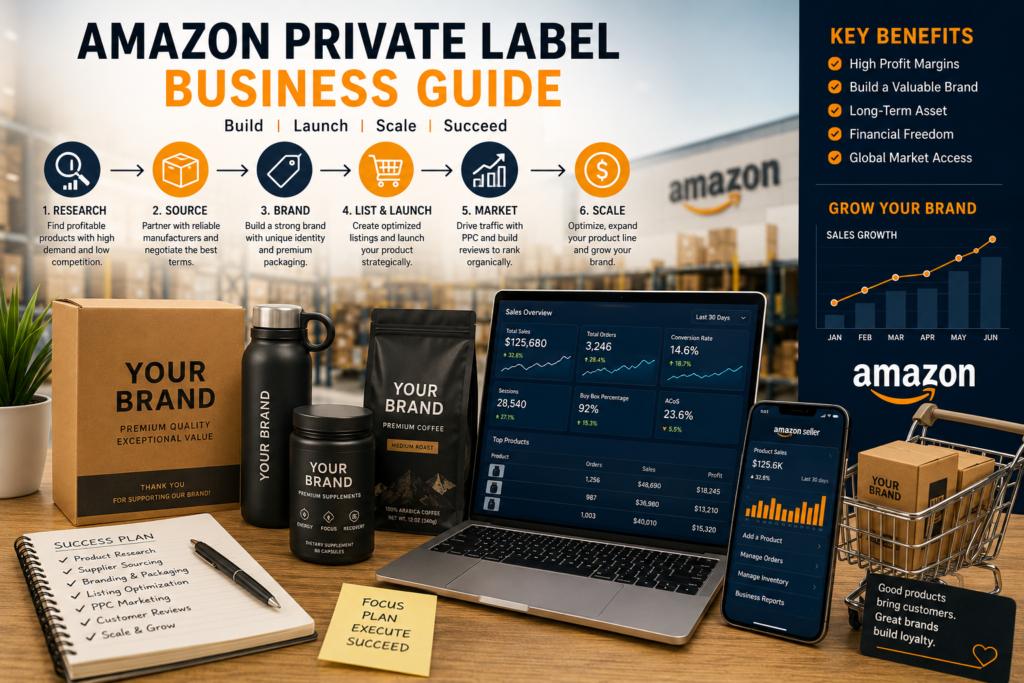
Successful private label businesses typically follow a structured process:
🧠 Expert Insight
Private labeling is fundamentally a branding strategy rather than a manufacturing strategy. The objective is to own the customer relationship, build trust, and create repeat purchasing behavior.
📦 Example
Consider a reusable water bottle category with hundreds of competitors. Instead of launching another identical product, a private label brand could differentiate itself by using food-grade stainless steel with enhanced insulation, including two interchangeable lids, offering premium eco-friendly packaging, providing a digital hydration guide via QR code, and backing the product with a lifetime satisfaction guarantee. These additions create a stronger value proposition without requiring entirely new product development.
Selecting the wrong product is one of the most expensive mistakes a seller can make. Inventory that fails to sell ties up capital, incurs storage fees, and limits the ability to invest in new opportunities.⚠️ Risk Level: High
Many beginners choose products based on personal preference or viral trends rather than objective market data.
New entrepreneurs often rely on intuition instead of structured research. They may overlook critical factors such as seasonality, competition, profit margins, shipping costs, or customer pain points.
Poor product selection can result in slow sales velocity, high advertising costs, thin profit margins, frequent returns, and inventory liquidation.
Evaluate products using a comprehensive framework: consistent year-round demand, moderate competition, healthy profit margins, lightweight and compact dimensions, opportunities for product differentiation, low return rates, compliance with Amazon policies, and reliable supplier availability.
Create a product evaluation scorecard that assigns weighted scores to demand, competition, profitability, sourcing complexity, and branding potential. Prioritize products with balanced scores rather than chasing high-demand categories with intense competition.
📈 Trend Analysis: In 2026, categories showing sustained private label potential include home organization, pet accessories, fitness equipment, kitchen storage solutions, eco-friendly household products, and office productivity accessories.
| Evaluation Criteria | Importance | Recommended Target |
|---|---|---|
| Monthly Demand | High | Consistent, year-round |
| Competition | High | Moderate |
| Gross Margin | High | 30–50% or higher |
| Shipping Cost | Medium | Low |
| Product Weight | Medium | Lightweight |
| Return Rate | High | Low |
| Branding Opportunity | High | Strong differentiation |
| Customer Improvement Potential | High | Clear pain points to solve |
Part 2: Product Research, Supplier Sourcing, Branding & Product Launch
Finding a product is easy. Finding the right product is what separates profitable Amazon brands from businesses that struggle to generate consistent sales. Thousands of sellers browse the same marketplaces, analyze identical bestseller lists, and use similar research tools. The advantage comes from interpreting data better than competitors—not merely collecting it.
Many entrepreneurs chase products that are already saturated. By the time a product becomes a social media trend, dozens or even hundreds of sellers have entered the market.⚠️ Risk Level: High
Entering a crowded niche often leads to aggressive price competition, higher advertising costs, and shrinking profit margins.
New sellers commonly make these mistakes: choosing products from Amazon Best Sellers alone, following viral TikTok trends too late, ignoring customer complaints, copying successful listings without differentiation, and overestimating market demand.
Launching an oversaturated product may result in high PPC costs, low organic ranking, reduced conversion rates, inventory storage fees, and poor profitability.
Instead of searching for “winning products,” identify winning opportunities. Ask questions such as: What frustrates current buyers? What features are repeatedly requested? Which competitors receive poor reviews? Can packaging be improved? Can the buying experience become easier? Customer complaints often reveal profitable opportunities.
A structured product research process includes:
Analyze top sellers, sponsored listings, average prices, number of reviews, images, and product descriptions.
Pay particular attention to ⭐ one-star reviews, ⭐⭐ two-star reviews, and ⭐⭐⭐⭐ four-star reviews. These often reveal missing accessories, poor durability, packaging damage, difficult assembly, and quality inconsistencies.
Avoid seasonal spikes unless your strategy specifically targets seasonal products. Look for stable search volume, consistent rankings, and evergreen demand.
🧠 Expert Insight
The best private label products rarely invent new categories—they improve existing ones.
Understanding competitors allows you to position your product more effectively.
Materials, durability, finish, and warranty.
Review images, videos, A+ Content, bullet points, and descriptions.
Compare entry-level competitors, premium brands, and average selling price.
Evaluate packaging, instructions, product inserts, and support quality.
📊 Industry Impact
Brands investing in premium customer experiences consistently achieve better reviews, higher conversion rates, lower return rates, and increased repeat purchases.
Choosing the wrong manufacturer can destroy an otherwise promising business.
Many sellers prioritize the lowest price. Unfortunately, the cheapest manufacturer often becomes the most expensive decision.
Low-cost factories may produce inconsistent quality, miss deadlines, have poor communication, create packaging errors, and have higher defect rates.
Poor manufacturing creates negative reviews, product returns, Amazon account health issues, refund requests, and lost Buy Box opportunities.
Evaluate suppliers using multiple criteria.
Before placing a large order, request product samples, material specifications, factory certifications, packaging samples, and a production timeline. Never rely solely on product photos.
📦 Example
Seller A orders 2,000 units without samples. Seller B orders five samples from three factories. Seller B discovers better packaging, higher-quality materials, and a lower defect rate. Although Seller B spends more initially, they avoid thousands of dollars in returns.
Negotiation extends beyond price. Professional buyers negotiate MOQ (Minimum Order Quantity), production timeline, packaging upgrades, shipping terms, replacement policies, and payment schedule.
✅ Best Practice
Instead of asking “Can you lower your price?” ask “How can we reduce overall production costs while maintaining quality?” This encourages collaborative problem-solving.
Products can be copied. Brands cannot. Customers remember experiences, trust, and consistency—not factory names.
Many private label businesses simply add a logo. That is not branding.
Entrepreneurs focus on sourcing products while ignoring brand positioning, brand story, packaging, and customer perception.
Weak branding results in low customer loyalty, price competition, poor repeat purchases, and limited expansion opportunities.
Build a memorable brand identity. Develop a logo, brand colors, typography, packaging, tone of voice, and customer promise.
🧠 Expert Insight
Consumers purchase emotions before they purchase products.
Packaging influences customer satisfaction, reviews, brand perception, and social sharing. Premium packaging increases perceived product value.
📦 Example
Compare a generic brown box vs. custom-designed recyclable packaging with a welcome card, QR setup guide, thank-you message, and brand story. The second experience creates stronger emotional engagement.
Registering your brand unlocks valuable tools. Benefits include brand protection, A+ Content, Sponsored Brands Ads, Brand Analytics, Amazon Storefront, and improved intellectual property protection. For serious businesses, Brand Registry is an essential investment.
One of the biggest operational decisions involves fulfillment.
| Feature | Amazon FBA | FBM |
|---|---|---|
| Storage | Amazon | Seller |
| Shipping | Amazon | Seller |
| Prime Eligibility | Yes | Limited |
| Customer Service | Amazon | Seller |
| Returns | Amazon | Seller |
| Startup Complexity | Low | Medium |
| Operational Control | Lower | Higher |
| Best For | Scaling | Specialized products |
Most private label brands choose Fulfillment by Amazon (FBA) because of faster shipping, better conversion rates, Prime eligibility, simplified logistics, and higher customer trust.
Inventory problems can quickly damage rankings. Too much inventory leads to higher storage fees. Too little inventory causes lost rankings, stockouts, and lost customers.
✅ Best Practice
Maintain approximately 30–60 days of inventory while continuously monitoring sales velocity, seasonal demand, manufacturing lead times, and shipping delays.
Your product listing functions as your digital salesperson. Every element should answer customer questions before they ask them.
Include the primary keyword, brand name, product type, key feature, and size or quantity. Avoid keyword stuffing.
High-performing listings typically include a hero image, lifestyle photos, infographics, dimensions, close-up details, and comparison images. Professional photography significantly improves conversions.
Each bullet should focus on customer benefits. Instead of “Made from stainless steel,” write “Premium stainless steel construction resists rust while keeping beverages cold for up to 24 hours.” Focus on outcomes rather than specifications.
Tell a story. Explain the problem, the solution, why your product is different, and its long-term value.
Enhanced Brand Content allows brands to showcase lifestyle imagery, comparison charts, brand mission, and feature highlights. A+ Content often improves conversion rates while strengthening brand perception.
Pricing influences conversion, advertising, profit, and brand perception. Pricing too low may create distrust. Pricing too high reduces sales velocity.
Manufacturing Cost + Shipping + Amazon Fees + Advertising + Returns + Desired Profit Margin = Selling Price
Avoid copying competitors blindly.
Launching without preparation wastes advertising dollars. Successful launches begin weeks before inventory reaches Amazon.
| Activity | Business Impact |
|---|---|
| Keyword Optimization | Higher visibility |
| Professional Images | Better conversions |
| PPC Campaigns | Faster ranking |
| Brand Registry | Enhanced credibility |
| Inventory Planning | Prevents stockouts |
| Competitive Pricing | Increased sales velocity |
Launching an Amazon private label product is no longer about being first. It is about being better prepared than competitors. Brands that combine thorough research, premium customer experiences, disciplined inventory management, and data-driven marketing consistently outperform sellers who rely on shortcuts or fleeting trends.
Part 3: Scaling, Risk Management, Future Outlook & SEO Assets
Launching a high-quality product is only half the battle. Without visibility, even the best product can struggle to generate sales. Amazon Pay-Per-Click (PPC) advertising remains one of the most effective ways to drive traffic, collect valuable customer data, and improve organic rankings.
Many sellers either overspend on advertising without tracking profitability or underinvest and fail to gain sufficient visibility during the critical launch period.⚠️ Risk Level: High
Poorly managed campaigns can quickly consume profit margins, while insufficient advertising can prevent products from gaining traction.
Broad keyword targeting, lack of negative keywords, no bid optimization, poor conversion-focused listings, and inadequate campaign monitoring.
High Advertising Cost of Sales (ACoS), low Return on Ad Spend (ROAS), poor keyword rankings, and wasted advertising budget.
Develop a structured PPC strategy that includes automatic campaigns for keyword discovery, manual campaigns for high-converting keywords, product targeting campaigns, Sponsored Brands campaigns, and Sponsored Display campaigns for remarketing.
📦 Example
A kitchen storage brand launched with automatic campaigns. Within three weeks, it identified high-converting search terms and shifted budget toward manual campaigns, reducing advertising costs while increasing organic rankings.
Advertising generates initial visibility, but sustainable growth depends on organic search performance.
✅ Best Practices
Optimize titles with primary keywords. Write customer-focused bullet points. Include backend search terms. Encourage authentic customer reviews. Maintain competitive pricing. Avoid inventory stockouts. Improve click-through rates with professional images. Deliver exceptional customer service.
Organic rankings improve when Amazon consistently sees positive customer engagement, high conversion rates, and reliable fulfillment.
Many successful Amazon businesses evolve from a single product into recognizable brands.
Introduce complementary products that serve existing customers. Example: A brand selling reusable water bottles expands into travel mugs, insulated lunch bags, cleaning brushes, and replacement lids.
Increase average order value by combining related products.
Amazon marketplaces in Canada, the United Kingdom, Germany, Australia, and other regions provide opportunities to reach new audiences.
Reduce dependence on Amazon by expanding to Shopify, Walmart Marketplace, eBay, Etsy (where appropriate), and brand-owned websites.
A profitable business requires disciplined financial planning.
Regular financial analysis enables informed decisions regarding inventory purchases, advertising budgets, and expansion opportunities.
Even experienced sellers encounter challenges. Recognizing common pitfalls can help prevent costly setbacks.
Risk Level: High
Description: Validate demand, competition, and profitability before selecting a product.
Implementation Guidance: Analyze customer reviews, search volume, competitor listings, and pricing.
What Happens If Ignored: Poor product selection, slow sales, and unsold inventory.
Risk Level: High
Description: Request samples and verify manufacturing capabilities.
Implementation Guidance: Compare multiple suppliers before placing bulk orders.
What Happens If Ignored: Quality issues, negative reviews, and increased returns.
Risk Level: Medium
Description: Invest in professional logos, packaging, and messaging.
Implementation Guidance: Create a consistent brand identity across all customer touchpoints.
What Happens If Ignored: Weak differentiation and increased price competition.
Risk Level: High
Description: Improve discoverability and conversion.
Implementation Guidance: Use keyword-rich titles, compelling bullet points, professional images, and A+ Content.
What Happens If Ignored: Reduced visibility and lower sales.
Risk Level: High
Description: Prevent stockouts and excessive storage fees.
Implementation Guidance: Forecast demand and reorder inventory proactively.
What Happens If Ignored: Lost rankings, reduced customer trust, and higher costs.
1 Initial Trigger: An entrepreneur identifies a trending kitchen gadget and places a large order based on optimistic sales projections without ordering product samples.
2 Escalation: After launch, customers begin reporting poor product quality and damaged packaging. Advertising campaigns continue driving traffic, increasing sales—but also increasing returns.
3 Failure Point: Negative reviews reduce the product’s average rating. Conversion rates decline, advertising costs increase, and organic rankings fall.
4 Consequences: Excess inventory accumulates. Advertising becomes unprofitable. Storage fees increase. Cash flow tightens. Customer trust declines.
5 Detection: Performance dashboards reveal rising return rates and declining customer satisfaction metrics.
6 Recovery: The seller pauses advertising, works with the manufacturer to improve quality, redesigns packaging, updates product listings, and relaunches with improved inventory. Although recovery takes time, proactive quality improvements help rebuild customer confidence.
The most successful Amazon private label businesses do not compete solely on products. They compete on customer trust, operational excellence, and continuous improvement.— Editorial Research Team
| Scenario | Without Controls | With Controls |
|---|---|---|
| Product Research | Trend chasing | Data-driven validation |
| Supplier Selection | Lowest-cost factory | Verified quality manufacturer |
| Branding | Generic logo | Distinct brand identity |
| Product Listing | Basic content | Optimized SEO listing with A+ Content |
| Inventory Management | Frequent stockouts | Forecast-based replenishment |
| Advertising | Unstructured campaigns | Keyword-optimized PPC strategy |
| Customer Experience | Inconsistent support | Proactive communication and quality assurance |
| Business Growth | Short-term sales | Long-term brand equity |
The Amazon marketplace continues to evolve rapidly, influenced by technological innovation, changing consumer expectations, and increasing competition. Over the next 12–24 months, several trends are expected to shape the future of private label businesses:
Launching an Amazon private label business offers significant opportunities, but success requires far more than sourcing a product and listing it online. Profitable brands are built through disciplined research, thoughtful product differentiation, reliable supplier relationships, compelling branding, and continuous optimization.
The most successful entrepreneurs approach Amazon as a long-term business rather than a short-term income opportunity. They analyze customer feedback, invest in quality improvements, monitor financial performance, and adapt to changing market conditions. By combining strategic planning with consistent execution, sellers can create brands that generate sustainable revenue and lasting customer loyalty.
While competition on Amazon will continue to intensify, opportunities remain abundant for businesses that prioritize innovation, operational excellence, and customer satisfaction. Whether you are launching your first product or expanding an existing portfolio, applying the principles outlined in this guide will help you build a stronger foundation for long-term success.
1. What is an Amazon private label business?
An Amazon private label business involves selling products manufactured by third parties under your own brand name.
2. How much does it cost to start?
Startup costs vary depending on the product, inventory quantity, branding, and advertising budget. Many businesses begin with several thousand dollars in capital.
3. Is Amazon FBA required?
No. Sellers can choose Fulfillment by Amazon (FBA) or Fulfillment by Merchant (FBM), though FBA often provides operational advantages.
4. How do I choose a profitable product?
Analyze demand, competition, customer reviews, profit margins, shipping costs, and opportunities for product differentiation.
5. How important is branding?
Branding is essential for building trust, increasing perceived value, and encouraging repeat purchases.
6. Can I sell internationally?
Yes. Amazon operates marketplaces in multiple countries, allowing businesses to expand globally.
7. What are the biggest risks?
Poor product selection, unreliable suppliers, inadequate quality control, ineffective advertising, and inventory mismanagement.
8. How long does it take to become profitable?
Results vary, but many businesses require several months of consistent optimization before achieving stable profitability.
9. Should I use AI tools?
AI-powered research and analytics tools can improve decision-making, but they should complement—not replace—human judgment.
10. Can I build a long-term brand on Amazon?
Yes. Businesses that prioritize quality, customer experience, and continuous improvement can create valuable brands with long-term growth potential.


How AI Voice Agents Improve Amazon Online Business in 2026 - highdreamsllc.com
July 9, 2026 at 9:05 am
“ […] 2026 AI Customer Support Why Businesses Are Investing in AI Customer Support Amazon Management Amazon Private Label Business Guide: Build a Profitable Amazon Brand in 2026 AI Chatbot Why Every Business Needs an AI Chatbot in 2026 AI Workflow Agents AI-Powered Sales […] “
How AI is changing SEO strategy for ecommerce stores - highdreamsllc.com
July 9, 2026 at 9:14 am
“ […] in 2026 AI Chatbot Why Businesses Are Investing in AI Customer Support Amazon Management Amazon Private Label Business Guide, Build a Profitable Amazon Brand in 2026 AI Workflow Agents AI Powered Sales Funnels Explained, How AI Is Rewriting Revenue Growth AI […] “
Amazon PPC Guide for Beginners - highdreamsllc.com
July 15, 2026 at 6:01 am
“ […] Amazon Private Label Business Guide: Build a Profitable Brand in 2026 The Algorithmic Marketplace: How to Start Selling on Amazon How AI Voice Agents Improve Amazon Online Business Walmart Advertising Strategies That Work How to Create a High-Converting eBay Listing How AI Is Changing SEO Strategy for E-Commerce Stores […] “
How to optimize Amazon Product Listing - highdreamsllc.com
July 16, 2026 at 6:11 am
“ […] Amazon Private Label Business Guide: Build a Profitable Brand in 2026 The Algorithmic Marketplace: How to Start Selling on Amazon Amazon PPC Guide for Beginners How AI Voice Agents Improve Amazon Online Business How AI Is Changing SEO Strategy for E-Commerce Stores How to Create a High-Converting eBay Listing […] “
Amazon Private Label Business Guide - highdreamsllc.com
July 16, 2026 at 6:50 am
“ […] Amazon Private Label Business Guide: Build a Profitable Brand in 2026 Amazon PPC Guide for Beginners The Algorithmic Marketplace: How to Start Selling on Amazon How AI Voice Agents Improve Amazon Online Business How AI Is Changing SEO Strategy for E-Commerce Stores How to Create a High-Converting eBay Listing […] “
Amazon Account Management Best Practices - highdreamsllc.com
July 16, 2026 at 12:47 pm
“ […] Amazon Private Label Business Guide: Build a Profitable Amazon Brand in 2026Amazon Management The Algorithmic Marketplace: How to Start Selling on Amazon in 2026Amazon Management How AI Voice Agents Improve Amazon Online Business in 2026AI Voice Agents How to Start Selling on Walmart Marketplace: The Complete 2026 Seller GuideWalmart Management How to Create a High-Converting eBay ListingeBay Management How AI Can Help Etsy Sellers Grow FasterEtsy Management […] “
Step-toStep Amazon Product Research Guide - highdreamsllc.com
July 20, 2026 at 6:14 am
“ […] Amazon Private Label Business Guide: Build a Profitable Brand in 2026 How to Optimize Amazon Product Listing Amazon PPC Guide for Beginners Amazon Account Management Best Practices The Algorithmic Marketplace: How to Start Selling on Amazon How AI Is Changing SEO Strategy for E-Commerce Stores […] “
Amazon Buy Box Guide: Win More Sales in 2026 Fast
July 21, 2026 at 9:30 am
“ […] How to Optimize Amazon Product Listing Amazon Account Management Best Practices Step-by-Step Amazon Product Research Guide Amazon PPC Guide for Beginners How AI is Revolutionizing Amazon Selling Amazon Private Label Business Guide: Build a Profitable Brand in 2026 […] “
AI Inventory Forecasting for Amazon Sellers Guide
July 22, 2026 at 6:35 am
“ […] Amazon Account Management Best Practices Amazon Buy Box Guide Step-by-Step Amazon Product Research Guide Amazon PPC Guide for Beginners How AI is Revolutionizing Amazon Selling Amazon Private Label Business Guide: Build a Profitable Brand in 2026 […] “
Best AI Voice Agent Platforms Compared for Business
July 25, 2026 at 7:05 am
“ […] Amazon Private Label Business Guide: Build a Profitable Brand in 2026 […] “
Future of Selling on Etsy: Trends Sellers Need
July 25, 2026 at 7:09 am
“ […] Amazon Private Label Business Guide: Build a Profitable Brand in 2026 […] “
Etsy Print-on-Demand Guide for Beginners 2026
July 27, 2026 at 7:12 am
“ […] Amazon Private Label Business Guide: Build a Profitable Brand in 2026 […] “
Amazon Account Health Best Practices for Sellers
July 27, 2026 at 7:16 am
“ […] Amazon Private Label Business Guide: Build a Profitable Brand in 2026 […] “
Common Amazon Seller Mistakes That Hurt Sales
July 30, 2026 at 6:01 am
“ […] Amazon Private Label Business Guide: Build a Profitable Brand in 2026 […] “
Best AI Tools for Etsy Product Photography Guide Best AI Tools for Etsy Product Photography
August 1, 2026 at 6:30 am
“ […] Amazon Private Label Business Guide: Build a Profitable Brand in 2026 […] “