Etsy Management · Branding & Trust
On Etsy, a buyer can’t hold the product, meet the maker, or walk into a store. Every signal of trust has to come through the screen — which makes branding less about looking pretty and more about answering one quiet question in a shopper’s mind: is this a real, reliable person I can buy from?
WHERE TRUST GETS BUILT ON YOUR SHOP HOME
Quick Answer
Build Etsy buyer trust by combining visual consistency (banner, logo, and product photography that look like one brand) with the platform’s built-in trust signals: a real shop owner photo, a specific About section, the Star Seller badge earned through fast responses and on-time shipping, and thoughtful responses to every review. None of these require a big budget — they require consistency.
Etsy’s own seller guidance puts it plainly: buyers want to know who they’re buying from. A friendly, clear shop owner photo lends a shop credibility and helps build trust, and seeing the person behind the products gives buyers greater confidence to complete a purchase. That’s not a minor detail — it’s the entire logic of why branding matters more on a handmade marketplace than it does for a big-box retailer buyers already recognize.
| Trust Signal | Requirement | Why Buyers Trust It |
|---|---|---|
| Star Seller badge | 95%+ message response within 24 hrs, 95%+ on-time shipping, 4.8+ rating, 5+ orders | Verified by Etsy itself, not self-reported |
| Reviews & ratings | Left only by buyers who completed a purchase | Independent social proof from real transactions |
| Reviews with photos | Buyer-submitted, unedited by the seller | Shows the product as it actually arrives |
| Shop policies & About section | Written and maintained by the seller | Sets clear expectations before a buyer commits |
Star Seller specifically is worth chasing for its own sake, not just the badge: Etsy evaluates it on a rolling three-month window, and it takes 90 days from a shop’s first sale before it’s even eligible for evaluation.
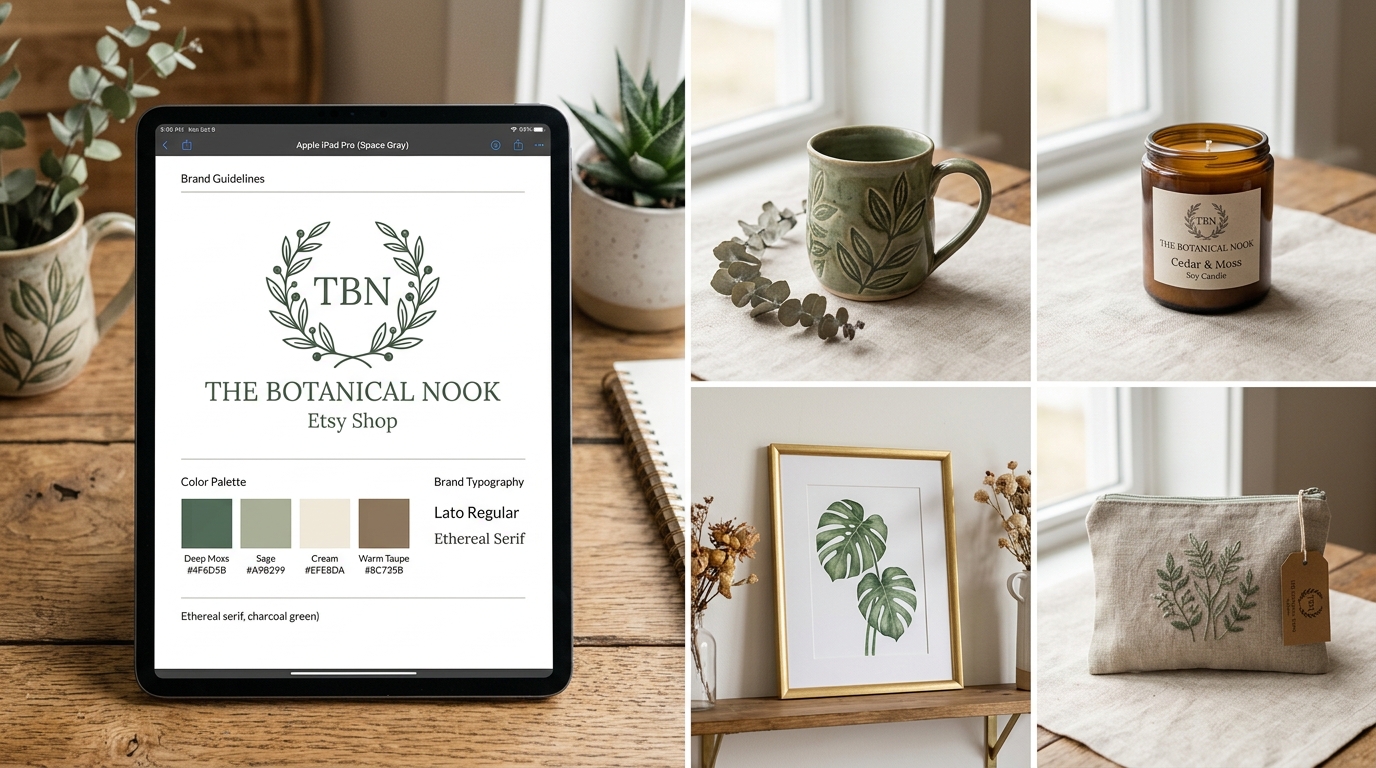
Etsy’s Seller Handbook is direct about this: consistency doesn’t mean everything has to match exactly, but the banner, logo, About section, and product photography should feel like pieces of one bigger picture rather than unrelated elements bolted together. A shop that photographs products against five different backgrounds with five different lighting setups reads as improvised, even if every individual photo is well shot. A shop with one consistent visual language reads as intentional — and intentional reads as trustworthy.
The About section is one of the only places on a listing page where a shop gets to talk directly to a buyer without the constraint of describing a specific product. Etsy’s own guidance frames this as the place to take buyers behind the scenes of your passion and process — the specifics of why you started, what you make, and what makes your approach different are what turn a passive visitor into someone who feels connected enough to buy, and to come back.
Etsy recommends a clear, friendly, square photo of at least 400 x 400 pixels for the shop owner section. A real face at the top of your shop home is one of the fastest, cheapest credibility signals available.
Generic copy like “handmade with love” says nothing a buyer can hold onto. A specific detail — why you started, what problem you set out to solve, what your process actually looks like — is what makes a shop memorable rather than interchangeable.
Pick colors, fonts, and a photo style that align with your brand identity, then carry them across every touchpoint. Consistency is what makes a shop feel curated rather than thrown together.
Fast responses, on-time shipping, and quality that earns high ratings are good business practices independent of any badge. The badge is simply Etsy’s way of making those habits visible to buyers before they commit.
Packaging and promotional inserts are among the only brand moments a buyer experiences physically. A simple branded thank-you note reinforces the same identity they saw in your listing photos, and it’s often what gets photographed and shared.
A calm, professional response to a negative review is visible to every future shopper who reads it. How a shop handles a problem often builds more trust than a page of five-star reviews with no context.
No shop owner photo, or a generic stock image. This is one of the first things a hesitant buyer looks for, and its absence reads as a red flag.
An About section copied from a template. Vague, generic language fails to give buyers any real reason to trust or remember the shop.
Inconsistent product photography. Mixing lighting, backgrounds, and editing styles across listings makes a shop feel unplanned.
Ignoring messages until they pile up. Slow responses don’t just risk the Star Seller badge — they directly signal unreliability to the buyer waiting on an answer.
Deleting or ignoring negative reviews instead of responding. An unanswered complaint reads worse to future buyers than a complaint handled well.
Treating branding as a one-time setup task. A banner or logo that never evolves as the shop grows starts to feel dated rather than established.
Start with the photo
If you do nothing else this week, add or update a real, well-lit shop owner photo.
Write for one buyer
Draft your About section as if speaking to one specific, real customer, not a general audience.
Automate the easy 24 hours
A saved-reply template for common first messages protects your response rate without feeling robotic.
Revisit branding quarterly
Review your banner, photos, and About section every few months as your shop and product line evolve.
Lean into the personal story — a real face and specific process details are your strongest trust asset against larger competitors.
Visual consistency across dozens of similar listings matters more than individual storytelling, since cohesion is what signals a real, organized business.
Shop sections and consistent category-level branding help buyers navigate without diluting the overall trust signal.
High Dreams LLC’s Etsy team works on shop branding as part of full shop optimization — not just keywords and listings, but the visual and trust signals that turn a browsing visitor into a buyer. That includes shop home cohesion, About section strategy, and the customer-service habits that support Star Seller status.
A real, well-lit shop owner photo and a specific, honest About section tend to move the needle fastest for new shops, since reviews take time to accumulate but these elements are available from day one.
As of 2026, the badge requires a 95%+ message response rate within 24 hours, 95%+ on-time shipping with valid tracking, a 4.8+ average review rating, and at least 5 completed orders, evaluated on a rolling three-month basis once a shop’s first sale is 90+ days old.
No. Losing the badge removes its display and a marginal ranking benefit until a shop re-qualifies at the next monthly evaluation; it doesn’t demote the shop itself.
Yes, and professionally. A calm, solution-oriented response often does more for buyer trust than the review itself does damage, since future buyers read how a shop handles problems.
Packaging is one of the few brand touchpoints a buyer experiences physically rather than on screen, which makes it disproportionately memorable and worth keeping consistent with your shop’s visual identity.
Yes. Digital shops still qualify for Star Seller and still benefit from a strong About section and consistent visuals; since digital orders automatically satisfy the shipping requirement, message response and review ratings become even more central to their trust profile.
Get a free shop branding review from a team that manages listings, branding, and customer experience for Etsy sellers every day.
Sources: Etsy Seller Handbook — The Ultimate Guide to Branding, Etsy Seller Handbook — Customizing the Look of Your Shop Home, Etsy Help — What is the Star Seller Badge?