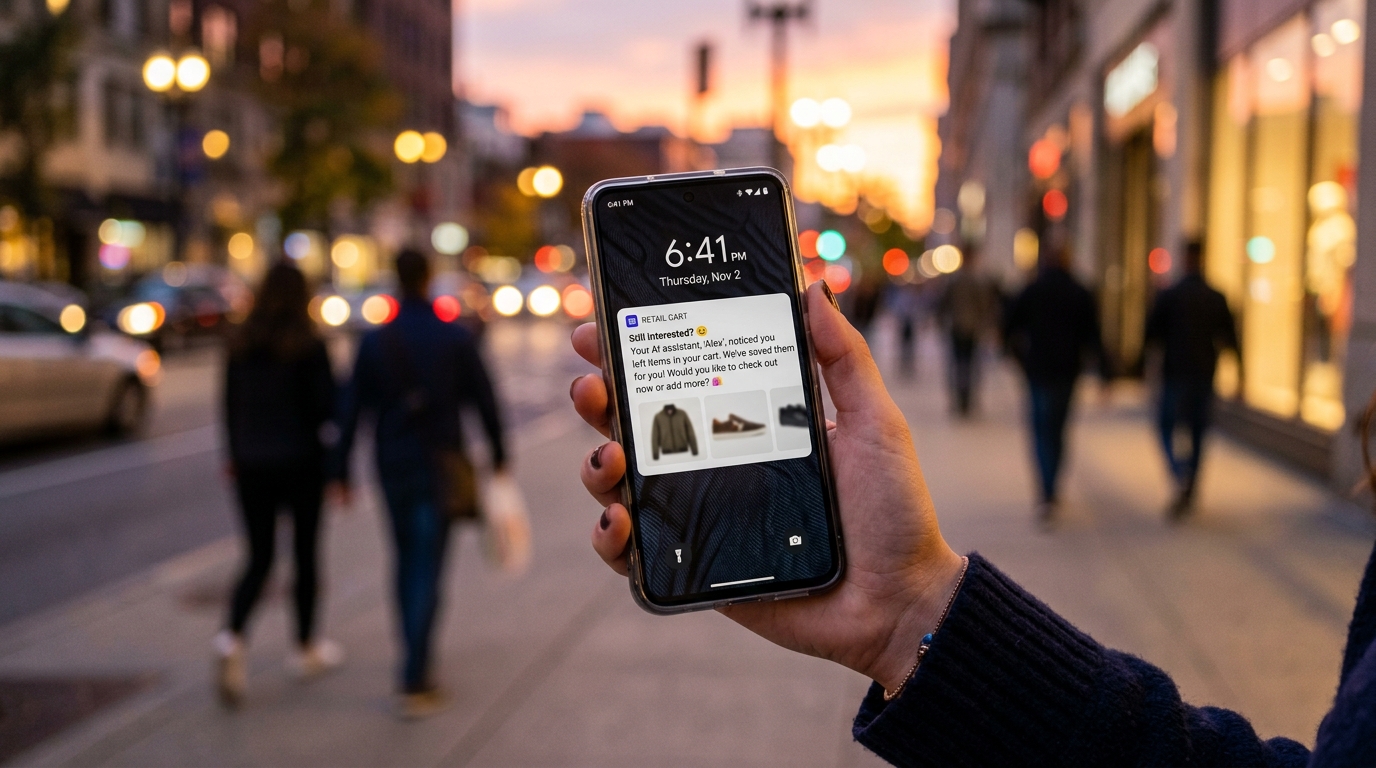
Cart abandonment content almost always leads with the same number — around 70% of shoppers leave without buying — and almost never gets more specific than “send a recovery email.” That’s a shame, because the Baymard Institute, the most cited research body in checkout UX, has spent over a decade documenting exactly why shoppers abandon, cause by cause. Once you have that breakdown, “install a chatbot” stops being vague advice and becomes a specific list of objections a well-built one can actually intercept in real time — and a shorter list of things it genuinely can’t fix.
The global average cart abandonment rate is 70.22%, based on the Baymard Institute’s meta-analysis of more than 50 studies, and roughly 43% of that is shoppers who were never planning to buy on that visit — browsing or comparing prices, and not meaningfully recoverable by any tool. Of the remaining abandonment, the top documented causes are unexpected costs at checkout (48%), forced account creation (26%), an overly long or complicated checkout (22%), and payment security concerns (18%) — and a well-built chatbot can intervene on nearly all of them in real time, before the customer ever reaches the point of leaving.
Before chasing every abandoned cart, it’s worth knowing that a meaningful share of them were never going to convert regardless of what happens next. Baymard’s own research finds that roughly 42–43% of shoppers who abandon a cart say they simply weren’t ready to buy on that visit — browsing, comparing prices, or saving items for later. That segment is largely unrecoverable, and treating it as a failure worth chasing aggressively usually just means annoying someone who was never close to buying. The genuine opportunity sits in the other roughly 57% — shoppers who had real purchase intent and got stopped by something specific and, in most cases, fixable.
Baymard’s ongoing research into checkout abandonment reasons (excluding the “just browsing” segment) consistently surfaces the same handful of causes, in roughly this order of impact:
| Reason for Abandonment | Share Citing It |
|---|---|
| Extra costs too high (shipping, taxes, fees) | 48% |
| Forced account creation | 26% |
| Checkout process too long or complicated | 22% |
| Lack of trust in payment/site security | 18% |
| Total cost not shown upfront | 17% |
What’s notable about this list: every item on it is a design and communication problem, not a pricing problem. Shoppers aren’t primarily abandoning because things cost too much — they’re abandoning because of surprise, friction, and unresolved doubt introduced late in the process.
It’s worth being honest about the limits here. A chatbot is a real-time objection handler, not a checkout redesign. Baymard’s own testing across a decade of large-scale checkout research found that fixing the solvable checkout usability issues they’ve documented can produce up to a 35.26% increase in conversion rate on its own — a bigger lever, in many cases, than anything a chatbot layered on top can achieve if the underlying checkout is still fundamentally broken. The “just browsing” 42–43% segment is also not meaningfully chatbot-recoverable; no amount of proactive messaging turns someone who was never planning to buy today into a completed order. The realistic framing: a chatbot works best as a complement to genuinely fixing checkout friction, not a substitute for it.
The mechanism that makes a chatbot different from a recovery email is speed. A recovery email arrives hours or a day after abandonment, by which point the shopper’s attention and intent have moved on. A chatbot triggered by exit intent or hesitation signals — cursor movement toward the close button, a long pause on the shipping cost line — intervenes before the decision to leave is finalized, not after. Behavioral, pre-abandonment intervention is a fundamentally different mechanism than post-abandonment recovery, and it’s the reason well-timed proactive messaging is generally reported to outperform email-only recovery campaigns by a wide margin — though the exact multiplier varies significantly by vendor and should be validated against your own store’s data rather than taken as a universal guarantee.
Reducing cart abandonment takes more than installing a chatbot widget — it takes knowing which specific objection is costing you the sale, and fixing the checkout flow underneath it too. High Dreams LLC handles both.
Proactive messaging built around the actual objections your customers are hitting, not a generic recovery script.
Underlying friction addressed directly, not just papered over with a chat widget.
Intervention timed to happen before abandonment, when it actually has a chance to change the outcome.
Explore related capabilities: AI chatbot development, e-commerce management for Shopify and marketplace sellers, and AI workflow agents for connecting cart data to your broader operations.
Get a free consultation and checkout audit to find out exactly where and why customers are abandoning.
Get Hired View Our ServicesWhat’s the average cart abandonment rate, and can a chatbot fix all of it?
The global average is 70.22%, per the Baymard Institute’s meta-analysis of over 50 studies. No — roughly 42–43% of that is shoppers who were never ready to buy on that visit, a segment that isn’t meaningfully recoverable by any tool. A chatbot’s real opportunity is in the remaining share, where a specific, fixable objection caused the abandonment.
What’s the single biggest reason shoppers abandon their cart?
Unexpected costs at checkout, cited by roughly 48% of shoppers in Baymard Institute research — typically shipping fees or taxes that weren’t disclosed until the final step, not the cost itself but the surprise of it.
Is a chatbot enough on its own to reduce cart abandonment?
Not entirely. Baymard’s own checkout usability research found that fixing solvable checkout friction directly can produce up to a 35.26% increase in conversion on its own — often a larger lever than a chatbot layered on top of an otherwise broken checkout. A chatbot works best as a complement to good checkout design, not a replacement for it.
Why is a chatbot generally more effective than a recovery email?
Timing. A recovery email arrives hours or a day after abandonment, once the shopper’s attention has moved on. A chatbot triggered by real-time hesitation signals can intervene before the decision to leave is finalized, addressing the specific objection in the moment rather than after the fact.
Should a business try to recover every abandoned cart?
No. A significant share of abandonment comes from shoppers who were only browsing or comparing prices and were never close to purchasing. Aggressively targeting that segment tends to produce diminishing returns and can create a negative experience rather than a recovered sale.
Sources: Baymard Institute, “50 Cart Abandonment Rate Statistics” (baymard.com/lists/cart-abandonment-rate) · DontPayFull, “Cart Abandonment Statistics 2026: Rates, Reasons, and Recovery Benchmarks” (citing Baymard Institute) · Searchlab, “Cart Abandonment Statistics 2026” (citing Baymard Institute, SaleCycle, Barilliance, Statista, Shopify, and ConversionXL Benchmarks 2026) · Zipchat AI, “Cart Abandonment Rate Benchmarks and Causes (2026 Data)” (citing Baymard Institute and Contentsquare) · Growth Suite, “Cart Abandonment Rate 2026 Statistics” (citing Baymard Institute) · Yokaify, “Cart Abandonment Statistics 2026” (citing Baymard Institute).