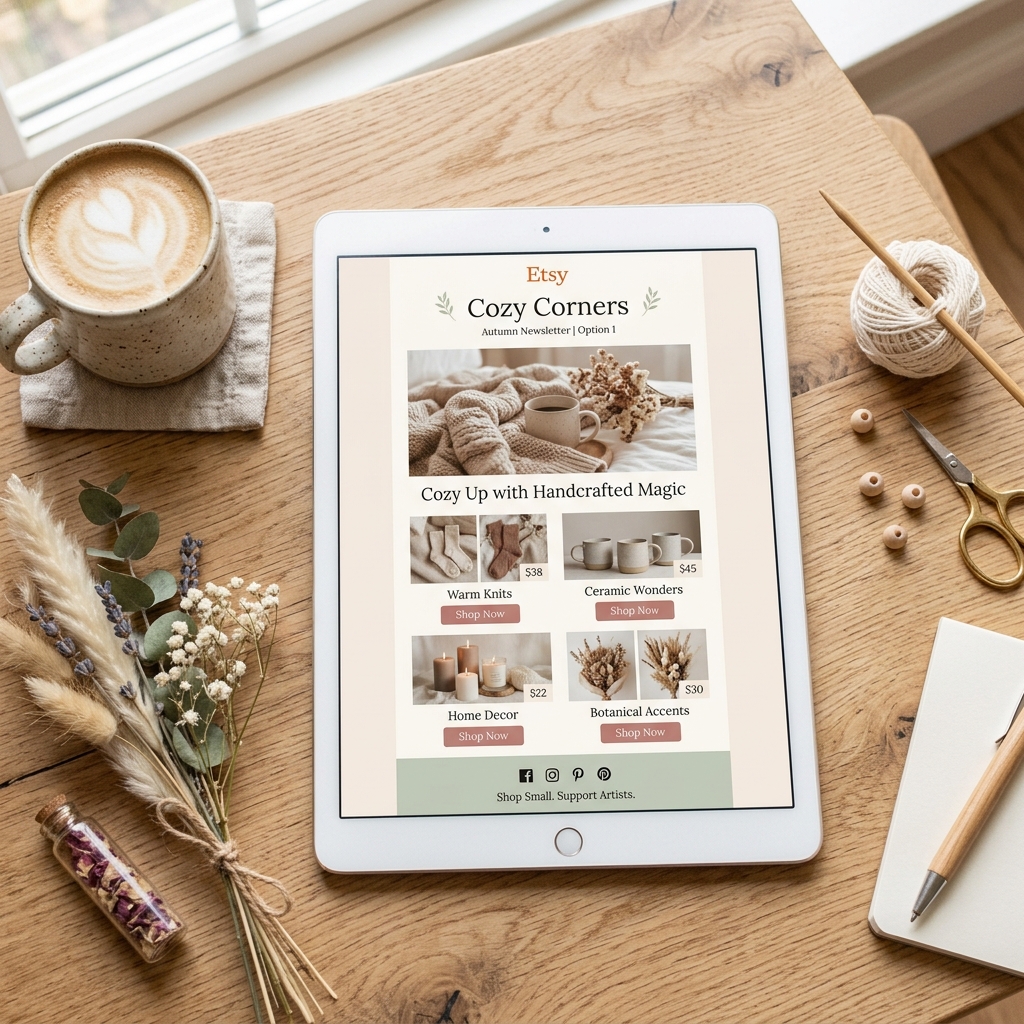
Etsy shoppers rarely come back on their own. Between a crowded marketplace, an algorithm that resets visibility with every new listing, and a checkout flow that hands the customer relationship back to Etsy the moment an order ships, sellers who rely on search traffic alone are constantly starting from zero. An owned email list is the one channel that lets you reach past buyers directly, on your schedule, without paying for another click.
This guide covers what Etsy actually allows when it comes to contacting buyers, how to build a compliant email list after Etsy’s 2024 privacy changes, the core campaigns that turn one-time buyers into repeat customers, and the legal basics every seller needs to know before hitting send.
Quick answer: Etsy does not let sellers pull buyer email addresses directly from orders, and Etsy Messages cannot be used for promotional emails. Instead, compliant sellers build a separate, opt-in list through packaging inserts, a link in their “message to buyers,” their shop’s social bio, and a standalone landing page — then run that list through an email platform like Klaviyo, Mailchimp, or ConvertKit.
Key takeaways:
• Repeat buyers convert at a dramatically higher rate than new visitors and typically spend more per order.
• As of February 2024, Etsy stopped sharing buyer email addresses with third-party integrations, so list-building has to happen through opt-in channels you control.
• Every promotional email you send is still subject to the FTC’s CAN-SPAM Act, regardless of how small your shop is.
Retention is cheaper than acquisition in almost every business, but the gap is especially wide for small Etsy shops that don’t have an advertising budget to compete with larger sellers. Industry research consistently puts the cost of winning a new customer at roughly five to twenty-five times higher than the cost of keeping an existing one, and the payoff for closing that gap is significant: shoppers who have already bought from you convert at somewhere around 60–70%, compared with roughly 5–20% for a first-time visitor landing on your shop for the first time. Returning Etsy buyers also tend to spend meaningfully more per order than new customers, since they already trust your quality, sizing, and shipping times.
Email is the most direct way to capture that value because it’s a channel you own. Etsy’s search ranking can bury a shop overnight, a social algorithm can throttle reach without warning, but a subscriber who opted in to hear from you will still see your message in their inbox.
Before building any campaign, it’s worth understanding the boundaries Etsy has drawn around buyer communication, because they’ve tightened considerably in the past two years.
Etsy’s official Seller Policy is explicit that Messages cannot be used to send unsolicited advertising, promotions, or spam to buyers. A short, personal note thanking a customer for their order and pointing them toward a place to opt in to future updates is generally fine; a recurring sales blast sent through Messages is not, and repeated violations can put a shop’s standing at risk.
For years, apps like AWeber, Alura, and Craftkit could pull a buyer’s email address automatically once an order was placed. That changed on February 5, 2024, when Etsy began restricting how much buyer personal information third-party integrations can access, a move it announced to its seller community as a privacy protection measure. Etsy later extended similar restrictions to shipping-related personal data shared with third-party shipping platforms in October 2024. The practical effect for sellers is the same in both cases: you can no longer count on an integration to silently harvest buyer contact details. Your list has to be built through explicit, buyer-initiated opt-in.
None of this means email marketing is off the table — it means the buyer has to choose to give you their email address, separate from the Etsy order itself. Building that opt-in flow the right way is covered in the next section.
Since Etsy won’t hand over buyer emails automatically, the list has to be earned. The strongest-performing Etsy sellers usually combine two or three of the channels below rather than relying on just one.
| Channel | How it works | Best for |
|---|---|---|
| Packaging insert with QR code | A small card in every order linking to a sign-up page, often offering a discount on the buyer’s next purchase | Physical product shops with strong unboxing moments |
| “Message to Buyers” link | The order confirmation note every buyer sees includes a short line inviting them to join your list, with a link | Every shop — easiest channel to set up |
| Standalone landing page | A simple opt-in page (built on your email platform or a free tool) that buyers reach from your shop announcement, bio link, or receipt | Sellers who want a lead magnet or first-order discount |
| Social media bio link | Instagram, TikTok, or Pinterest bio pointing non-buyers and past buyers to the same sign-up page | Shops actively growing a social following |
Whichever combination you use, keep the ask small: one sentence, one clear benefit (a discount, early access, or restock alerts), and one link. Etsy shoppers who just completed a purchase are primed to say yes if the offer is obvious and the friction is low.
Once you have a list, the campaigns below cover the full lifecycle of a repeat customer, from their first purchase through their fifth.
| Campaign | When it sends | Goal |
|---|---|---|
| Welcome email | Immediately after opt-in | Confirm the subscription, deliver any promised discount, set expectations for future emails |
| Post-purchase thank-you | 1–3 days after delivery | Build goodwill, encourage a review, softly introduce related products |
| New arrivals / restock alert | Whenever new inventory goes live | Drive past buyers straight to fresh listings before they rank organically |
| Seasonal or gifting campaign | 4–6 weeks before major holidays | Capture gift-buying intent and shipping-cutoff urgency |
| Win-back / re-engagement | 60–90 days of subscriber inactivity | Re-ignite interest with a stronger offer before removing cold contacts |
| VIP or loyalty perk | After 2+ purchases | Reward repeat buyers with early access or exclusive discounts |
A thoughtful thank-you note is often the highest-leverage email in this list — it’s the moment a customer is happiest with their purchase, which makes it the natural time to ask for a review or gently point them toward a complementary item.
A single blast to your entire list will always underperform a segmented one. At minimum, split subscribers into:
Most email platforms let you tag subscribers automatically based on what they clicked, which makes this easy to maintain without manual list management.
Every promotional email a shop sends — including a message to former Etsy customers announcing a new product line — falls under the FTC’s CAN-SPAM Act, regardless of shop size or whether the message is sent to one person or ten thousand. The core requirements are straightforward:
If any subscribers are based in the EU, UK, or California, layer on GDPR and CCPA basics as well — clear consent language, a documented opt-in timestamp, and an up-to-date privacy policy on your sign-up page. Most established email platforms build compliant unsubscribe links and sender information into every template automatically, but the responsibility for using them correctly still sits with the shop owner.
Klaviyo, Mailchimp, and ConvertKit are the platforms most commonly used by Etsy sellers, and each leans toward a slightly different strength.
| Platform | Strength | Good fit for |
|---|---|---|
| Klaviyo | Deep automation and e-commerce segmentation | Shops ready to build multi-step flows (welcome, post-purchase, win-back) that run on autopilot |
| Mailchimp | Beginner-friendly, broad free-tier feature set | New sellers sending their first campaigns and building basic automations |
| ConvertKit | Strong landing pages and creator-style opt-ins | Sellers who want a lead magnet or simple sign-up page without extra tools |
Whichever tool you choose, confirm it’s on the approved list for connecting to your Etsy shop, since Etsy periodically updates which integrations it allows to access order data.
Track these numbers weekly rather than per-campaign, since trends matter more than any single send:
For sellers running multiple Etsy shops, or agencies managing Etsy accounts on behalf of clients, the principles above scale into a full lifecycle marketing system: segmented flows per product category, automated post-purchase sequences synced with fulfillment status, and win-back campaigns triggered by real purchase data rather than guesswork. Pairing email automation with an AI chatbot for on-site questions or an automated workflow for order follow-ups extends the same retention logic across every touchpoint a buyer has with the brand, not just their inbox.
High Dreams LLC works with Etsy sellers on shop optimization, listing SEO, and the automation systems that turn one-time buyers into repeat customers.
High Dreams LLC’s team includes dedicated marketplace specialists who work inside Etsy shops daily — handling listing optimization, shop branding, and order management alongside the retention systems covered in this guide. Combined with in-house e-commerce services and AI-driven automation, the goal is a shop that doesn’t just attract first-time buyers, but keeps bringing them back without adding more manual work to a seller’s plate.
Can I email my Etsy customers directly?
Not through Etsy’s own systems using a buyer’s order email address. Etsy Messages can’t be used for promotional content, and Etsy no longer shares buyer emails with third-party marketing tools. You can email past customers only if they’ve separately opted in to your own list.
Is it legal to email past Etsy customers?
Yes, as long as they gave explicit consent to join your list and every email complies with the FTC’s CAN-SPAM Act — accurate sender information, a clear indication the message is promotional, and a working unsubscribe link.
How do I build an email list for my Etsy shop?
Use a combination of packaging inserts, a link in your Etsy “message to buyers,” a landing page, and your shop’s social media bio — each pointing to the same opt-in sign-up page, ideally with a small incentive like a discount on the next order.
What’s the best email marketing platform for Etsy sellers?
Klaviyo, Mailchimp, and ConvertKit are the most widely used among Etsy sellers. Klaviyo suits sellers who want deep automation, Mailchimp is easiest for beginners, and ConvertKit is strong for building simple opt-in landing pages.
How often should I email my Etsy customers?
Most sellers see good results with one to four emails per month — enough to stay visible without training subscribers to expect a discount every time you send.