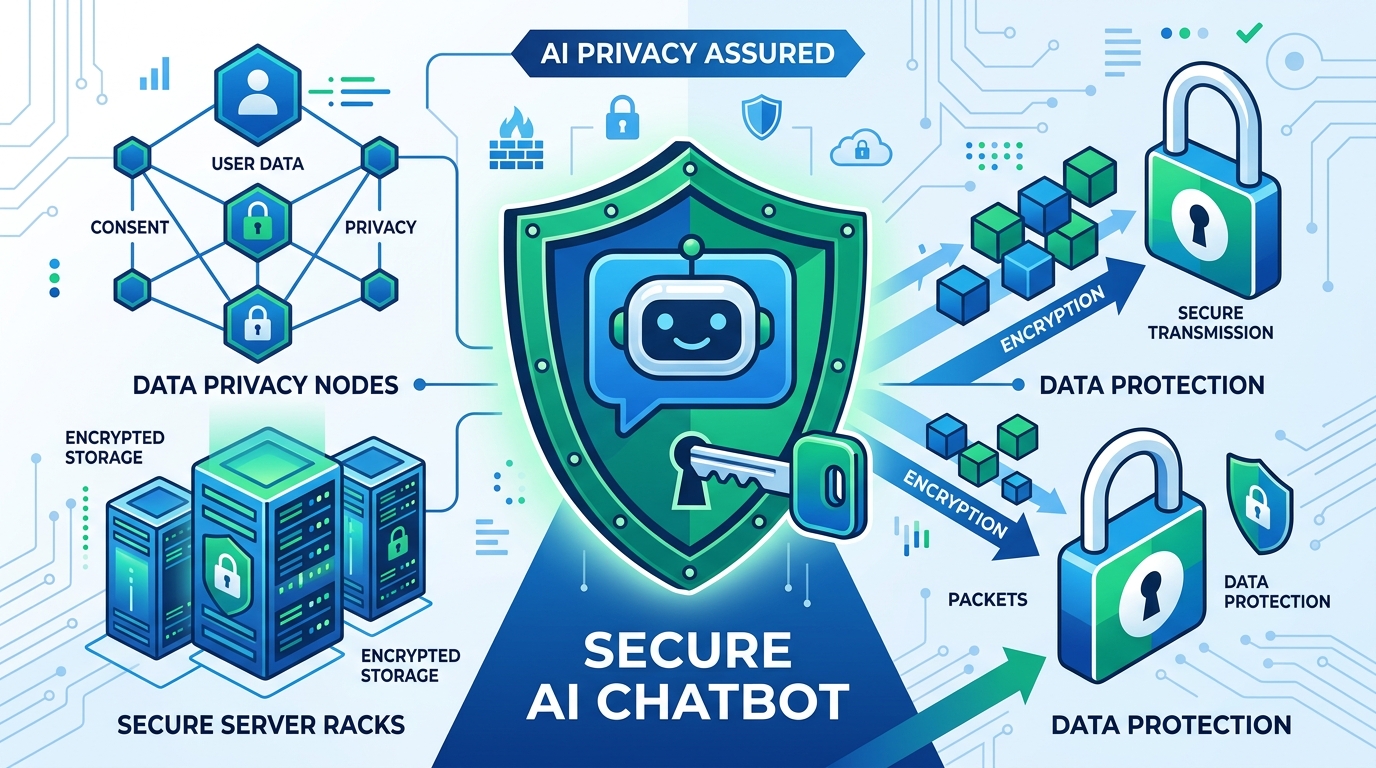
AI chatbots now sit in front of customer data, payment questions, health intake forms, and internal company knowledge — which means a chatbot’s security posture is really a data-protection posture. A single misconfigured integration or an unfiltered prompt can expose personally identifiable information (PII), violate a privacy regulation, or hand an attacker a path into backend systems. This guide breaks down the real risks behind AI chatbot deployments and the concrete practices that keep them secure, compliant, and trustworthy.
Quick answer: Secure, privacy-compliant AI chatbots are built on data minimization, encryption in transit and at rest, strict access controls, vendor due diligence, clear user consent and disclosure, defined data retention limits, and ongoing testing against known LLM-specific threats such as prompt injection and sensitive information disclosure. Compliance depends on the regulations that apply to your data — commonly GDPR, CCPA/CPRA, and, in healthcare contexts, HIPAA.
AI chatbot security spans three overlapping layers: the application layer (the chatbot interface, APIs, and integrations), the model layer (the underlying LLM and how it’s prompted, fine-tuned, or grounded with your data), and the data layer (what’s collected, where it’s stored, who can access it, and how long it’s kept). A chatbot can fail at any one of these layers even if the other two are solid — for example, a well-secured API sitting in front of a model with no output filtering can still leak sensitive data pulled from a connected database.
Privacy, by contrast, is about the rights and expectations of the people whose data the chatbot touches: what they were told, what they consented to, and what control they retain. Security failures often become privacy failures, but the reverse is also true — a chatbot can be technically secure and still violate privacy expectations if it collects more data than it discloses or retains conversations indefinitely without a stated reason.
Chatbots often capture far more than they need — full conversation transcripts, device and location metadata, and sometimes sensitive categories of data (health symptoms, financial details) volunteered by users who don’t realize they’re talking to an AI system rather than a human agent.
Most businesses don’t train their own foundation model — they call an API from a provider like OpenAI, Anthropic, or Google. That means conversation data may briefly transit or be processed by a third party under its own data-handling terms. Reviewing the provider’s data retention policy, and whether prompts are used for model training by default, is a baseline privacy step, not an optional one.
It’s common for logs to be kept indefinitely “just in case” for debugging or QA. Without a defined retention schedule, this becomes a growing liability — the longer sensitive data sits in storage, the larger the exposure if that storage is ever breached.
If your chatbot vendor, hosting region, or LLM provider processes data outside the jurisdiction your users are in, transfer mechanisms (such as GDPR-compliant Standard Contractual Clauses) may be required. This is frequently overlooked when a business adds a chatbot vendor without legal review.
The Open Worldwide Application Security Project (OWASP) maintains a dedicated Top 10 list for LLM applications, distinct from its classic web app Top 10, because generative AI introduces attack patterns that don’t exist in traditional software. The most relevant ones for customer-facing chatbots include:
For a full technical reference, OWASP publishes and updates this list at owasp.org.
| Regulation | Who It Applies To | Chatbot-Relevant Requirement |
|---|---|---|
| GDPR (EU) | Any business processing EU residents’ data | Lawful basis for processing, data minimization, breach notification within 72 hours, right to erasure |
| CCPA / CPRA (California) | Businesses meeting CA revenue/data thresholds | Disclosure of data collected, right to opt out of sale/sharing, right to delete |
| HIPAA (US) | Healthcare providers and their business associates | Chatbots touching protected health information need a signed Business Associate Agreement with the vendor |
| PCI DSS | Any chatbot handling payment card data | Card data should never be typed into or stored in chat logs; use tokenized payment links instead |
Regulatory requirements change and vary by jurisdiction and sector — confirm current obligations with legal counsel before finalizing a compliance program.
Only ask for the data the chatbot actually needs to complete a task. If an order number is enough to check shipping status, don’t also collect full name, email, and address in the same flow.
All chatbot traffic should run over TLS, and stored conversation logs, embeddings, and any connected databases should be encrypted at rest with managed key rotation.
Not every team member needs raw access to chat transcripts. Limit access by role, log every access event, and separate who can view conversation content from who can adjust the chatbot’s configuration.
Add an output-checking layer that screens for PII leakage, unexpected system-prompt disclosure, or malformed content before a response is displayed or passed into another API call.
Review the provider’s data processing agreement, default training-data usage settings, data residency options, and security certifications (such as SOC 2) before integrating.
Decide how long conversation logs are needed for support and quality purposes, document that period, and automate deletion once it expires.
Many jurisdictions and platforms — including marketplaces like Etsy — now require clear disclosure when content or interactions are AI-generated or AI-driven. Make this disclosure visible at the start of the chat, not buried in a policy page.
Refunds, account changes, medical guidance, and anything involving a vulnerable user should route to a human agent rather than being fully automated.
Run periodic red-team style tests for prompt injection, jailbreak attempts, and data-extraction prompts — not just standard penetration testing aimed at the web application layer.
Know in advance who is notified, how the chatbot is taken offline or rolled back, and how affected users are informed if the model discloses data it shouldn’t have.
Chatbots handling order status, returns, or product questions typically touch order IDs, shipping addresses, and payment status. Keep payment details out of chat entirely and route them through the platform’s own checkout or payment tools. If AI is used to generate customer-facing responses or content, check the specific marketplace’s AI-disclosure policy — these requirements have been tightening across major platforms.
Any chatbot that could touch protected health information needs a Business Associate Agreement with every vendor in the data path, plus strict access logging and a documented, minimal retention period.
Chatbots should never request or store full card numbers, account credentials, or Social Security numbers in plain chat. Use secure, tokenized hand-offs to verified systems for anything regulated under PCI DSS or similar frameworks.
Strong chatbot security isn’t only a compliance requirement — it’s a differentiator. Customers are more willing to share the information a chatbot needs (order details, preferences, contact info) when disclosure is clear, data use is limited, and the business can point to a real security process rather than a vague privacy policy. For companies deploying AI chatbots, voice agents, or workflow automation, building these controls in from the start is significantly cheaper than retrofitting them after an incident.
High Dreams LLC designs and deploys AI chatbots, voice agents, and workflow automation with security and privacy built into the architecture from day one — not bolted on afterward. Our team handles data-minimized design, encrypted integrations, access controls, and compliance-aware deployment for AI systems across e-commerce, healthcare, hospitality, and financial services clients.
Yes, if access is scoped and read-only. The chatbot should query only the specific fields it needs (such as order status) through a restricted API layer rather than having open access to the full customer database.
In most cases, yes. Your privacy policy should disclose that an AI system processes user inputs, name any third-party model provider involved, and explain how long conversation data is retained.
It’s when a user or an external piece of content tricks the chatbot into ignoring its original instructions — for example, getting it to reveal internal configuration or perform an action it wasn’t meant to allow.
It can. GDPR applies based on whether you process the personal data of people located in the EU, regardless of where your business is headquartered.
Retained chat logs are business records and can potentially be requested in legal proceedings, which is another reason to keep only what’s necessary and to define a clear retention period.