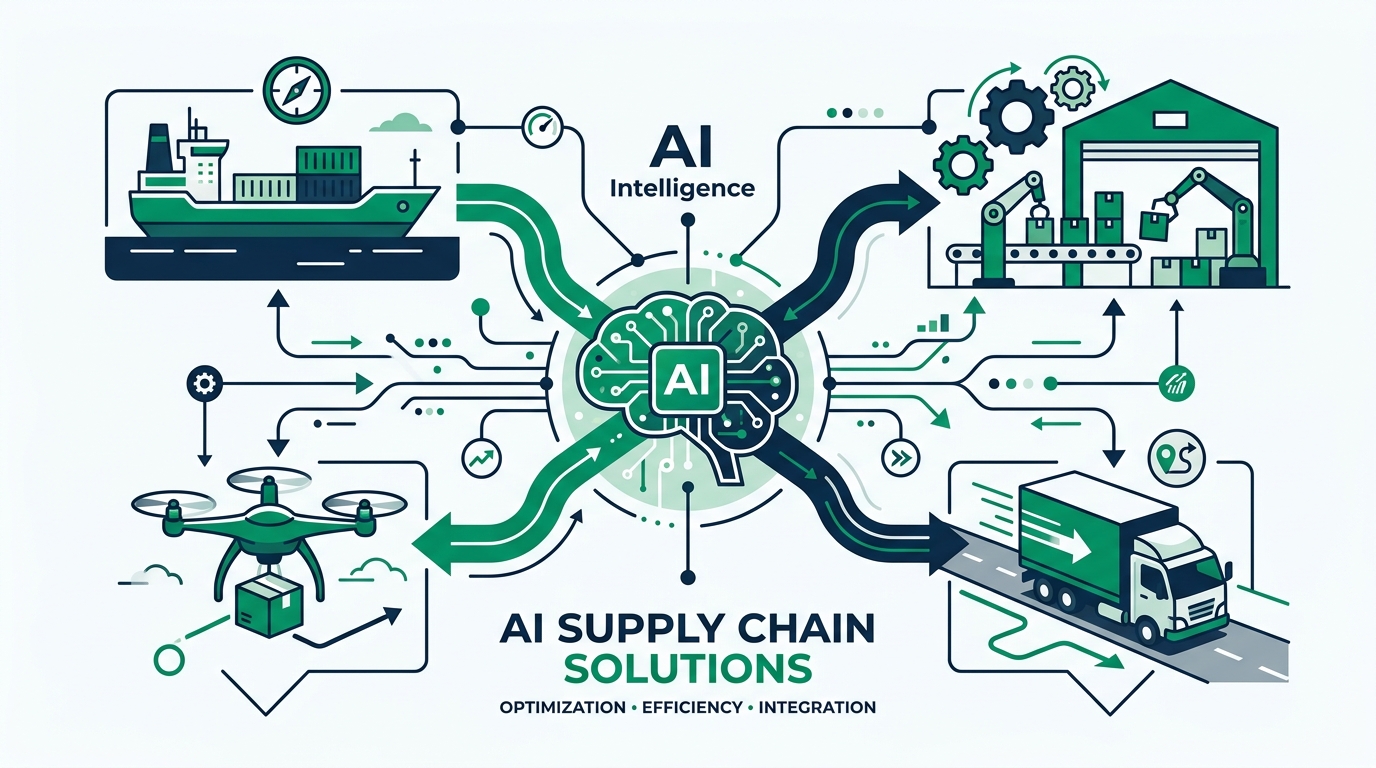
A single missed reorder point, a shipment delay no one catches until it’s too late, or a supplier issue that surfaces two weeks after it started — these are the everyday failure points that quietly drain margin out of a supply chain. AI applications are increasingly being used to close that gap, not by replacing supply chain teams, but by giving them visibility and prediction they can’t get from spreadsheets and manual reporting alone.
Quick answer: AI improves supply chain management through demand forecasting, inventory optimization, predictive maintenance, route and logistics optimization, supplier risk monitoring, warehouse automation, and real-time shipment visibility — connecting directly to the ERP, WMS, and TMS systems businesses already run on.
AI in supply chain management refers to machine learning models, predictive analytics, and intelligent automation applied to the planning, sourcing, production, and delivery functions that make up a supply chain. Rather than reacting to problems after they surface in a report, AI systems are designed to flag patterns and risks — a supplier trending toward a delay, a SKU trending toward a stockout — while there’s still time to act.
The practical value shows up less in “AI” as a headline feature and more in specific, narrow applications wired into the systems a business already uses for planning and fulfillment.
Machine learning models analyze historical sales, seasonality, promotions, and external signals to produce forecasts that adjust continuously, rather than being locked in for a quarter at a time. More accurate forecasts directly reduce both stockouts and excess inventory.
AI systems recommend reorder points and safety stock levels per SKU and per location, instead of applying a single blanket rule across an entire catalog — which is particularly valuable for businesses managing inventory across multiple marketplaces or warehouses.
For businesses running their own manufacturing or fulfillment equipment, AI models trained on sensor and performance data can flag likely equipment failures before they cause unplanned downtime.
AI-driven routing considers traffic, weather, fuel cost, and delivery windows simultaneously to plan more efficient routes than static routing rules, cutting both delivery time and freight spend.
AI systems can continuously monitor supplier performance data, news signals, and delivery history to flag a supplier trending toward risk long before a missed shipment shows up on the floor.
Computer vision and AI-guided robotics support picking, packing, and sorting accuracy, reducing manual error rates in high-volume fulfillment operations.
AI-powered tracking systems aggregate carrier data to give a single, continuously updated view of where every shipment is, replacing manual status-checking across multiple carrier portals.
AI applications deliver the most value when they’re integrated directly with the systems a business already relies on for planning and execution — ERP platforms, warehouse management systems (WMS), and transportation management systems (TMS). Rather than operating as a separate dashboard staff have to check manually, well-implemented AI tools write recommendations and alerts directly into existing workflows, so a reorder suggestion or risk flag shows up where the team is already working.
| AI Application | Replaces | Business Impact |
|---|---|---|
| Demand forecasting | Static, periodic forecasts | Fewer stockouts and less excess inventory |
| Inventory optimization | Blanket reorder rules | Lower carrying costs, higher in-stock rates |
| Predictive maintenance | Scheduled or reactive maintenance | Reduced unplanned downtime |
| Route optimization | Static routing | Lower freight cost, faster delivery |
| Supplier risk monitoring | Periodic manual review | Earlier warning on disruption risk |
| Factor | Traditional Approach | AI-Enhanced Approach |
|---|---|---|
| Forecasting method | Historical averages, manual adjustment | Continuously updated predictive models |
| Risk detection | Reactive, after disruption occurs | Proactive, pattern-based early warning |
| Data view | Siloed by department or system | Unified, connected across systems |
| Decision speed | Periodic review cycles | Near real-time recommendations |
Expert tip: The fastest, lowest-risk starting point is usually demand forecasting for a single high-volume product category. It’s easier to measure, requires less system integration than warehouse robotics or full route optimization, and the accuracy gains typically show up within the first few planning cycles.
No. Small and mid-sized businesses can apply AI to a single function, like demand forecasting or reorder recommendations, without the enterprise-wide infrastructure large logistics networks use.
No. AI is most effective as a decision-support layer that surfaces recommendations and risk flags for planners to review, rather than a fully autonomous replacement for human judgment.
At minimum, clean historical sales data, current inventory levels, and lead time data. Adding promotional calendars and external demand signals typically improves accuracy further.
It depends on the use case and data readiness, but a focused pilot, such as forecasting for one product category, often shows measurable accuracy improvement within a few planning cycles.
Yes, well-implemented AI applications are built to connect directly with existing ERP, WMS, and TMS platforms rather than operating as a separate, disconnected system.
Ready to bring AI-driven visibility and efficiency to your supply chain?
Note for publisher: the three links marked below are placeholders — verify or replace with current live post URLs before publishing, since URL verification wasn’t available for this draft.