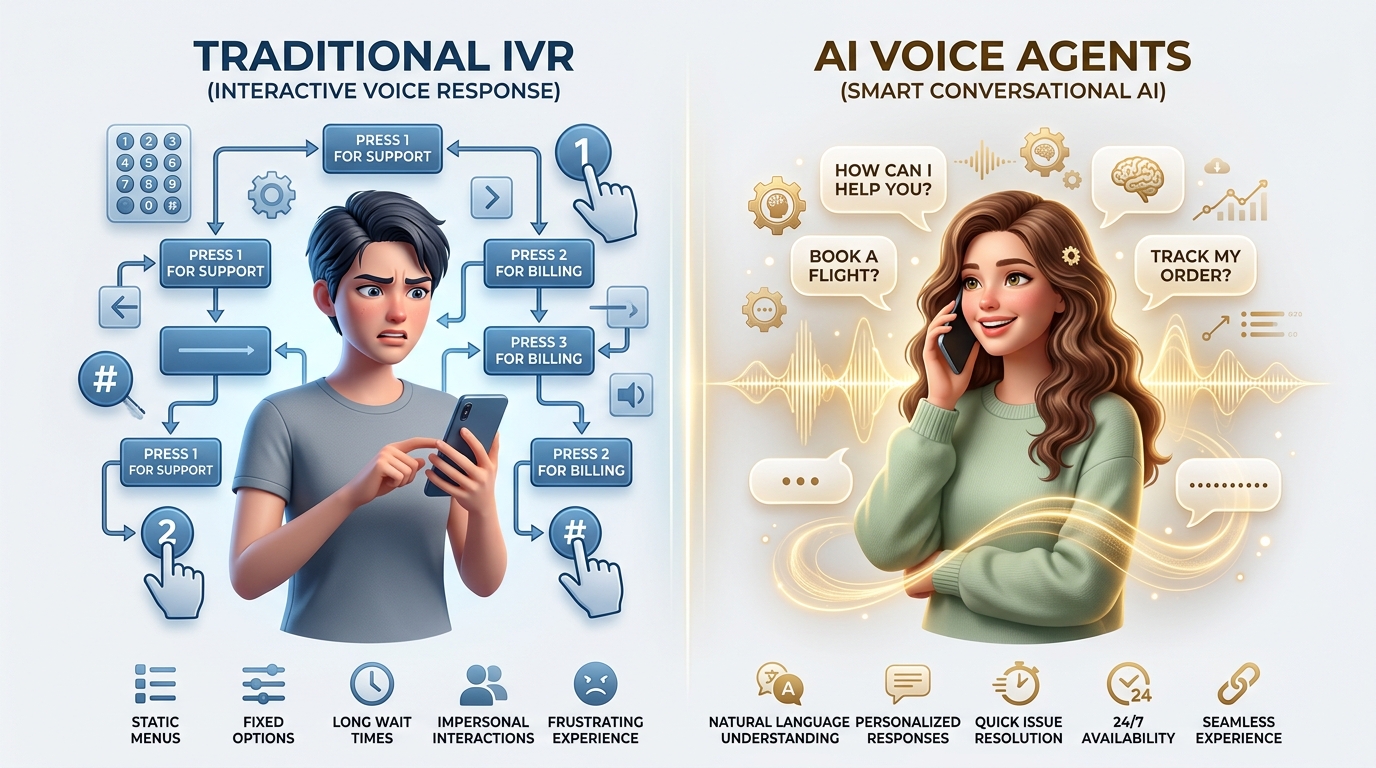
Every inbound call is either building trust in your business or quietly eroding it. Traditional Interactive Voice Response (IVR) menus have handled that job for decades — and frustrated callers for just as long. AI voice agents built on modern conversational AI are now replacing rigid phone trees with systems that actually understand what a caller is asking for. This guide breaks down how the two technologies differ, where each one still makes sense, and how to evaluate a move from IVR to an AI voice agent for your business.
Quick answer: Traditional IVR systems route callers through fixed, pre-recorded menus using keypad or basic keyword input (“Press 1 for billing”). AI voice agents use natural language understanding and speech AI to hold real conversations, answer questions in free-form language, and complete multi-step tasks — like rescheduling an appointment or checking an order status — without forcing the caller through a menu tree. The right choice depends on call complexity, budget, and how much of the interaction needs human-like flexibility.
An Interactive Voice Response (IVR) system is the automated phone menu most people grew up with. It plays pre-recorded prompts and routes the caller based on keypad tones (DTMF) or simple, rigid keyword recognition. “For sales, press 1. For support, press 2.” Traditional IVR is built on decision trees: a fixed set of branches that a caller must navigate correctly to reach the right outcome.
IVR platforms are dependable for narrow, predictable tasks — routing a call, capturing an account number, or offering a store’s hours — but they break down quickly once a caller’s need falls outside the scripted path. Anyone who has shouted “representative!” into a phone at a menu that won’t budge has felt the core limitation of legacy IVR: it can’t understand intent, only input.
An AI voice agent is a phone-based assistant powered by conversational AI: automatic speech recognition (ASR) to transcribe what the caller says, natural language understanding (NLU) or a large language model (LLM) to interpret intent, and text-to-speech (TTS) to respond in a natural voice — often in real time, with interruption handling and context retention across the whole call.
Instead of forcing a caller to match their need to a menu option, an AI voice agent lets them say what they want in plain language — “I need to move my Thursday appointment to next week” — and the system interprets the request, checks it against connected systems (a calendar, CRM, or order database), and either completes the task or hands off to a human with full context already captured.
| Capability | Traditional IVR | AI Voice Agent |
|---|---|---|
| Input method | Keypad tones or fixed keywords | Natural, free-form speech |
| Understands intent | No — matches input to a fixed branch | Yes — interprets meaning, not just keywords |
| Handles multi-step tasks | Limited, often escalates | Yes — can complete bookings, lookups, changes |
| Context retention across the call | Minimal to none | Persistent across the full conversation |
| Setup complexity | Lower — scripted menu trees | Higher upfront — requires integration and training |
| Best fit | Simple routing, hours, basic lookups | Support, scheduling, sales, complex service calls |
| Caller experience | Often rigid and repetitive | Conversational, closer to a live agent |
Modern AI voice agents are built from a stack of coordinated technologies rather than a single script:
| Industry | Common IVR Use | Where an AI Voice Agent Adds More Value |
|---|---|---|
| Healthcare | Office hours, department routing | Appointment scheduling, prescription refill requests, insurance intake |
| Home services | Basic call routing | Booking service calls, quoting, after-hours emergency triage |
| E-commerce / retail | Order status by account number | Order changes, returns initiation, product questions |
| Financial services | Balance checks, PIN reset menu | Fraud alert follow-up, payment scheduling, account questions |
| Hospitality | Reservation line routing | Booking changes, upsell offers, concierge-style requests |
Expert tip: Start with your three or four highest-volume call reasons. An AI voice agent that handles those flawlessly — and hands off everything else cleanly — usually delivers more value than one asked to do everything on day one.
Traditional IVR platforms typically carry lower setup costs since they involve recording prompts and mapping a fixed menu tree. AI voice agents involve more upfront work — conversation design, system integrations, testing across real call scenarios — which usually means a higher initial investment.
The return tends to show up differently for each. IVR mainly saves cost by deflecting simple calls from live agents. AI voice agents can do that too, but their bigger impact is often in the calls that used to go unhandled outside business hours, the tasks that previously required a callback, and the reduction in repeat calls caused by a caller giving up on a menu. When evaluating ROI, weigh setup and integration cost against staff time saved, after-hours coverage gained, and the value of not losing a caller to a competitor mid-call.
High Dreams LLC designs and builds AI voice agents, chatbots, and workflow automation systems tailored to how your business actually operates — not a generic script bolted onto your phone line. From conversation design and system integrations to ongoing tuning after launch, our team handles the technical work so your calls get resolved, not routed in circles.
No. A chatbot typically handles text-based conversations on a website or messaging app, while an AI voice agent handles spoken conversations over the phone, combining speech recognition and text-to-speech with the same underlying conversational AI.
Yes. Many businesses run a hybrid setup, using an AI voice agent to handle open-ended requests and complex tasks while keeping simple routing in place for very basic needs, then phasing out the legacy menu as confidence grows.
Not typically. The most effective deployments use AI voice agents to handle routine, repetitive calls and free up staff for complex, sensitive, or high-value conversations that benefit from a human touch.
Timelines vary based on the number of call types, the systems that need to be integrated, and how much conversation design and testing is required. Simpler, single-purpose deployments move faster than agents handling many complex workflows.
A well-designed system recognizes when it’s out of its depth and escalates to a human agent, passing along the conversation context so the caller doesn’t have to repeat information.