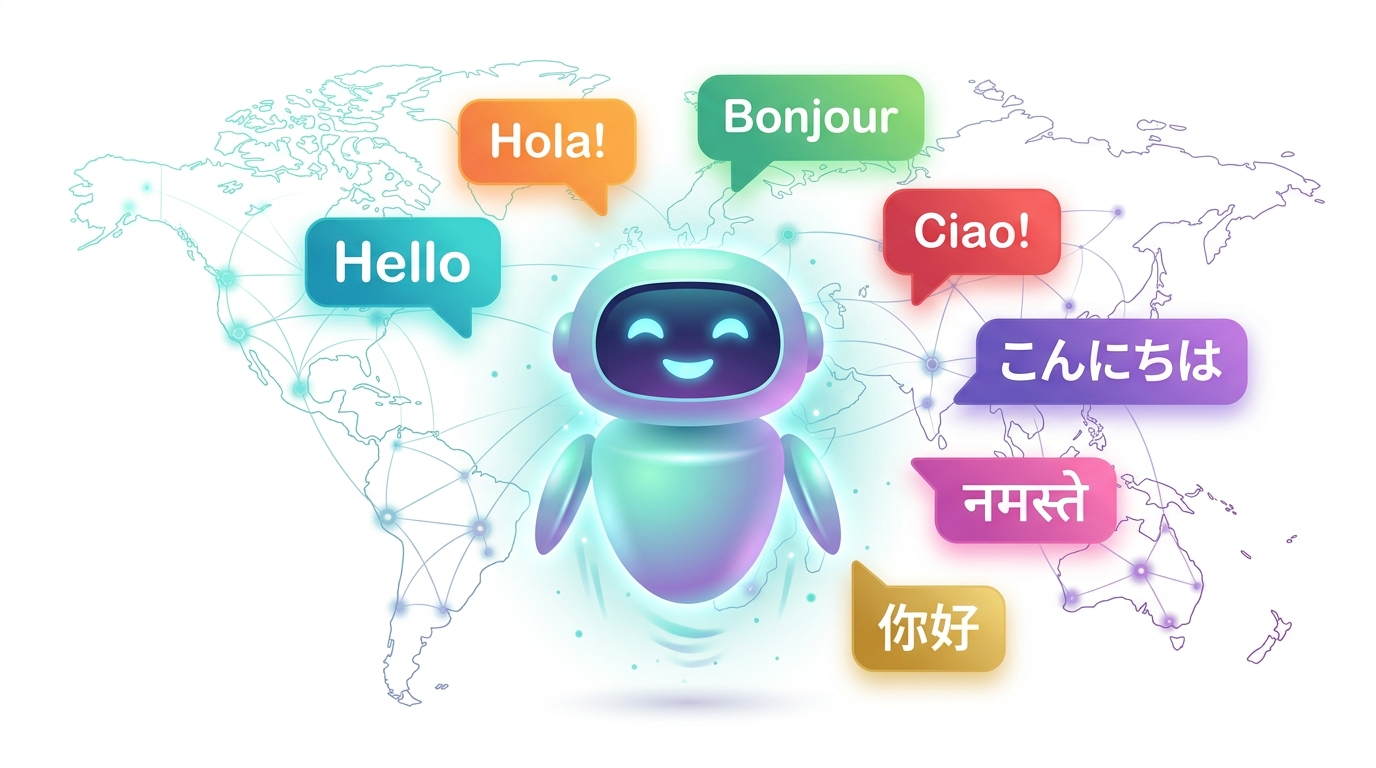
Customers don’t stop needing help just because your support team doesn’t speak their language. AI chatbots built for multilingual support close that gap — detecting a customer’s language automatically and responding fluently, without hiring a separate agent for every market you sell into. Here’s how multilingual AI chatbots work, where they deliver the most value, and how to plan a rollout that doesn’t just translate words but actually resolves issues.
Quick answer: A multilingual AI chatbot uses natural language understanding to detect the language a customer is writing in, then responds in that same language — often across dozens of languages — without needing a separately trained bot or human agent for each one. The strongest implementations go beyond translation, handling idioms, tone, and region-specific context so replies feel native rather than machine-translated.
A multilingual AI chatbot is a conversational AI system that can understand and respond in more than one language within the same conversation, automatically, without the customer having to select a language from a menu first. Unlike older bots that relied on a single language model plus a translation layer bolted on afterward, modern chatbots built on large language models can reason and generate responses natively across many languages, which tends to preserve nuance and tone far better than a translate-then-respond pipeline.
This matters most for businesses selling into multiple regions, marketplaces with international buyers, or any company whose customer base doesn’t map neatly to the languages its support team speaks.
| Benefit | Why It Matters |
|---|---|
| 24/7 coverage across time zones | International customers get answers outside your support team’s working hours |
| No per-language hiring | Expand into new markets without recruiting native-speaking agents for each one |
| Consistent brand voice | Responses follow the same policies and tone guidelines across every language |
| Faster first response | Customers get an immediate reply instead of waiting for a language-matched agent |
| Better data on global demand | Conversation logs reveal which regions and languages are generating the most support volume |
| Industry | Multilingual Chatbot Use Case |
|---|---|
| E-commerce (Amazon, Etsy, Walmart, eBay sellers) | Pre- and post-purchase questions from international buyers, order status, returns |
| SaaS & software | Onboarding and troubleshooting support for global user bases |
| Travel & hospitality | Booking questions and itinerary support for international travelers |
| Healthcare & services | Appointment scheduling and intake for non-native-speaking patients |
| Education | Admissions and student support questions across international applicant pools |
Expert tip: Start with the languages tied to your highest-volume markets, not the longest list of languages the platform supports. A chatbot that’s excellent in three languages beats one that’s mediocre in fifteen.
Multilingual AI chatbots typically cost more to configure well than a single-language bot, mainly because of the work involved in reviewing knowledge base accuracy and tone across each supported language — not because the underlying AI charges more per language. Budget for an initial content and QA pass per market, plus ongoing monitoring, rather than treating “add a language” as a one-click toggle.
High Dreams LLC builds AI chatbots configured for the languages your customers actually use, grounded in your real policies and product content rather than generic translation. From language prioritization and knowledge base setup to escalation design and post-launch monitoring, we handle the full rollout so support feels native in every market you serve.
It varies by platform and the quality of the underlying language model, but many modern AI chatbots can support dozens of languages. Quality tends to be strongest in widely-used languages with more available training data.
Ideally, yes — an accurate, up-to-date knowledge base in each supported language produces far more reliable answers than relying on the bot to translate a single source on the fly.
Occasionally, especially with very short messages, mixed-language text, or heavy slang. Well-configured bots allow a customer to manually switch languages if detection gets it wrong.
They serve different purposes. A chatbot scales instant coverage across many languages and time zones, while bilingual staff are often better suited to complex, sensitive, or high-value conversations. Many businesses use both together.
Timelines depend on how many languages are launched at once and how much knowledge base preparation is needed. Starting with two or three priority languages is typically faster than a simultaneous full rollout.