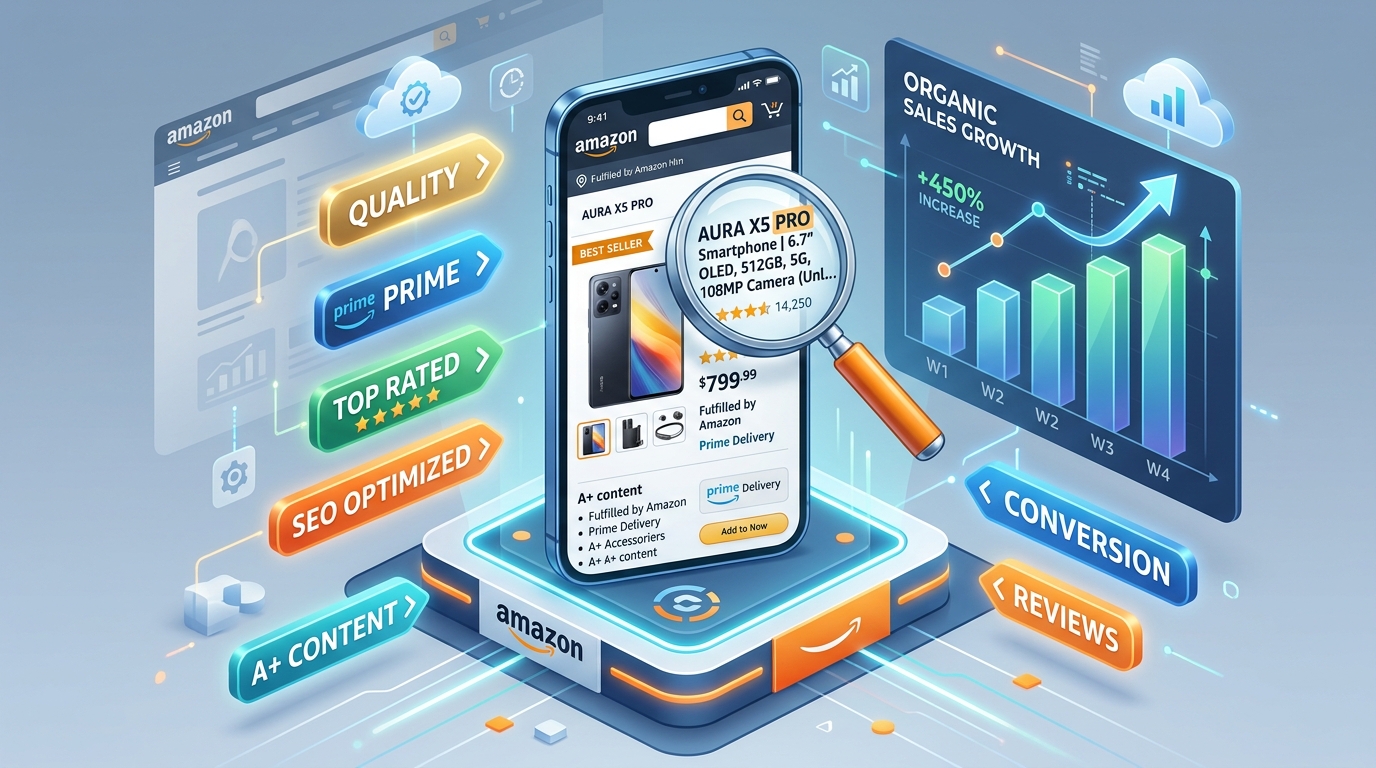
Quick answer: Amazon’s ranking system (commonly called A9/A10) rewards listings that combine strong keyword relevance with strong sales performance. To rank higher organically, you need to align your title, bullet points, backend search terms, and images with real buyer search language, then back that relevance up with a conversion rate, click-through rate, and review profile that shows Amazon your listing satisfies shoppers. Optimization is not a one-time task — it is an ongoing cycle of research, testing, and refinement.
Most shoppers on Amazon never scroll past the first page of search results, and a large share of purchases happen from the first few organic listings they see. That makes your product’s position in Amazon’s search results one of the single biggest levers on revenue — often more important than the product itself, since even a great product can underperform if shoppers never find it.
Unlike Google, Amazon’s algorithm is built around one primary goal: helping the platform sell more products. That means Amazon does not just reward keyword relevance — it rewards listings that convert browsers into buyers. Understanding this dual focus is the foundation of any effective Amazon SEO strategy.
Amazon’s search and ranking system is frequently referred to as A9, with more recent updates sometimes described as A10. While Amazon does not publish the exact formula, sellers and researchers generally agree the algorithm weighs two broad categories of signals:
Relevance gets your listing shown. Performance keeps it ranked. Sellers who focus only on stuffing keywords into a listing while ignoring conversion elements — images, pricing, reviews — typically see rankings stall or decline over time.
Your title is the single most heavily weighted field for keyword relevance. Lead with your most important keyword phrase, followed by brand, key attributes (size, color, quantity), and a clear description of what the product is. Avoid keyword stuffing — titles that read as unnatural strings of keywords can hurt both conversion and how Amazon’s algorithm parses relevance.
Bullet points are prime real estate for both secondary keywords and conversion copy. Each bullet should lead with a benefit or use case, then support it with a feature. Front-load the most persuasive and most searched points first, since many shoppers only skim the first two or three bullets.
Amazon gives sellers a hidden backend search terms field. Use it for synonyms, misspellings, alternate phrasing, and relevant terms that don’t fit naturally into your visible copy. Never repeat words already used in your title or bullets — Amazon indexes them once regardless of repetition, so repeating wastes limited character space.
If you’re brand registered, A+ Content (Enhanced Brand Content) lets you replace the plain-text description with rich modules — comparison charts, lifestyle imagery, and brand story sections. Beyond the conversion benefit, a complete description or A+ module gives Amazon more indexable text tied to your listing.
Images don’t carry keyword weight directly, but they are one of the strongest conversion levers on the page, and conversion rate feeds directly back into ranking. Use a mix of studio product shots, lifestyle context images, infographic-style callouts, and — where possible — a short product video.
| Listing Element | Primary Role | Optimization Focus |
|---|---|---|
| Title | Relevance | Primary keyword + core attributes |
| Bullet Points | Relevance + Conversion | Secondary keywords, benefits, objections |
| Backend Search Terms | Relevance | Synonyms, misspellings, hidden variants |
| Images / Video | Conversion | Clarity, lifestyle context, trust signals |
| A+ Content | Conversion + Relevance | Brand story, comparison, extra indexable text |
| Reviews / Ratings | Trust + Performance | Volume, recency, average rating |
Amazon keyword research differs from Google keyword research because every query on Amazon carries commercial intent — shoppers are already searching to buy, not to learn. Effective research typically combines several approaches:
Group your keywords by search intent — broad category terms, specific feature terms, and long-tail buyer-intent phrases — and make sure your highest-intent terms appear in the title and first bullet point.
Because Amazon’s algorithm weighs performance as heavily as relevance, a listing that ranks well on keywords but converts poorly will typically lose position over time to a better-converting competitor. Key conversion levers include:
Amazon listing optimization is research-intensive and ongoing — new competitors enter, search terms shift with seasonality, and performance data needs regular review. This is where workflow automation and AI tooling increasingly support sellers and agencies managing multiple listings or storefronts:
Sellers managing a growing catalog often find that manual listing management becomes a bottleneck well before the product line itself does — which is why many turn to dedicated e-commerce management and automation support.
High Dreams LLC helps sellers build, optimize, and automate their e-commerce operations across Amazon, Walmart, Etsy, and eBay — from listing SEO to AI-driven workflow support.
High Dreams LLC is a Colorado-based AI and digital growth agency led by CEO Imran Sohail, offering a full stack of services built for modern e-commerce and service businesses:
Rather than treating SEO, automation, and customer experience as separate projects, High Dreams LLC connects them so sellers get a system that compounds over time instead of a one-off fix.
It varies by category, competition, and how much sales history the listing already has, but most sellers begin seeing measurable movement within a few weeks of consistent optimization and sales activity, since Amazon needs time to gather new performance data.
Yes. Backend search terms are indexed by Amazon even though shoppers never see them, so they extend your keyword relevance without cluttering your visible copy. They should be used for terms you can’t naturally fit into the title, bullets, or description.
Yes, though Amazon PPC can accelerate the process by driving early sales velocity and click-through data. Strong organic fundamentals — relevant copy, good images, competitive pricing, and reviews — remain the foundation regardless of ad spend.
Treat it as an ongoing process rather than a one-time setup. Reviewing keyword performance, competitor changes, and conversion metrics on a regular cadence — and adjusting copy, images, or pricing accordingly — tends to produce better long-term results than a single optimization pass.