The order came in. The money is there. But the day is gone. For most small sellers, every order takes a little longer than it should. This guide breaks fulfilment into five steps and shows how to time each one, find the slowest, and fix it first.
For most small sellers the slowest fulfilment step is not shipping — it is picking, packing, or answering order messages, because those steps repeat on every order and have no fixed routine. Time the five steps for one week, fix the slowest first, and the whole store gets faster without hiring anyone.
In this guide
Marketplace fees and shipping options change from time to time, so this article quotes no exact rates — confirm current details in your marketplace account.
Every hour spent on orders is an hour not spent on listings, pricing, or new products. That is the real cost of slow fulfilment — it never appears on an invoice.
The profit guide showed that a sale is only profitable after every cost is counted — and time belongs in that count. An order taking 25 minutes costs more than twice as much of your day as one taking 10.
A store behind on orders is behind on everything else. The returns guide showed what happens when a rushed order goes out wrong — a return, a reship, and a message thread.
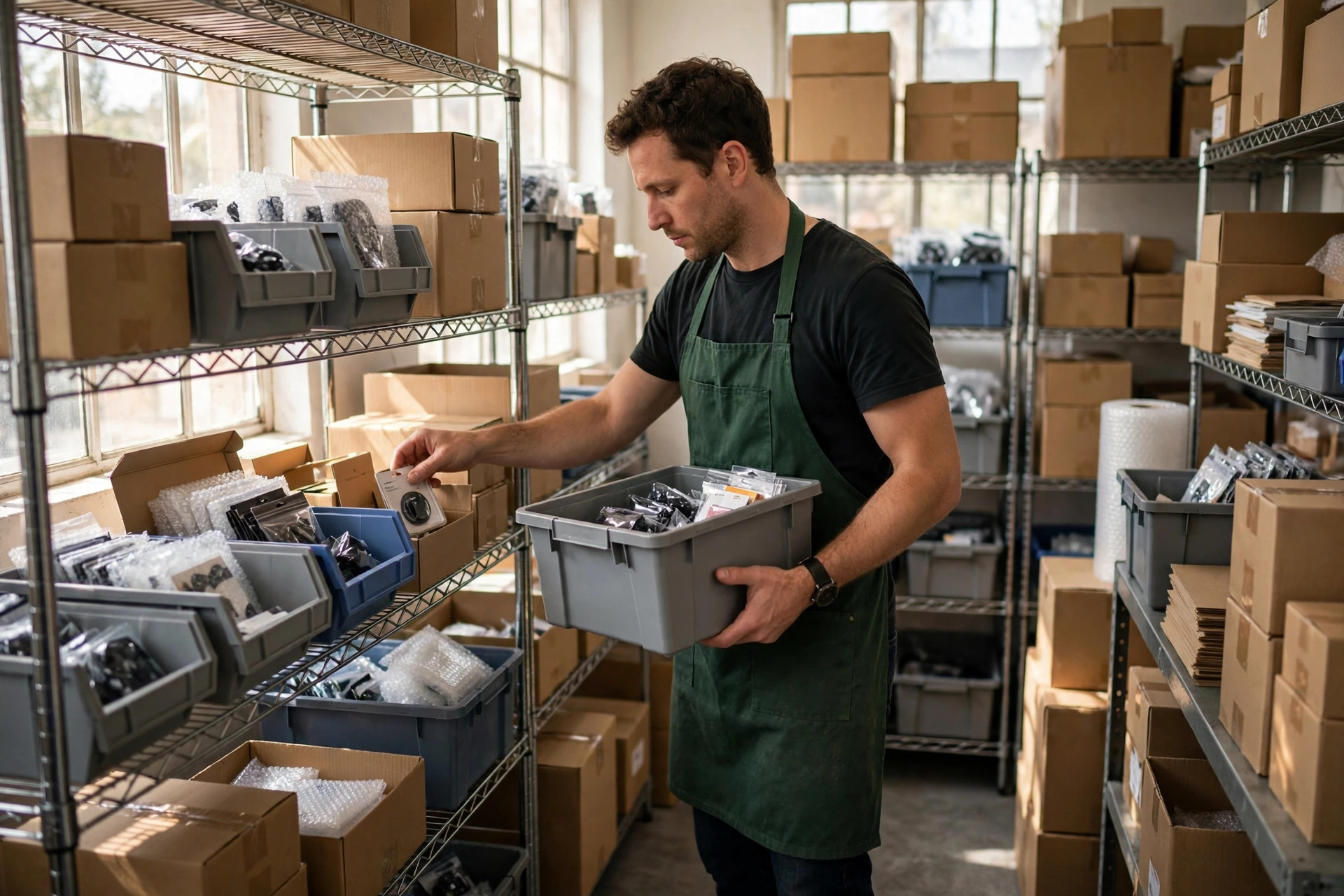
Picking is finding the item and getting it to the packing table. It becomes the slowest step the moment stock has no fixed place.
Pick one labelled place for each best-seller and keep it there. Put the fastest sellers closest to the packing table, at waist height. Slow sellers can live further away.
Picking one order at a time means walking the same shelves five times. Pick in batches: list the morning’s items once and pick them all in one walk. A short pick list — item, quantity, shelf — stops the second trip back.
Packing is slow when every order is packed differently. The fix is to make packing boring — the same routine, every time.
Keep three box sizes, not ten — small, medium, large — with a rule for which goes where. Fewer sizes mean fewer decisions. Two mailer sizes cover most small orders.
A packing station is a table with everything within arm’s reach: boxes, tape, scissors, labels, inserts, and a pen. If you leave the table to fetch something, it belongs on the table. Tape a one-page check above it — item, quantity, insert, seal.
Labelling is where a small mistake becomes an expensive one: one wrong address costs a return, a reship, and a message thread. Check once, properly, and never rework a label.
Printing one label at a time means opening the same screen five times a day. Print in a batch instead — morning orders in the morning, the rest in the afternoon. Batching turns five interruptions into one short task.
Before you print, read the address on the order and on the label side by side. One slow check beats a fast check done twice. Where it fits, use the marketplace’s own label flow: the address comes straight from the order.
For dropshipping, the slowest part is usually not in your hands — it is the wait for the supplier to dispatch. The fix is a clearer handover, not faster hands.
Nothing slows a dropship order like selling an item the supplier no longer has. Use the stock check before the listing goes live, and re-check best-sellers regularly. Selling what you cannot supply costs the sale and the buyer’s trust.
Ask the supplier for a dispatch window in writing: orders before a certain time go out the same day, the rest go out the next. Put the honest delivery window on the listing — buyers forgive a five-day wait they expected, not a two-day wait that turns into five.
Most buyer messages are fulfilment messages: “where is my order?”, “when will it arrive?”, “did you send it yet?” Each one means the buyer did not get the information in time. Stopping them from arriving beats answering them one by one.
The most effective message is the tracking message, sent early, on every order. Once the parcel is handed over, the buyer should have the tracking number and the expected window. One message on time replaces a whole thread.
Most buyer questions are the same five: where is my order, when will it arrive, address changes, cancellations, and returns. Write one short reply for each, kept where you can copy it in seconds. A damaged parcel, a wrong item, or an upset buyer needs a person, not a template — answer those yourself and say what you will do.

You cannot fix what you have not measured, and guessing the slowest step is how most sellers fix the wrong one. The audit takes one week and ten orders — the only part of this guide that asks you to write anything down.
For one week, time each step on ten orders: picking, packing, labelling, and messages. The supplier wait is the supplier’s time, not yours — note it separately. A phone timer and a notebook are enough.
The example below is illustrative only, with round numbers chosen to show the maths. It is not data from any real store.
Ten orders in a week. Picking took 6 minutes per order, packing 4, labelling 2, and messages 5 — 60, 40, 20, and 50 minutes, 170 in all. Picking and messages together were 110 of those 170. The fix is obvious: fixed shelf spots, and tracking sent early on every order.
Add the times up, name the slowest step, and fix only that one. Do not fix all five at once — a store that changes everything learns nothing. Fix it, run the audit again next week, and repeat until no single step dominates.

The table below sums up the five steps, what slows each one down, and the first fix to try.
| Step | What slows it down | First fix |
|---|---|---|
| Picking | No fixed spot for stock | One fixed place per best-seller |
| Packing | A different pack every time | Standard boxes + set routine |
| Label and ship | Wrong address, rework | Batch labels, one address check |
| Supplier wait | Unclear dispatch time | Agree it up front, tell the buyer |
| Buyer messages | Late or missing tracking | Send tracking early, once |
Run this checklist once, then keep it on the packing table until the audit becomes a habit.
“The slowest step is never the one you think it is. Time it, and it tells you itself.”
Fulfilment is not a separate job from the rest of the store — it is where listing, pricing, and returns all show up. High Dreams LLC helps sellers with store setup, product listing, and store management on Amazon, eBay, and Etsy, and fulfilment is checked as part of every one of those services. When we review a store, we time the five steps with the seller — a store losing two hours a day to picking usually needs shelf spots and a pick list.
High Dreams LLC manages Amazon, eBay, and Etsy stores for sellers who want the work done properly: listings, pricing, returns, ads, and the order handling that sits behind all of them. We check fulfilment against real marketplace steps and buyer behaviour, not a generic template — so the fix fits the store it is fixing.
Which step is slowest for most sellers?
Usually picking or packing, because they repeat on every order; dropshippers feel the supplier wait most.
Should I hire help for fulfilment?
Only after the routine is fixed: hiring into a messy process just pays someone else to be slow.
How do I speed up picking without new software?
Fixed spots, batch picking, and a short pick list per order.
What if my supplier is the slow part?
Agree a dispatch window, confirm stock where possible, and set honest expectations.
Can High Dreams LLC look at my fulfilment?
Yes: message the page for a free store check covering listings, pricing, returns, and order handling.
Fulfilment is five steps, and one of them is eating your day. Time them for one week and fix the slowest first — or message the page for a free store check, and we will time your five steps together.
Related Reading: Read our guide to e-commerce profit tracking: the 5 numbers every seller should check weekly, our guide to e-commerce returns on Amazon, eBay, and Etsy, and our guide to e-commerce pricing mistakes that eat your profit.