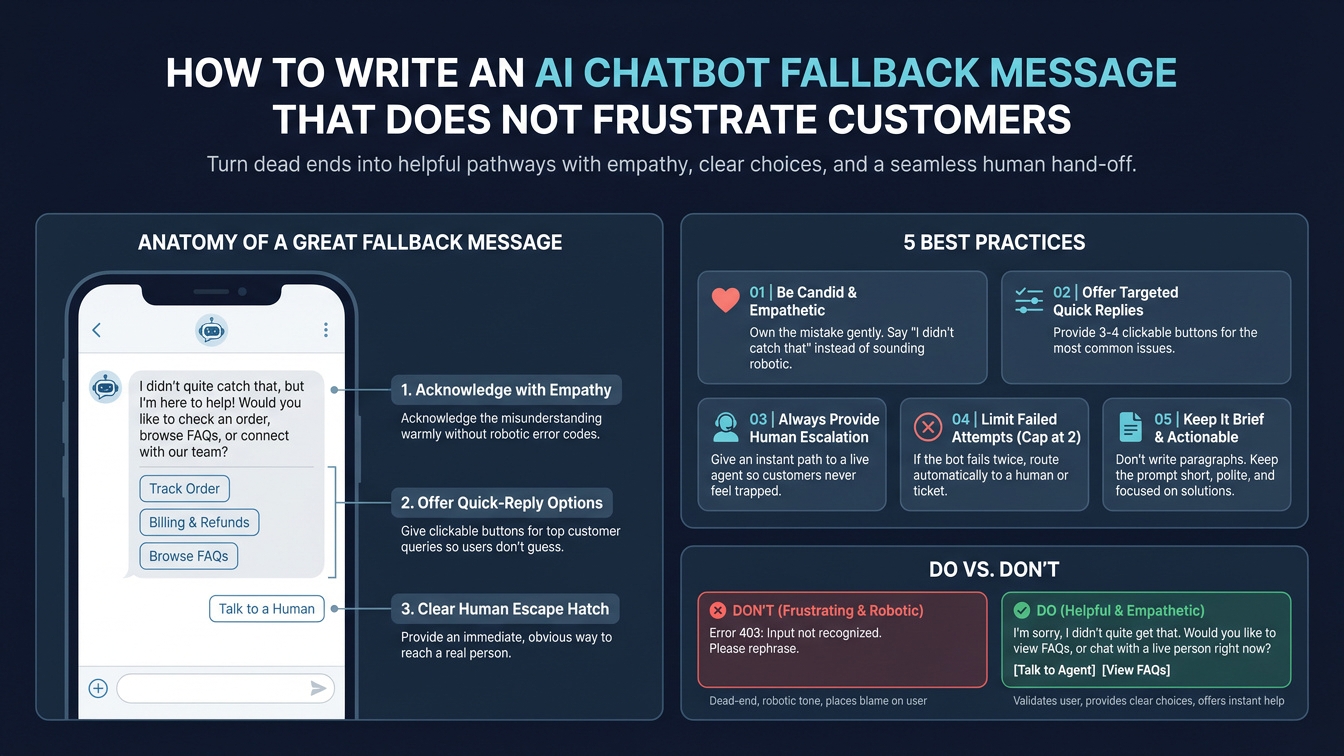
A good chatbot fallback message owns the miss, says what the bot can do, and offers a clear next step, such as buttons, a rephrase tip, or a handoff to a person. Never blame the customer, repeat the same line, or guess an answer. First, vary the message. Next, offer options. After about three misses, hand off to a human.
Customers rarely remember the ten questions your bot answered well. They remember the one it fumbled. That moment is the fallback.
A weak chatbot fallback message says “Sorry, I didn’t understand” and stops. A strong chatbot fallback message keeps the conversation moving. This guide gives you a formula, 12 copy-paste templates, and the rules that keep your bot honest.

A chatbot fallback message is the reply your bot sends when it cannot answer. Sometimes it did not understand. Sometimes the question is out of scope. Sometimes something broke.
Each case needs a different response. Microsoft’s error-handling guidance treats misunderstandings and technical errors as separate problems, and it suggests asking for a rephrase when the bot cannot interpret an input.
| Situation | Goal of the fallback | Direction |
|---|---|---|
| The bot did not understand | Get a clearer request | Ask for a rephrase, or show options |
| The request is out of scope | Set expectations | Say what you cannot do, then what you can |
| The bot is not confident | Avoid a wrong answer | Link to the source, or offer a person |
| The topic is sensitive | Protect the customer | Hand off to a human quickly |
| A technical error happened | Keep trust | Say it is not their fault, then give another route |
Because the situations differ, one message cannot cover them all. So build a small set of messages, not a single catch-all.
Most frustration comes from four habits.
That case study is a practitioner’s account, not a controlled study. Still, the pattern matches what Microsoft recommends: give people a way forward.
A good chatbot fallback message shares five parts. You do not need all five every time, but the first three should almost always appear.
| Part | What it does | Example |
|---|---|---|
| 1. Acknowledge | Owns the miss without blaming the customer | “Sorry, I did not catch that.” |
| 2. Clarify | Says what the bot can help with | “I can help with orders, returns, and store hours.” |
| 3. Offer a next step | Gives buttons or a rephrase tip | “Pick one below, or try a few key words.” |
| 4. Offer a human | Provides an exit before frustration builds | “Or I can connect you with a team member.” |
| 5. Stay short | Keeps it readable on a phone | Aim for two short sentences or fewer |
Microsoft’s guidance on graceful fallbacks gives a similar pattern. Its examples say what the agent can help with, such as “I can help you with X or Y,” instead of only saying it failed.
Replace the brackets with your own details. Adjust the tone to match your brand. Then test each one before it goes live.
| # | Situation | Template (edit the brackets) |
|---|---|---|
| 1 | First miss: ask to rephrase | Sorry, I did not catch that. Could you say it another way? |
| 2 | First miss: show options | I am not sure I understood. I can help with [orders], [returns], or [store hours]. Which is closest? |
| 3 | First miss: keyword tip | I am having trouble with that one. Try a few key words, like “track order” or “return item.” |
| 4 | Second miss: buttons | Still not getting it, sorry. Pick one and I will take it from there: [Button A] [Button B] [Button C]. |
| 5 | Second miss: narrow it down | Let us narrow it down. Is this about an order you already placed, or something you want to buy? |
| 6 | Third miss: offer a person | This one needs a person. I can connect you with a team member. [Talk to a person] |
| 7 | Handoff with timing | Connecting you now. Our team is available [hours]. Outside those hours, leave your email and we will reply by [time]. |
| 8 | Handoff with context | I will pass along what you told me, so you do not have to repeat it. |
| 9 | Out of scope | I cannot help with [topic]. For that, please [contact or link]. I can help with [X] and [Y]. |
| 10 | Sensitive topic | A person should handle this. Please contact [team or number]. I cannot give advice on this topic. |
| 11 | Technical error | Something went wrong on our side, not yours. Please try again in a moment, or reach us at [contact]. |
| 12 | Low confidence | I am not certain about this. Here is what our [policy page] says: [link]. A team member can confirm if you like. |
Each chatbot fallback message above makes a few choices on purpose. Templates 1 to 3 differ, so repeat misses do not sound robotic. Template 12 never guesses. It points to the source and offers a person. That protects both the customer and you.
A simple structure keeps your messages from looping. One practitioner describes a “3 strikes” pattern: the bot tries a different recovery each time, then resets the count. Here is a version of the chatbot fallback message path you can use:
Three is a convention, not a law. If your questions are complex or high stakes, hand off after two. If your bot handles simple tasks, you might allow a fourth try. Review your logs and adjust.
Sometimes the best chatbot fallback message is a handoff. Hand off to a human when any of these happen:
| Trigger | Why it matters |
|---|---|
| Three misses in a row | More tries usually add frustration, not progress. |
| The customer asks for a person | Respect the request right away. |
| Payment, refund, or billing disputes | Mistakes here cost money and trust. |
| Health, legal, or safety topics | A bot should not give advice here. |
| Angry or urgent language | A human can calm and prioritize. |
| The bot would have to guess a policy | A wrong answer can create real liability. |
When you hand off, say what is happening. Infobip’s chatbot design guidelines suggests short status lines like “I am checking if an agent is available.” Also tell the customer what happens after hours. Otherwise they wait for a reply that never comes.
Human backup matters for every bot. Our AI chatbot vs live chat comparison explains how the two work together.
Two legal points shape what your messages should say. These are general facts, not legal advice.
In the EU, Article 50 of the AI Act has applied since August 2, 2026. According to the European Commission’s Article 50 FAQ, people must be informed when they are interacting with an AI system, unless that is obvious. the text of Article 50 says the information must be clear and given at the latest at the first interaction.
The duty to design for this falls on the provider of the AI system. If you buy a chatbot tool, ask your vendor how it handles disclosure. Even where the law does not require it, a one-line opener such as “I’m an AI assistant” builds trust.
In Moffatt v. Air Canada, a British Columbia tribunal found the airline liable after its chatbot gave wrong information about bereavement fares. a summary from the American Bar Association reports that the tribunal treated the chatbot as part of the company’s website, so the company was responsible for what it said.
The lesson is clear. When the bot is unsure about a policy, price, or deadline, the fallback should link to the official page or hand off. It should not improvise.
Follow these steps to put your chatbot fallback message together.
The last step pays off the most. Microsoft’s Fallback topic guide advises tracking what customers say that does not trigger a standard topic, then using those phrases to improve existing topics or create new ones. In short, every fallback is free training data.
Run these tests on every chatbot fallback message before launch, and again after every change.
| Test | How to run it | Pass looks like |
|---|---|---|
| Nonsense input | Type random letters. | A short, calm fallback with options |
| Repeated miss | Fail three times in a row. | A different message each time, then a handoff |
| Out-of-scope question | Ask something you do not cover. | A clear “cannot help” plus a next step |
| Policy question | Ask about a refund or fee. | A link or a handoff, not a guess |
| Mobile view | Test on a phone. | Buttons are tappable and text fits |
| After hours | Request a human at night. | Clear hours and a way to leave contact details |
Ask a colleague to try it without help. They will find dead ends you no longer see.
Most problems with a chatbot fallback message come from the same few habits. Check your own bot against this list.
| Mistake | Better approach |
|---|---|
| Repeating the same “I did not understand” line | Change the message each time and add options. |
| Blaming the customer (“Invalid input”) | Own the miss: “I did not catch that.” |
| Offering a generic menu every time | Show the closest matching options. |
| Hiding the human option | Offer a person by the third miss. |
| Guessing a policy or price | Link to the source or hand off. |
| Never reading the logs | Review unrecognized messages every week. |
Fall back to order tracking, returns, and a person for refunds. See our guide on AI chatbots and cart abandonment.
Send sensitive questions straight to staff. Read our post on AI voice agents in healthcare clinics.
Offer hours, menus, and a booking link when a question is unclear. See AI voice agents for restaurants.
Route admissions and fee questions to staff. Read about an AI chatbot for educational institutions.
High Dreams LLC builds AI chatbots and voice agents with clear fallbacks and human handoff built in. Tell us what your customers ask most.
High Dreams LLC is a Colorado-based AI and digital growth agency focused on practical AI for business. The team builds AI chatbots, voice agents, workflow automation, websites, apps, and e-commerce systems. Each project starts with the workflow a business actually needs, and human escalation is built in from the start.
It is the reply a chatbot sends when it cannot understand or answer a request. A good one admits the miss, says what the bot can help with, and gives a next step, such as buttons or a handoff to a person.
Many designers use about three tries: rephrase, then options, then a person. That is a convention, not a rule. For sensitive or high-value topics, hand off sooner.
Yes, briefly and once. Then move to help. A long apology with no next step is a dead end, which Microsoft’s guidance warns against.
In the EU, Article 50 of the AI Act has applied since August 2, 2026 and requires that people be informed they are interacting with AI, unless that is obvious. Rules elsewhere vary. Ask your vendor and a legal professional, and consider disclosing anyway.
It should not guess on policies, prices, or deadlines. In Moffatt v. Air Canada, a tribunal held the airline responsible for wrong information from its chatbot. Link to the official source or hand off instead.
Review the messages the bot missed each week. Microsoft advises using those phrases to improve existing topics or build new ones. Then retest your fallback paths.
You cannot stop a chatbot from missing. You can decide what happens next. Own the miss, offer a path, and bring in a person before frustration builds.
Start with the 12 chatbot fallback message templates, set a three-strike path, and read your logs every week. Small fixes there make the whole chatbot feel smarter.
Laws and platform guidance change often. Details reflect pages retrieved on November 25, 2026. This article is general information, not legal advice. The three-strike rule and the template wording are suggestions, not standards. High Dreams LLC is not affiliated with Microsoft, the European Commission, or Air Canada.