
A seller lists 200 products on eBay in January 2026. By March, only 11 have sold.
Another seller launches with just 30 carefully selected listings. By the end of the same quarter, they’ve crossed six figures in revenue.
Same marketplace. Same economy. Completely different outcomes.
The difference is no longer about “working harder” or simply uploading more products. In 2026, eBay has evolved into a highly algorithm-driven marketplace where visibility, trust signals, fulfillment speed, pricing intelligence, and listing quality determine who wins.
This is a major shift.
Years ago, success on eBay was relatively straightforward: list an item, choose a competitive price, wait for buyers. Today, the platform behaves more like a search engine combined with a retail recommendation engine. Buyers expect Amazon-level shipping, Google-level search relevance, and TikTok-level visual engagement.
That means sellers face three major pressures:
At the same time, new technologies are creating opportunities. AI-driven repricing, predictive demand analysis, automation workflows, and listing optimization tools are enabling smaller sellers to outperform much larger competitors.
This creates a new reality:
The sellers who thrive in 2026 are not necessarily those with the biggest inventory. They are the ones with the smartest systems.
Whether you are:
Your strategy matters more than ever.
This guide breaks down the most effective eBay selling strategies for 2026—from search ranking optimization and product selection to pricing, fulfillment, automation, and AI-driven scaling.
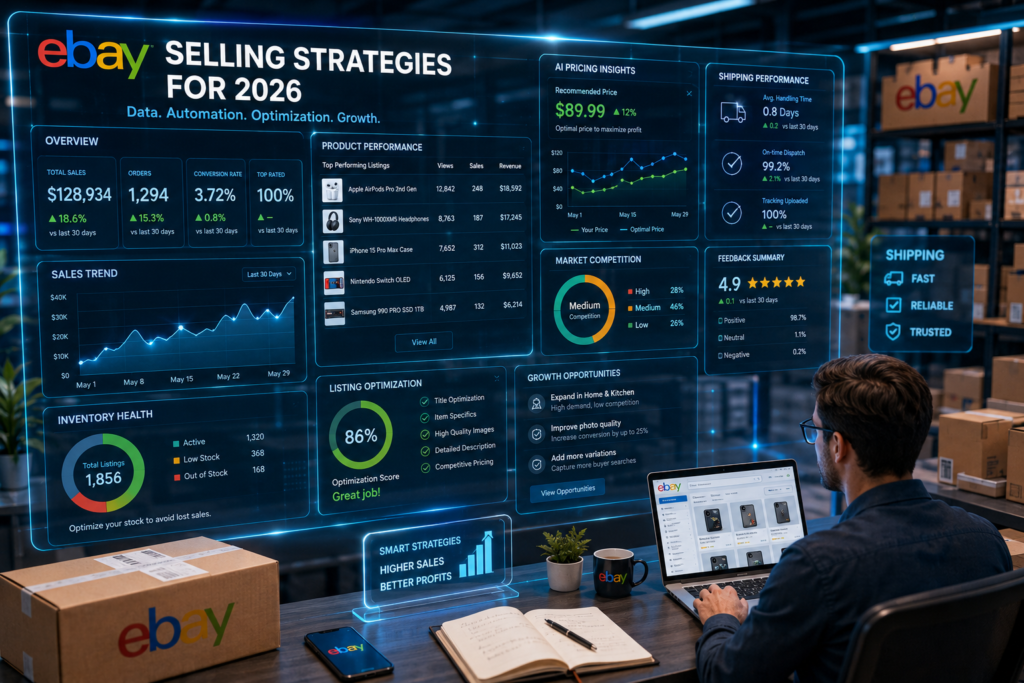
Global e-commerce continues to accelerate, and online marketplaces remain a dominant sales channel.
eBay still serves millions of active buyers and remains especially strong in categories such as:
⚠️ Risk: HighRising Competition — More sellers means reduced visibility.
📈 Trend AnalysisAI Pricing Wars — Dynamic repricers are changing profit margins. Prices now shift multiple times daily in competitive niches.
📊 Industry Impact Buyer Expectations — Consumers now expect fast shipping, free returns, professional packaging, and high-resolution images. Poor UX directly lowers conversion.
Poor strategy causes:
Strong strategy creates:
“Winning on eBay in 2026 isn’t about listing more products—it’s about making every listing more discoverable, trustworthy, and profitable.”
| Strategy | Beginner Impact | Advanced Impact | Priority |
|---|---|---|---|
| Product Research | High | High | Critical |
| SEO Optimization | High | High | Critical |
| Fast Shipping | Medium | High | Critical |
| AI Pricing | Low | High | Important |
| Automation | Medium | High | Important |
Many sellers choose products based on personal preference rather than market demand.
Beginners often assume “popular” means profitable.
⚠️ Risk: High
Use data-driven product selection. Target products with:
Research:
Use:
A seller chooses generic USB cables. Competition: Massive. Margins: Tiny. Instead, they pivot to premium braided USB-C gaming cables. Result: less competition, higher margin, better conversion.
✅ Best Practice Sell differentiated products.
Great products remain invisible.
Listings lack keyword optimization. eBay’s Cassini search engine ranks listings using relevance, sales velocity, CTR, seller metrics, and conversion rate.
🔒 Search Ranking Control
Poor SEO causes low impressions.
Optimize listing structure.
High-Converting Title Formula: Brand + Product + Key Feature + Size + Color + Benefit
Example:
Include main keyword, buyer intent terms, and product specifics.
🧠 Expert Insight Keywords drive discovery. Adding “Waterproof” increased clicks by 19% for one electronics seller.
| Element | Poor Listing | Optimized Listing |
|---|---|---|
| Title | Generic | Keyword-rich |
| Images | 2 blurry | 10 HD |
| Description | Short | Detailed |
| Specifics | Missing | Complete |
| Shipping | Slow | Fast |
Listings miss filters.
Sellers skip metadata.
Products disappear from filtered searches.
Complete size, brand, material, color, model, etc.
Treat specifics as ranking signals.
A shoe seller added width and material fields. Result: 32% more visibility.
Low CTR.
Weak images. Buyers judge listings in seconds.
Use professional imagery. Requirements: white background, zoom-ready, multiple angles, lifestyle shots.
📈 Trend Analysis Video listings are rising.
A seller improved photos and doubled CTR.
Sellers overprice.
Emotional attachment to inventory.
No sales velocity.
Use pricing models:
| Pricing Type | Best For | Pros | Cons |
|---|---|---|---|
| Competitive | Commodity items | Fast sales | Lower margins |
| Premium | Branded goods | Higher profits | Slower sales |
| Dynamic | High-volume sellers | Automated | Tool cost |
Slow shipping reduces conversion.
Weak logistics.
Reduce handling time. Offer same-day handling, tracking, reliable carriers.
📊 Industry Impact Shipping speed affects rankings.
Static pricing loses deals.
No negotiation flexibility.
Enable Best Offer. Benefits: higher conversion, more buyer interaction, faster turnover.
A laptop seller improved sales by 24%.
Poor account health. Metrics matter: cancellation rate, late shipment rate, defect rate, feedback score.
⚠️ Risk: Critical Bad metrics reduce exposure.
Operational discipline. Monitor response times, delivery performance, customer complaints.
Organic reach is limited.
Competition.
Overpaying for ads.
Promote selectively. Recommended ad rate: 2–5%. Use ads for high-margin products, new listings, competitive niches.
Manual operations limit growth.
No systems.
Automate. Use tools for inventory sync, bulk edits, repricing, order routing.
🔒 Operational Control
01
Product Research
Risk Level: High
Use demand data before listing. Check sold listings.
Ignored? Dead inventory.
02
SEO Optimization
Risk Level: Critical
Optimize titles and specifics.
Ignored? Low visibility.
03
Image Quality
Risk Level: High
Use premium visuals.
Ignored? Low CTR.
04
Fast Shipping
Risk Level: Critical
Reduce delivery time.
Ignored? Poor conversion.
05
Automation
Risk Level: Medium
Scale efficiently.
Ignored? Growth stalls.
“The modern marketplace rewards trust signals and operational excellence more than raw inventory volume.”
— Editorial Research Team
| Scenario | Without Controls | With Controls |
|---|---|---|
| Pricing | Random | Data-driven |
| Shipping | Delayed | Fast |
| Listings | Weak SEO | Optimized |
| Inventory | Manual | Automated |
| Growth | Slow | Scalable |

eBay selling will increasingly depend on:
📈 Trend Analysis Sellers using AI-assisted optimization may outperform traditional sellers by substantial margins. The next 12–24 months will reward operational intelligence.
eBay in 2026 is no longer a simple listing marketplace. It is an algorithmic commerce ecosystem.
Success depends on understanding how ranking systems, pricing models, buyer behavior, and fulfillment performance interact. Sellers who still rely on outdated tactics—generic titles, weak product research, poor images, and manual workflows—will continue to struggle.
The winners will be those who build systems. That means:
The core lesson is clear. High-performing eBay businesses do not grow through luck. They grow through repeatable processes backed by data.
Whether you are just starting or scaling to thousands of orders per month, the path forward is the same: improve discoverability, increase trust, and maximize operational efficiency.
In 2026, eBay rewards sellers who behave like modern digital retailers—not casual marketplace users.
Treat your store like a brand. Measure everything. Optimize relentlessly. That is how sustainable marketplace growth happens.
🚀 Call to Action
Want to scale faster?
What sells best on eBay in 2026?
Electronics, collectibles, automotive parts, pet products, and refurbished goods are strong categories.
Is eBay still profitable in 2026?
Yes, especially for niche, differentiated products with strong margins.
How important is SEO on eBay?
Critical. SEO affects visibility and sales.
What is Cassini?
Cassini is eBay’s search algorithm.
Are promoted listings worth it?
Yes, when margins support ad spend.
Should beginners use automation?
Not immediately, but essential for scaling.
How many products should I list?
Quality matters more than quantity.
Does shipping speed matter?
Yes. Faster shipping improves conversion and ranking.
Is dropshipping viable on eBay?
Yes, if supplier reliability is strong.
Can AI help sellers?
Yes. AI improves pricing, forecasting, and optimization.


How to Create High-Converting Ebay Listing - highdreamsllc.com
July 13, 2026 at 6:15 am
“ […] Top eBay Selling Strategies for 2026: How Smart Sellers Win in a Hyper-Competitive MarketplaceRead m… The Algorithmic Marketplace: How to Start Selling on Amazon in 2026Read more → How to Find Profitable Etsy Niches in 2026Read more → How AI Can Help Etsy Sellers Grow Faster: The Autonomous Growth Stack for Handmade CommerceRead more → How to Start Selling on Walmart Marketplace: The Complete 2026 Seller GuideRead more → How AI Is Changing SEO Strategy for Ecommerce StoresRead more → […] “