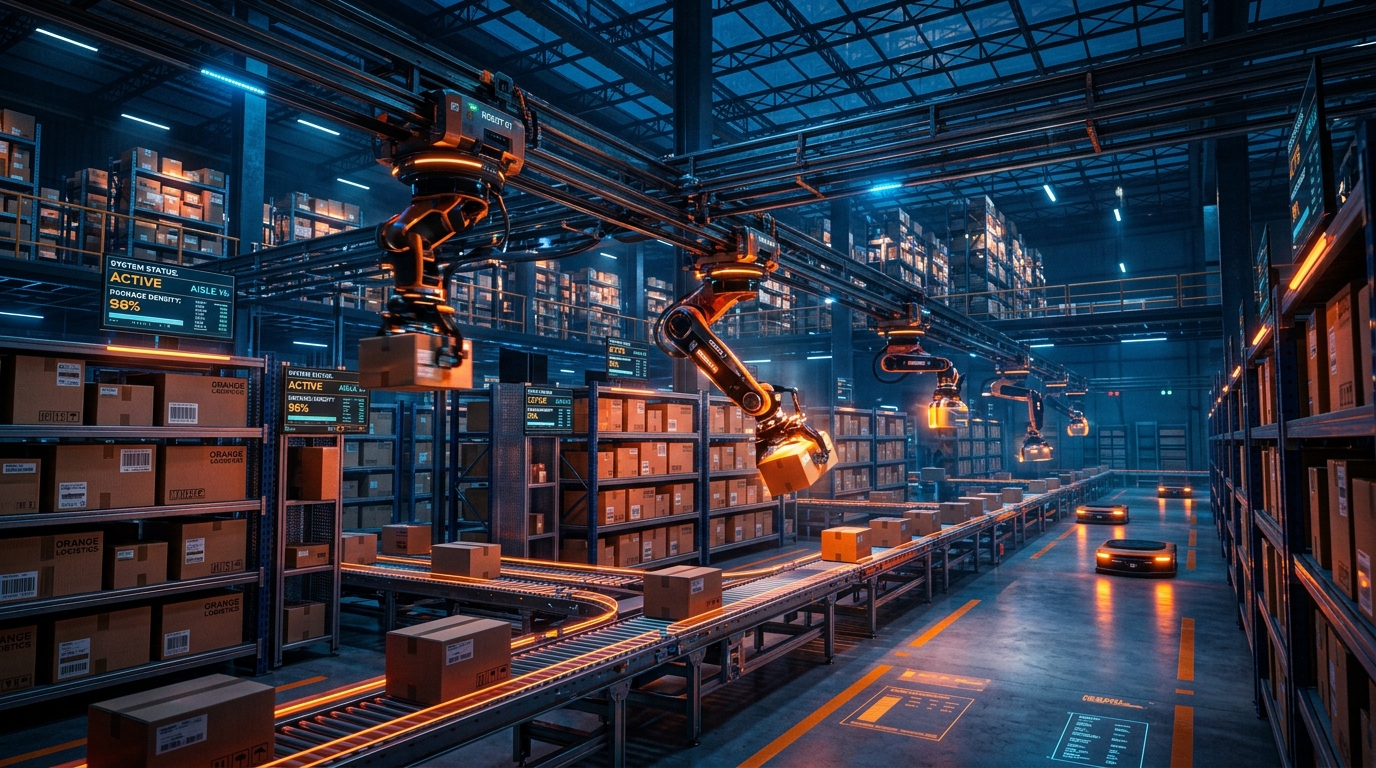
A truck route that used to take a dispatcher an hour to plan now gets recalculated in seconds, mid-route, every time traffic shifts. A warehouse that once relied on paper pick lists now runs on robots that reroute themselves around congestion in real time. None of this is future-tense anymore — it’s how a growing share of freight, warehousing, and last-mile delivery already works in 2026.
AI in logistics refers to machine learning, predictive analytics, computer vision, and robotics applied to moving and storing goods — route optimization, warehouse automation, demand forecasting, predictive maintenance, and autonomous vehicles. DHL reports that 64% of logistics companies have already adopted AI for supply chain management and 52% for warehouse automation, with AI-driven route optimization cutting transportation costs by up to 15% and demand forecasting improving accuracy by up to 50%. For most businesses, the highest-return starting points are demand forecasting and inventory optimization — not the flashier autonomous-vehicle use cases still working through regulatory approval.
Logistics generates exactly the kind of data AI is good at exploiting: constant, high-volume, and tightly tied to measurable outcomes like cost per mile, on-time delivery, and inventory turns. That combination is why the sector has moved from experimentation to real deployment faster than most.
Market-size estimates for AI in logistics vary widely between research firms — figures for the current market range from roughly $12 billion to $20 billion, depending on how each firm defines the category, with most projecting compound annual growth above 25% through the early 2030s. Global Market Insights puts the 2024 baseline at $20.1 billion, growing at roughly 26% annually through 2034, driven by demand for real-time visibility, route optimization, and smart warehousing. Whatever the precise number, the direction is consistent across every major forecast: this is one of the fastest-growing applications of AI in the enterprise.
UPS’s ORION system is the reference case study here, and the numbers hold up under scrutiny. According to INFORMS, the operations research professional society that documented the project, ORION had already saved UPS more than $320 million by the end of 2015 and was projected to save $300–400 million annually at full deployment. A case study from the Business for Social Responsibility network found that more than 70% of UPS’s 55,000 U.S. routes used the system, cutting daily driving distance by six to eight miles per driver — savings that compound fast across a fleet that size.
Amazon’s robotics program is the largest deployment of its kind. Amazon’s own reporting describes its Sequoia inventory system as capable of identifying and storing inventory up to 75% faster than earlier methods, and the company’s newest fulfillment center in Shreveport, Louisiana, reduced fulfillment processing times by up to 25%. By mid-2025, GeekWire reported Amazon had deployed over one million robots across its fulfillment network, coordinated by a generative AI system called DeepFleet that improves travel efficiency by roughly 10% by routing robots around congestion much like a traffic control system.
McKinsey’s research finds that AI-driven forecasting can reduce errors by 20–50% and cut lost sales from stockouts by up to 65% compared with traditional spreadsheet-based forecasting. For any business managing physical inventory, this is usually the fastest path to measurable ROI, because it doesn’t require new hardware — it improves decisions made from data companies already have.
Sensors on trucks, conveyor systems, and warehouse equipment feed continuous data into models trained to flag likely failures before they happen. Unplanned downtime on a distribution line or a stalled delivery truck is expensive in ways that are hard to recover from mid-route, which is why predictive maintenance is one of the quieter but most consistently cited AI use cases among large fleet operators and 3PLs.
Autonomous trucking is real but still narrow in scope. The Federal Motor Carrier Safety Administration is targeting May 2026 for a proposed rule establishing a federal regulatory framework for automated driving system (ADS)-equipped commercial trucks, following years of preliminary rulemaking that began in 2018. In the meantime, companies like Aurora are operating driverless trucks under narrow, company-specific waivers in states like Texas, but deployment remains concentrated in a handful of Sun Belt freight corridors rather than nationwide. For most logistics and e-commerce businesses, autonomous trucking is worth watching rather than planning around in the next year or two.
Customers now expect an accurate delivery window, not just a delivery date. AI models that combine historical delivery data, live traffic, and weather conditions can narrow ETA prediction windows considerably compared with static estimates, which is part of why real-time tracking has become a baseline expectation rather than a premium feature across carriers and marketplaces alike.
Most sellers reading this aren’t running their own freight network — they’re deciding between FBA, a 3PL, or self-fulfillment, and trying to keep inventory balanced without tying up cash in dead stock. AI in logistics touches that decision more directly than it first appears.
Enterprise logistics AI is a different market from the seller-facing tools most Amazon or Shopify sellers use day to day. These platforms are built for shippers, carriers, and 3PLs managing complex, multi-node networks.
| Platform | Primary Use Case | Best Suited For |
|---|---|---|
| project44 | Real-time supply chain visibility | Mid-size to enterprise shippers |
| FourKites | Predictive ETA and shipment tracking | Multi-carrier freight networks |
| Blue Yonder | Demand forecasting and supply chain planning | Retailers and manufacturers |
| Samsara | AI fleet telematics and predictive maintenance | Trucking fleets and delivery operations |
| Locus Robotics | Warehouse robotics-as-a-service | 3PLs and high-volume fulfillment centers |
| o9 Solutions | Integrated business planning and demand sensing | Large enterprises with complex networks |
None of these publish standard pricing — deployments are quoted per network and typically require a sales conversation. For a seller managing one or two 3PL relationships rather than a full logistics network, the more relevant question is usually not “which platform should I buy” but “does my 3PL already run one of these under the hood.”
It’s worth being direct about where the hype outpaces the reality. Beyond the autonomous-trucking timeline covered above, industry surveys consistently find that most companies struggle to move AI logistics projects past the pilot stage. Analysis referencing McKinsey’s supply chain research suggests fewer than one in five enterprises successfully scale AI from an initial pilot to full deployment across their network, with the biggest obstacles being data silos and organizational coordination rather than the underlying technology itself.
That gap matters for smaller businesses evaluating vendors or 3PL partners: a flashy AI feature list means less than evidence the tool is actually running in production at scale, not just in a demo.
Most e-commerce sellers don’t need to build a logistics AI stack from scratch — they need their fulfillment, inventory, and customer communication working together intelligently. High Dreams LLC’s AI Workflow Agent connects inventory signals, order data, and customer service into automated workflows, while our e-commerce management services help sellers on Amazon, Walmart, Etsy, and eBay make smarter fulfillment and 3PL decisions instead of guessing. We also build AI chatbots that handle the shipping and order-status questions logistics AI generates in the first place — closing the loop between “where’s my order” and an answer that doesn’t need a human every time.
Let’s look at where AI-driven forecasting and workflow automation can cut costs and stockouts across your catalog.
It’s the application of machine learning, predictive analytics, computer vision, and robotics to moving and storing goods — including route optimization, warehouse automation, demand forecasting, predictive maintenance, and autonomous vehicles.
Yes, but narrowly. A small number of companies operate driverless trucks under company-specific regulatory waivers in limited freight corridors, mostly in the Sun Belt. A federal regulatory framework for automated trucks isn’t expected until at least mid-2026, so widespread deployment is still years away.
Demand forecasting and inventory optimization typically offer the best return with the least upfront investment, since they improve decisions from data a business already has rather than requiring new hardware or fleet technology.
Usually not directly. Most independent sellers benefit more from choosing 3PL or fulfillment partners who already run AI-driven systems internally, rather than purchasing and managing enterprise logistics software themselves.
Industry research points to data silos, fragmented systems, and organizational coordination — not the AI technology itself — as the main reasons pilots don’t make it to full deployment.
Sources: DHL, “Crossing the Efficiency and Ethics Streams of AI” · Global Market Insights, “AI in Logistics and Supply Chain Market” · INFORMS, “Optimizing Delivery Routes” (UPS ORION case study) · BSR, “Looking Under the Hood: ORION Technology Adoption at UPS” · Amazon, “Meet the Robots Inside Fulfillment Centers” · GeekWire, “Amazon Tops 1 Million Robots” · McKinsey & Company, “AI-Driven Operations Forecasting in Data-Light Environments” · Overdrive, “FMCSA, Federal Agencies Offer Regulatory Timeline Updates.”
A truck route that used to take a dispatcher an hour to plan now gets recalculated in seconds, mid-route, every time traffic shifts. A warehouse that once relied on paper pick lists now runs on robots that reroute themselves around congestion in real time. None of this is future-tense anymore — it’s how a growing share of freight, warehousing, and last-mile delivery already works in 2026.
AI in logistics refers to machine learning, predictive analytics, computer vision, and robotics applied to moving and storing goods — route optimization, warehouse automation, demand forecasting, predictive maintenance, and autonomous vehicles. DHL reports that 64% of logistics companies have already adopted AI for supply chain management and 52% for warehouse automation, with AI-driven route optimization cutting transportation costs by up to 15% and demand forecasting improving accuracy by up to 50%. For most businesses, the highest-return starting points are demand forecasting and inventory optimization — not the flashier autonomous-vehicle use cases still working through regulatory approval.
Logistics generates exactly the kind of data AI is good at exploiting: constant, high-volume, and tightly tied to measurable outcomes like cost per mile, on-time delivery, and inventory turns. That combination is why the sector has moved from experimentation to real deployment faster than most.
Market-size estimates for AI in logistics vary widely between research firms — figures for the current market range from roughly $12 billion to $20 billion, depending on how each firm defines the category, with most projecting compound annual growth above 25% through the early 2030s. Global Market Insights puts the 2024 baseline at $20.1 billion, growing at roughly 26% annually through 2034, driven by demand for real-time visibility, route optimization, and smart warehousing. Whatever the precise number, the direction is consistent across every major forecast: this is one of the fastest-growing applications of AI in the enterprise.
UPS’s ORION system is the reference case study here, and the numbers hold up under scrutiny. According to INFORMS, the operations research professional society that documented the project, ORION had already saved UPS more than $320 million by the end of 2015 and was projected to save $300–400 million annually at full deployment. A case study from the Business for Social Responsibility network found that more than 70% of UPS’s 55,000 U.S. routes used the system, cutting daily driving distance by six to eight miles per driver — savings that compound fast across a fleet that size.
Amazon’s robotics program is the largest deployment of its kind. Amazon’s own reporting describes its Sequoia inventory system as capable of identifying and storing inventory up to 75% faster than earlier methods, and the company’s newest fulfillment center in Shreveport, Louisiana, reduced fulfillment processing times by up to 25%. By mid-2025, GeekWire reported Amazon had deployed over one million robots across its fulfillment network, coordinated by a generative AI system called DeepFleet that improves travel efficiency by roughly 10% by routing robots around congestion much like a traffic control system.
McKinsey’s research finds that AI-driven forecasting can reduce errors by 20–50% and cut lost sales from stockouts by up to 65% compared with traditional spreadsheet-based forecasting. For any business managing physical inventory, this is usually the fastest path to measurable ROI, because it doesn’t require new hardware — it improves decisions made from data companies already have.
Sensors on trucks, conveyor systems, and warehouse equipment feed continuous data into models trained to flag likely failures before they happen. Unplanned downtime on a distribution line or a stalled delivery truck is expensive in ways that are hard to recover from mid-route, which is why predictive maintenance is one of the quieter but most consistently cited AI use cases among large fleet operators and 3PLs.
Autonomous trucking is real but still narrow in scope. The Federal Motor Carrier Safety Administration is targeting May 2026 for a proposed rule establishing a federal regulatory framework for automated driving system (ADS)-equipped commercial trucks, following years of preliminary rulemaking that began in 2018. In the meantime, companies like Aurora are operating driverless trucks under narrow, company-specific waivers in states like Texas, but deployment remains concentrated in a handful of Sun Belt freight corridors rather than nationwide. For most logistics and e-commerce businesses, autonomous trucking is worth watching rather than planning around in the next year or two.
Customers now expect an accurate delivery window, not just a delivery date. AI models that combine historical delivery data, live traffic, and weather conditions can narrow ETA prediction windows considerably compared with static estimates, which is part of why real-time tracking has become a baseline expectation rather than a premium feature across carriers and marketplaces alike.
Most sellers reading this aren’t running their own freight network — they’re deciding between FBA, a 3PL, or self-fulfillment, and trying to keep inventory balanced without tying up cash in dead stock. AI in logistics touches that decision more directly than it first appears.
Enterprise logistics AI is a different market from the seller-facing tools most Amazon or Shopify sellers use day to day. These platforms are built for shippers, carriers, and 3PLs managing complex, multi-node networks.
| Platform | Primary Use Case | Best Suited For |
|---|---|---|
| project44 | Real-time supply chain visibility | Mid-size to enterprise shippers |
| FourKites | Predictive ETA and shipment tracking | Multi-carrier freight networks |
| Blue Yonder | Demand forecasting and supply chain planning | Retailers and manufacturers |
| Samsara | AI fleet telematics and predictive maintenance | Trucking fleets and delivery operations |
| Locus Robotics | Warehouse robotics-as-a-service | 3PLs and high-volume fulfillment centers |
| o9 Solutions | Integrated business planning and demand sensing | Large enterprises with complex networks |
None of these publish standard pricing — deployments are quoted per network and typically require a sales conversation. For a seller managing one or two 3PL relationships rather than a full logistics network, the more relevant question is usually not “which platform should I buy” but “does my 3PL already run one of these under the hood.”
It’s worth being direct about where the hype outpaces the reality. Beyond the autonomous-trucking timeline covered above, industry surveys consistently find that most companies struggle to move AI logistics projects past the pilot stage. Analysis referencing McKinsey’s supply chain research suggests fewer than one in five enterprises successfully scale AI from an initial pilot to full deployment across their network, with the biggest obstacles being data silos and organizational coordination rather than the underlying technology itself.
That gap matters for smaller businesses evaluating vendors or 3PL partners: a flashy AI feature list means less than evidence the tool is actually running in production at scale, not just in a demo.
Most e-commerce sellers don’t need to build a logistics AI stack from scratch — they need their fulfillment, inventory, and customer communication working together intelligently. High Dreams LLC’s AI Workflow Agent connects inventory signals, order data, and customer service into automated workflows, while our e-commerce management services help sellers on Amazon, Walmart, Etsy, and eBay make smarter fulfillment and 3PL decisions instead of guessing. We also build AI chatbots that handle the shipping and order-status questions logistics AI generates in the first place — closing the loop between “where’s my order” and an answer that doesn’t need a human every time.
Let’s look at where AI-driven forecasting and workflow automation can cut costs and stockouts across your catalog.
It’s the application of machine learning, predictive analytics, computer vision, and robotics to moving and storing goods — including route optimization, warehouse automation, demand forecasting, predictive maintenance, and autonomous vehicles.
Yes, but narrowly. A small number of companies operate driverless trucks under company-specific regulatory waivers in limited freight corridors, mostly in the Sun Belt. A federal regulatory framework for automated trucks isn’t expected until at least mid-2026, so widespread deployment is still years away.
Demand forecasting and inventory optimization typically offer the best return with the least upfront investment, since they improve decisions from data a business already has rather than requiring new hardware or fleet technology.
Usually not directly. Most independent sellers benefit more from choosing 3PL or fulfillment partners who already run AI-driven systems internally, rather than purchasing and managing enterprise logistics software themselves.
Industry research points to data silos, fragmented systems, and organizational coordination — not the AI technology itself — as the main reasons pilots don’t make it to full deployment.
Sources: DHL, “Crossing the Efficiency and Ethics Streams of AI” · Global Market Insights, “AI in Logistics and Supply Chain Market” · INFORMS, “Optimizing Delivery Routes” (UPS ORION case study) · BSR, “Looking Under the Hood: ORION Technology Adoption at UPS” · Amazon, “Meet the Robots Inside Fulfillment Centers” · GeekWire, “Amazon Tops 1 Million Robots” · McKinsey & Company, “AI-Driven Operations Forecasting in Data-Light Environments” · Overdrive, “FMCSA, Federal Agencies Offer Regulatory Timeline Updates.”
A truck route that used to take a dispatcher an hour to plan now gets recalculated in seconds, mid-route, every time traffic shifts. A warehouse that once relied on paper pick lists now runs on robots that reroute themselves around congestion in real time. None of this is future-tense anymore — it’s how a growing share of freight, warehousing, and last-mile delivery already works in 2026.
AI in logistics refers to machine learning, predictive analytics, computer vision, and robotics applied to moving and storing goods — route optimization, warehouse automation, demand forecasting, predictive maintenance, and autonomous vehicles. DHL reports that 64% of logistics companies have already adopted AI for supply chain management and 52% for warehouse automation, with AI-driven route optimization cutting transportation costs by up to 15% and demand forecasting improving accuracy by up to 50%. For most businesses, the highest-return starting points are demand forecasting and inventory optimization — not the flashier autonomous-vehicle use cases still working through regulatory approval.
Logistics generates exactly the kind of data AI is good at exploiting: constant, high-volume, and tightly tied to measurable outcomes like cost per mile, on-time delivery, and inventory turns. That combination is why the sector has moved from experimentation to real deployment faster than most.
Market-size estimates for AI in logistics vary widely between research firms — figures for the current market range from roughly $12 billion to $20 billion, depending on how each firm defines the category, with most projecting compound annual growth above 25% through the early 2030s. Global Market Insights puts the 2024 baseline at $20.1 billion, growing at roughly 26% annually through 2034, driven by demand for real-time visibility, route optimization, and smart warehousing. Whatever the precise number, the direction is consistent across every major forecast: this is one of the fastest-growing applications of AI in the enterprise.
UPS’s ORION system is the reference case study here, and the numbers hold up under scrutiny. According to INFORMS, the operations research professional society that documented the project, ORION had already saved UPS more than $320 million by the end of 2015 and was projected to save $300–400 million annually at full deployment. A case study from the Business for Social Responsibility network found that more than 70% of UPS’s 55,000 U.S. routes used the system, cutting daily driving distance by six to eight miles per driver — savings that compound fast across a fleet that size.
Amazon’s robotics program is the largest deployment of its kind. Amazon’s own reporting describes its Sequoia inventory system as capable of identifying and storing inventory up to 75% faster than earlier methods, and the company’s newest fulfillment center in Shreveport, Louisiana, reduced fulfillment processing times by up to 25%. By mid-2025, GeekWire reported Amazon had deployed over one million robots across its fulfillment network, coordinated by a generative AI system called DeepFleet that improves travel efficiency by roughly 10% by routing robots around congestion much like a traffic control system.
McKinsey’s research finds that AI-driven forecasting can reduce errors by 20–50% and cut lost sales from stockouts by up to 65% compared with traditional spreadsheet-based forecasting. For any business managing physical inventory, this is usually the fastest path to measurable ROI, because it doesn’t require new hardware — it improves decisions made from data companies already have.
Sensors on trucks, conveyor systems, and warehouse equipment feed continuous data into models trained to flag likely failures before they happen. Unplanned downtime on a distribution line or a stalled delivery truck is expensive in ways that are hard to recover from mid-route, which is why predictive maintenance is one of the quieter but most consistently cited AI use cases among large fleet operators and 3PLs.
Autonomous trucking is real but still narrow in scope. The Federal Motor Carrier Safety Administration is targeting May 2026 for a proposed rule establishing a federal regulatory framework for automated driving system (ADS)-equipped commercial trucks, following years of preliminary rulemaking that began in 2018. In the meantime, companies like Aurora are operating driverless trucks under narrow, company-specific waivers in states like Texas, but deployment remains concentrated in a handful of Sun Belt freight corridors rather than nationwide. For most logistics and e-commerce businesses, autonomous trucking is worth watching rather than planning around in the next year or two.
Customers now expect an accurate delivery window, not just a delivery date. AI models that combine historical delivery data, live traffic, and weather conditions can narrow ETA prediction windows considerably compared with static estimates, which is part of why real-time tracking has become a baseline expectation rather than a premium feature across carriers and marketplaces alike.
Most sellers reading this aren’t running their own freight network — they’re deciding between FBA, a 3PL, or self-fulfillment, and trying to keep inventory balanced without tying up cash in dead stock. AI in logistics touches that decision more directly than it first appears.
Enterprise logistics AI is a different market from the seller-facing tools most Amazon or Shopify sellers use day to day. These platforms are built for shippers, carriers, and 3PLs managing complex, multi-node networks.
| Platform | Primary Use Case | Best Suited For |
|---|---|---|
| project44 | Real-time supply chain visibility | Mid-size to enterprise shippers |
| FourKites | Predictive ETA and shipment tracking | Multi-carrier freight networks |
| Blue Yonder | Demand forecasting and supply chain planning | Retailers and manufacturers |
| Samsara | AI fleet telematics and predictive maintenance | Trucking fleets and delivery operations |
| Locus Robotics | Warehouse robotics-as-a-service | 3PLs and high-volume fulfillment centers |
| o9 Solutions | Integrated business planning and demand sensing | Large enterprises with complex networks |
None of these publish standard pricing — deployments are quoted per network and typically require a sales conversation. For a seller managing one or two 3PL relationships rather than a full logistics network, the more relevant question is usually not “which platform should I buy” but “does my 3PL already run one of these under the hood.”
It’s worth being direct about where the hype outpaces the reality. Beyond the autonomous-trucking timeline covered above, industry surveys consistently find that most companies struggle to move AI logistics projects past the pilot stage. Analysis referencing McKinsey’s supply chain research suggests fewer than one in five enterprises successfully scale AI from an initial pilot to full deployment across their network, with the biggest obstacles being data silos and organizational coordination rather than the underlying technology itself.
That gap matters for smaller businesses evaluating vendors or 3PL partners: a flashy AI feature list means less than evidence the tool is actually running in production at scale, not just in a demo.
Most e-commerce sellers don’t need to build a logistics AI stack from scratch — they need their fulfillment, inventory, and customer communication working together intelligently. High Dreams LLC’s AI Workflow Agent connects inventory signals, order data, and customer service into automated workflows, while our e-commerce management services help sellers on Amazon, Walmart, Etsy, and eBay make smarter fulfillment and 3PL decisions instead of guessing. We also build AI chatbots that handle the shipping and order-status questions logistics AI generates in the first place — closing the loop between “where’s my order” and an answer that doesn’t need a human every time.
Let’s look at where AI-driven forecasting and workflow automation can cut costs and stockouts across your catalog.
It’s the application of machine learning, predictive analytics, computer vision, and robotics to moving and storing goods — including route optimization, warehouse automation, demand forecasting, predictive maintenance, and autonomous vehicles.
Yes, but narrowly. A small number of companies operate driverless trucks under company-specific regulatory waivers in limited freight corridors, mostly in the Sun Belt. A federal regulatory framework for automated trucks isn’t expected until at least mid-2026, so widespread deployment is still years away.
Demand forecasting and inventory optimization typically offer the best return with the least upfront investment, since they improve decisions from data a business already has rather than requiring new hardware or fleet technology.
Usually not directly. Most independent sellers benefit more from choosing 3PL or fulfillment partners who already run AI-driven systems internally, rather than purchasing and managing enterprise logistics software themselves.
Industry research points to data silos, fragmented systems, and organizational coordination — not the AI technology itself — as the main reasons pilots don’t make it to full deployment.
Sources: DHL, “Crossing the Efficiency and Ethics Streams of AI” · Global Market Insights, “AI in Logistics and Supply Chain Market” · INFORMS, “Optimizing Delivery Routes” (UPS ORION case study) · BSR, “Looking Under the Hood: ORION Technology Adoption at UPS” · Amazon, “Meet the Robots Inside Fulfillment Centers” · GeekWire, “Amazon Tops 1 Million Robots” · McKinsey & Company, “AI-Driven Operations Forecasting in Data-Light Environments” · Overdrive, “FMCSA, Federal Agencies Offer Regulatory Timeline Updates.”