Healthcare has absorbed more AI hype than almost any other industry, which makes the actual, documented progress easy to lose in the noise. Strip away the “revolutionary” headlines and a smaller, more interesting story emerges: a handful of applications — diagnostic imaging, clinical documentation, and early-stage drug discovery — have moved from pilot to peer-reviewed evidence, while plenty of other claims remain exactly that, claims. Knowing the difference matters whether you’re a clinic leader deciding what to adopt or a patient trying to understand what’s actually changing about your care.
Three AI applications in healthcare now have real regulatory and clinical evidence behind them: diagnostic imaging (1,451 FDA-authorized AI-enabled devices as of the end of 2025, three-quarters of them in radiology), ambient AI clinical documentation (peer-reviewed randomized trials showing meaningful reductions in documentation time and physician burnout), and AI-assisted drug discovery (Insilico Medicine’s AI-designed drug reached Phase IIa with published results in roughly 18 months, versus a typical 6–8 years). Each comes with real limitations that the marketing rarely mentions.
The most useful starting point isn’t a vendor’s pitch deck — it’s the FDA’s own AI-Enabled Medical Device List. As of the end of 2025, the FDA had authorized 1,451 cumulative AI-enabled devices, and radiology imaging alone accounts for roughly 76% of them, with cardiovascular and neurology applications growing steadily behind it. That concentration matters: it tells you where the evidence base is actually deepest, rather than where the marketing is loudest. The FDA has also been actively updating its framework — a January 2025 draft guidance introduced new transparency and labeling requirements, recommending manufacturers disclose that a device uses AI, along with its inputs, outputs, performance measures, and known sources of bias, often through structured “model cards.” Separately, a January 2026 guidance update relaxed requirements for certain clinical decision support tools, allowing more generative AI tools offering diagnostic suggestions or supportive tasks to reach clinics without full FDA vetting — a shift worth watching closely as adoption accelerates.
Radiology remains the area with the longest track record and the largest evidence base — the first AI-enabled device the FDA ever cleared, PAPNET, dates back to 1995, and the first AI-enabled radiology device followed in 1998. A 2025 taxonomy study in npj Digital Medicine examining 1,016 FDA authorizations documented how the category has evolved from narrow, single-purpose detection tools toward broader platforms. One recent example: Aidoc’s FDA clearance combined 11 newly cleared indications with three existing ones into a single triage platform, with its pivotal study reporting mean sensitivity between 97% and 98.5%, and mean specificity between 98% and 99.7% — genuinely strong numbers, though it’s worth remembering that pivotal-study performance and real-world performance across diverse patient populations don’t always match exactly.
If diagnostic imaging has the deepest evidence base, ambient AI scribes — tools that listen to a patient visit and draft the clinical note automatically — may be the fastest-adopted generative AI use case in medicine, with roughly one-third of clinicians already having access to the technology and broader adoption projected by industry trackers through the rest of 2026. The evidence here is unusually rigorous for healthcare AI, and unusually honest about its limits.
A randomized trial published in NEJM AI compared two leading ambient scribe products against usual care: one product showed a statistically significant 9.5% reduction in time spent writing notes, while the other showed no significant change in that metric — yet both groups showed measurable improvements in clinician satisfaction and burnout indicators compared to the control group. A separate study using UChicago Medicine’s ambient documentation pilot, published in JAMA Network Open, found clinicians using the tool spent 8.5% less total time in the electronic health record and saw a more than 15% drop in time spent composing notes specifically, compared to a matched control group. Kaiser Permanente’s Southern California region reported an estimated 15,791 hours of documentation time saved, alongside 84% of physicians reporting improved communication and 82% reporting improved work satisfaction.
The honest caveat: not every study agrees on the size of the time savings. One larger study across roughly 1,800 clinicians at five academic medical centers found more modest gains — around 16 minutes saved per eight hours of patient care — while a separate time-motion study measured well under a minute saved per visit. Researchers studying the gap have suggested that the benefit may have as much to do with reduced cognitive load — not having to mentally hold a note together while listening to a patient — as with raw minutes saved, which may explain why burnout scores can improve meaningfully even when measured time savings look modest.
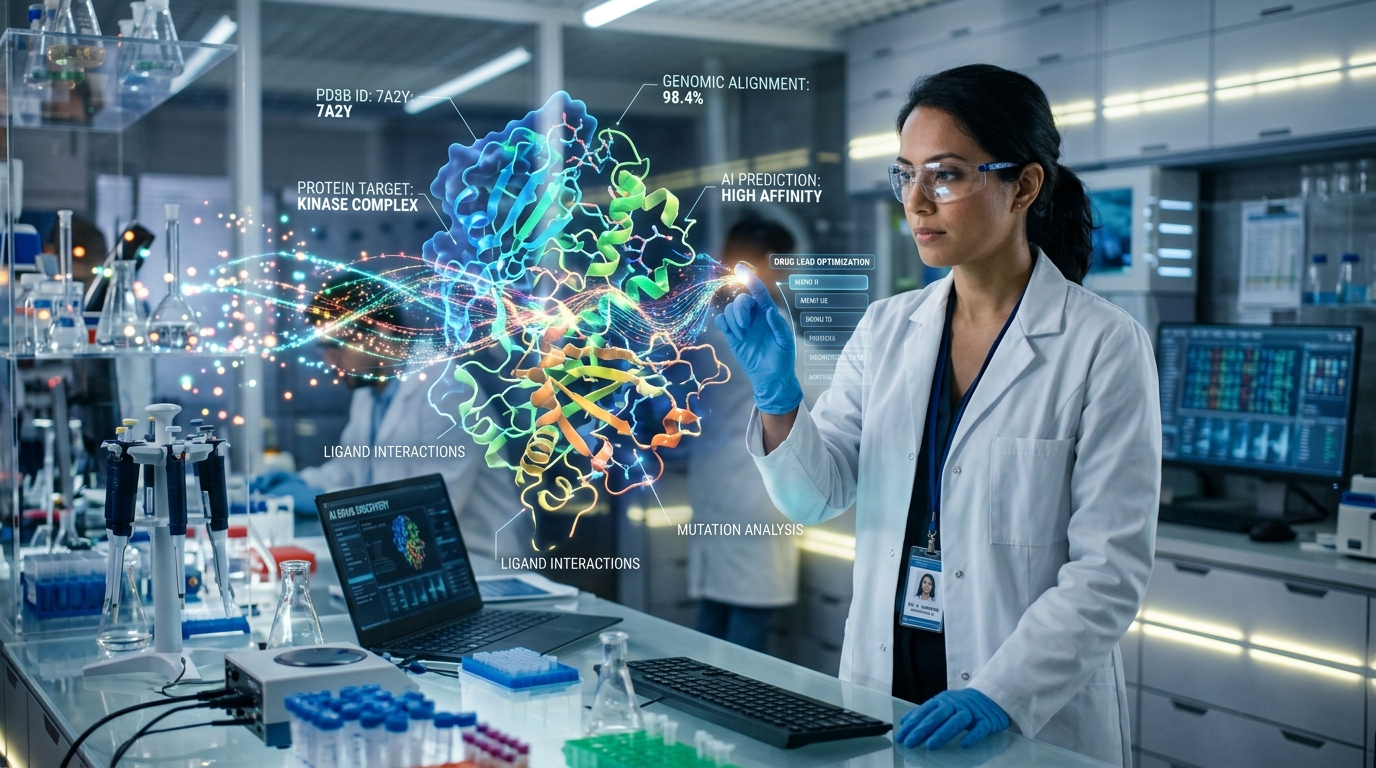
The most-cited case study in AI drug discovery is Insilico Medicine’s INS018_055 (also referred to as rentosertib), a treatment for idiopathic pulmonary fibrosis. Insilico used AI for target identification, molecule design, and optimization, taking the compound from concept to Phase IIa with statistically significant efficacy results published in Nature Medicine — reportedly in around 18 months, at an estimated cost near $6 million. For comparison, that stage of development traditionally takes roughly 6–8 years and $100–200 million using conventional methods. Across the wider industry, more than 200 AI-designed drugs are reportedly now in some stage of development, with a first regulatory approval possible in 2026 or 2027.
The asterisk matters, though. Industry analysts tracking the space caution against claims of “10x faster drug development” broadly, since AI has mainly compressed the early discovery phase — target identification and molecule design — while clinical trial duration, regulatory review timelines, and manufacturing scale-up remain governed by biology and regulation, not computing power. AI has not yet produced a single fully approved drug from discovery through market; 2026’s pivotal Phase III readouts across several AI-designed candidates are widely viewed as the real test of whether the technology improves clinical success rates, not just early timelines.
| Application | Strongest Evidence | Where the Hype Outpaces Proof |
|---|---|---|
| Diagnostic imaging | 1,451 FDA-authorized devices; decades of clinical use in radiology | Real-world performance across diverse populations vs. pivotal-study conditions |
| Ambient documentation | Multiple peer-reviewed RCTs showing burnout and satisfaction gains | Measured time-savings vary widely study to study |
| AI drug discovery | Documented compression of early discovery timelines and cost | No fully AI-discovered drug has completed approval yet; trial and regulatory timelines unchanged |
The AI applications making headlines — imaging algorithms, AI-designed drugs — sit inside hospitals and pharma labs, not most clinics’ reach. But the same underlying shift is opening up real, practical automation for everyday practices: patient communication, scheduling, and administrative workflows that don’t require an FDA clearance to implement responsibly.
Chatbots and voice agents built for scheduling, FAQs, and reminders — never positioned to offer clinical or diagnostic guidance.
BAA-ready vendor relationships and clear escalation paths whenever patient data is involved.
Integrations with the scheduling and EHR tools your practice already uses, not a bolt-on that creates more work.
Explore related capabilities: AI chatbots for patient communication, AI voice agents for phone-based scheduling, and AI workflow agents for back-office automation.
Get a free consultation on which AI applications are proven, practical, and worth adopting now — and which are still just headlines.
Get Hired View Our ServicesHow many AI-powered medical devices has the FDA actually approved?
As of the end of 2025, the FDA had authorized 1,451 cumulative AI-enabled medical devices, with radiology imaging accounting for roughly 76% of them.
Do ambient AI scribes actually save physicians time?
The evidence is mixed but generally positive. Some peer-reviewed studies show meaningful reductions in documentation time (around 8.5–9.5%), while others show more modest measured time savings — yet most studies agree on improvements in clinician satisfaction and burnout indicators, suggesting the benefit isn’t purely about the clock.
Has AI actually gotten a drug approved by the FDA?
Not yet through full approval. AI-designed drugs like Insilico Medicine’s rentosertib have reached Phase IIa with published, statistically significant results, and more than 200 AI-designed drugs are reportedly in development, but no fully AI-discovered drug has completed the approval process as of this writing.
Does AI replace doctors in diagnosis?
No. FDA-cleared AI diagnostic tools are generally designed to assist and flag findings for physician review, not to replace clinical judgment. Regulatory frameworks and current clinical practice both keep a physician in the decision loop.
What AI application in healthcare has the strongest evidence right now?
Diagnostic imaging has the deepest and longest-running evidence base, given decades of FDA clearances. Ambient AI documentation has the fastest-growing body of peer-reviewed randomized trial evidence specifically around clinician wellbeing.
Sources: U.S. Food and Drug Administration, AI-Enabled Medical Device List, cited via IntuitionLabs, “FDA’s AI Medical Device List: Stats, Trends & Regulation” · npj Digital Medicine, “How AI is used in FDA-authorized medical devices: a taxonomy across 1,016 authorizations” · IntuitionLabs, “FDA-Approved AI Medical Devices List: Complete 2026 Guide” · NEJM AI, randomized trial of ambient AI scribes (via Pulmonology Advisor) · JAMA Network Open, UChicago Medicine ambient documentation study (via Advisory Board) · Technology.org, “How Ambient AI Scribes Are Easing the Clinician Burnout Crisis” · SOAP Note AI, “Ambient AI Scribe Adoption in 2026” · Nature Medicine, published Phase IIa results for Insilico Medicine’s rentosertib (INS018_055), cited via PMC, “From Lab to Clinic” and Drug Target Review, “AI in drug discovery: predictions for 2026.”