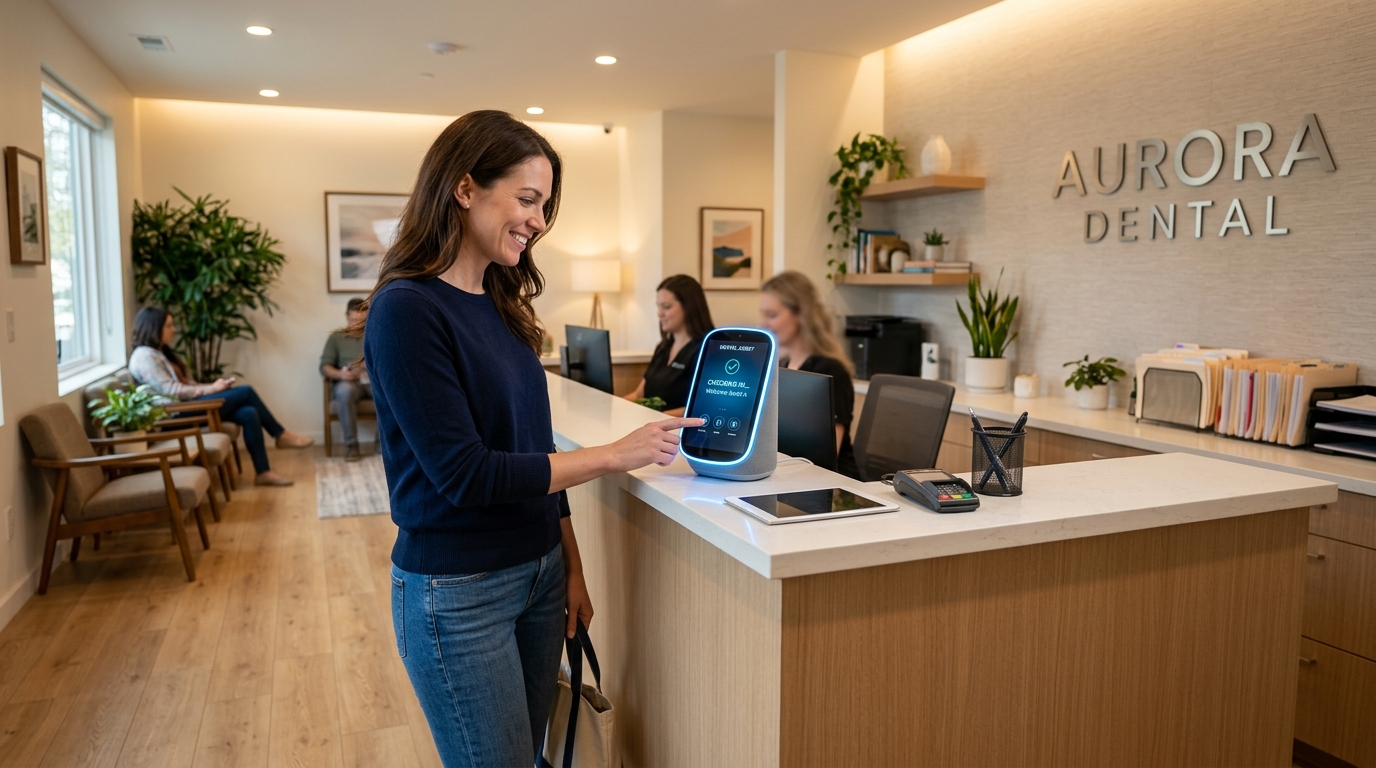
A typical dental clinic gets 150-300 calls a month and misses about 35% of them. Up to 80% of those callers won’t leave a voicemail — they just call the next clinic on Google. Industry estimates put the resulting lost annual production at $50,000 to $150,000 per practice. AI voice agents solve that math convincingly. But dental practices sit in a category most generic “AI receptionist” content ignores entirely: every call involves patient information covered by HIPAA, and choosing a vendor on price alone — without a signed Business Associate Agreement — can expose a practice to civil penalties starting at $100 per violation. Here’s what a dental voice agent actually needs to do, and get right.
AI voice agents for dental clinics answer calls 24/7, book and reschedule appointments directly into practice management software like Dentrix, Eaglesoft, or Open Dental, answer routine insurance and treatment questions, and send reminders that reduce no-shows. Industry-reported results include 20-30 hours of weekly phone management time saved per location and materially fewer missed new-patient calls. The requirement most vendor pages downplay: because every call involves patient data, any voice AI vendor is legally a “business associate” under HIPAA the moment it handles a call — a signed Business Associate Agreement (BAA) is non-negotiable, and it needs to cover every vendor in the voice pipeline, not just the company whose name is on the product.
Dental offices run on a structural mismatch: the same front desk staff answering the phone are also checking patients in, verifying insurance, and handling in-person questions — meaning phone coverage inevitably drops during a busy morning or a lunch rush. Industry data suggests a typical practice misses roughly a third of its inbound calls as a result, and the behavior of a missed caller is unforgiving: up to 80% won’t leave a voicemail at all, moving straight to the next clinic in their search results instead. For a new-patient inquiry specifically, that’s not a delayed appointment — it’s a permanently lost one.
AI voice agents close that gap by answering every call immediately, day or night, without needing a human available at that exact moment. Reported industry results include practices saving 20-30 hours of phone management time weekly per location and meaningfully reducing missed new-patient calls — though as with any vendor-reported figures, actual results vary by call volume, current front-desk staffing, and how deeply the agent integrates with the practice’s scheduling system.
Checking real-time availability and booking directly into the practice management system — not just taking a message for staff to call back later.
Answering routine questions about accepted insurance, coverage basics, and payment options without pulling a staff member away from an in-person patient.
Capturing the details of a new patient inquiry — including which procedure they’re interested in — so the front desk has full context before the first callback, rather than starting from scratch.
Automated reminder calls and texts are a well-established no-show reduction lever; some vendors report substantial reductions in no-show-related revenue loss when reminders are handled consistently.
Answering evening and weekend calls — including basic triage for urgent concerns — rather than sending every after-hours caller straight to voicemail.
Modern platforms integrate with Dentrix, Eaglesoft, Open Dental, and other common systems, so call outcomes update the actual patient record instead of creating a parallel, manually-reconciled log.
This is the section that separates a genuinely useful guide from a sales page, and it matters because the stakes are real. Any AI voice vendor answering calls for a dental practice is handling patient information — names, appointment details, sometimes treatment context — the moment a call connects. That makes the vendor a “business associate” under HIPAA, and a signed Business Associate Agreement isn’t a nice-to-have, it’s the legal floor for the relationship. Civil penalties for a HIPAA violation start at $100 and can reach $50,000 per violation depending on culpability, with some incidents carrying penalties into the millions.
The detail most practices miss: a voice AI system isn’t one product, it’s a stack. The conversation typically passes through a telephony provider, a speech-to-text engine, a language model, a text-to-speech engine, and the voice agent platform itself — and every one of those sub-processors touching patient data needs to be covered under the compliance agreement, not just the company whose logo is on the product. A vendor who can sign a BAA for their own platform but can’t speak to whether their underlying model or transcription provider is covered hasn’t actually solved the compliance problem.
A vendor who hesitates to sign a BAA, can’t produce security documentation, or is vague about sub-processor coverage is a clear red flag — regardless of how compelling the demo sounds.
Purpose-built, HIPAA-compliant AI voice agents for dental practices generally run $300-$900 per month as of 2026, with the range driven by call volume, depth of scheduling integration, and how much of the compliance infrastructure the vendor manages on your behalf versus leaving to you. That’s a meaningful range below the reported $5,000-$12,000 monthly cost of an equivalent human receptionist role — but the cheapest option in that range is rarely the one that’s actually solved the sub-processor compliance question properly, which is exactly where due diligence upfront saves real risk later.
A price-first decision that skips compliance due diligence is the single most consequential mistake a practice can make here — the cost difference between a compliant and non-compliant vendor is small next to the penalty exposure of getting it wrong.
A signed BAA with the voice agent company doesn’t automatically mean every underlying sub-processor is compliant. Ask directly which parties in the pipeline are covered, and get it in writing.
A patient calling with a dental emergency needs a fast, reliable path to reach a human or receive clear guidance — a voice agent that treats every call identically regardless of urgency risks a bad outcome in exactly the situation that matters most.
A voice agent that only takes messages instead of actually booking into Dentrix, Eaglesoft, or Open Dental creates a second manual step for staff — undermining much of the time savings the tool is supposed to deliver.
High Dreams LLC is a Colorado-based AI and digital growth agency that has shipped AI voice agents for 150+ clients worldwide — moving from idea to production in 1 to 4 weeks, with a scoping process that treats compliance requirements as part of the build from day one rather than an afterthought bolted on before launch.
Your call volume, missed-call patterns, and practice management system are mapped, along with the compliance requirements specific to handling patient calls.
A working voice agent is tested against real scheduling and FAQ scenarios, including the escalation path for urgent calls.
Booking accuracy, escalation handling, and data-handling practices are tested against defined thresholds before launch.
Relevant services include AI voice agent development, AI chatbots for web-based inquiries, and AI workflow agents for appointment reminders and follow-up.
Get a free consultation to see what a compliant, PMS-integrated voice agent would look like for your practice.
They can be, but compliance isn’t automatic — it depends entirely on the vendor. Any vendor handling patient calls is legally a business associate under HIPAA and must sign a Business Associate Agreement covering every sub-processor in their voice pipeline, not just their own platform.
Industry data suggests around 35% of inbound calls go unanswered at a typical practice, with up to 80% of those callers not leaving a voicemail and instead calling a competing clinic.
That’s a clear red flag. Without a signed BAA, a practice using that vendor for patient calls is exposed to HIPAA violations the moment patient data flows through the system, with civil penalties starting at $100 per violation.
Purpose-built, compliant solutions generally run $300-$900 per month as of 2026, depending on call volume and integration depth — well below the reported $5,000-$12,000 monthly cost of an equivalent human receptionist role.
Yes, when properly integrated. Modern platforms connect with Dentrix, Eaglesoft, Open Dental, and other common systems to book directly rather than just taking a message for staff to enter manually.
Sources: Voice.ai, “24/7 AI Receptionist – Dental Office Voice Agent” and “AI Voice Agents for Dentists” · VoAgents.ai, “AI Dental Receptionist and Voice Agents for Dentists” · WildRunAI, “HIPAA Compliant AI Voice Agent: What Dental Offices Need in 2026” · SIMBA Voice Agents, “HIPAA Compliance for AI Voice Agents in Healthcare” (2026) · Dialzara, “HIPAA Compliant AI Voice Agent: Security & Compliance Guide for Healthcare” · Simbie.ai, “HIPAA BAA Compliant AI Phone System: A 2026 Guide” · Greetmate.ai, “Best HIPAA-Compliant Voice AI Agents in 2026.”


Future of AI Voice Technology - highdreamsllc.com
July 25, 2026 at 6:33 am
“ […] Voice AgentsAI Voice Agents for Dental Clinics AI Voice AgentsHow AI Voice Agents Increase Appointment Bookings AI Voice AgentsVoice AI vs Human […] “
AI Voice Agents for Restaurants: Smarter Reservations
July 25, 2026 at 6:40 am
“ […] AI Voice Agents for Dental Clinics […] “
Etsy Ads Guide for New and Experienced Sellers
July 25, 2026 at 6:43 am
“ […] AI Voice Agents for Dental Clinics […] “
AI Chatbots for Healthcare Clinics: Better Care Fast
July 25, 2026 at 6:50 am
“ […] AI Voice Agents for Dental Clinics […] “
Best AI Voice Agent Platforms Compared for Business
July 25, 2026 at 6:57 am
“ […] AI Voice Agents for Dental Clinics […] “
AI Applications Revolutionizing Healthcare Today
July 27, 2026 at 7:09 am
“ […] AI Voice Agents for Dental Clinics […] “
AI Voice Agents for Home Service Businesses
August 4, 2026 at 6:55 am
“ […] Voice AgentsAI Voice Agents for Dental Clinics AI Voice AgentsAI Voice Agents for Restaurants: Automating Reservations and Customer Calls AI Voice […] “