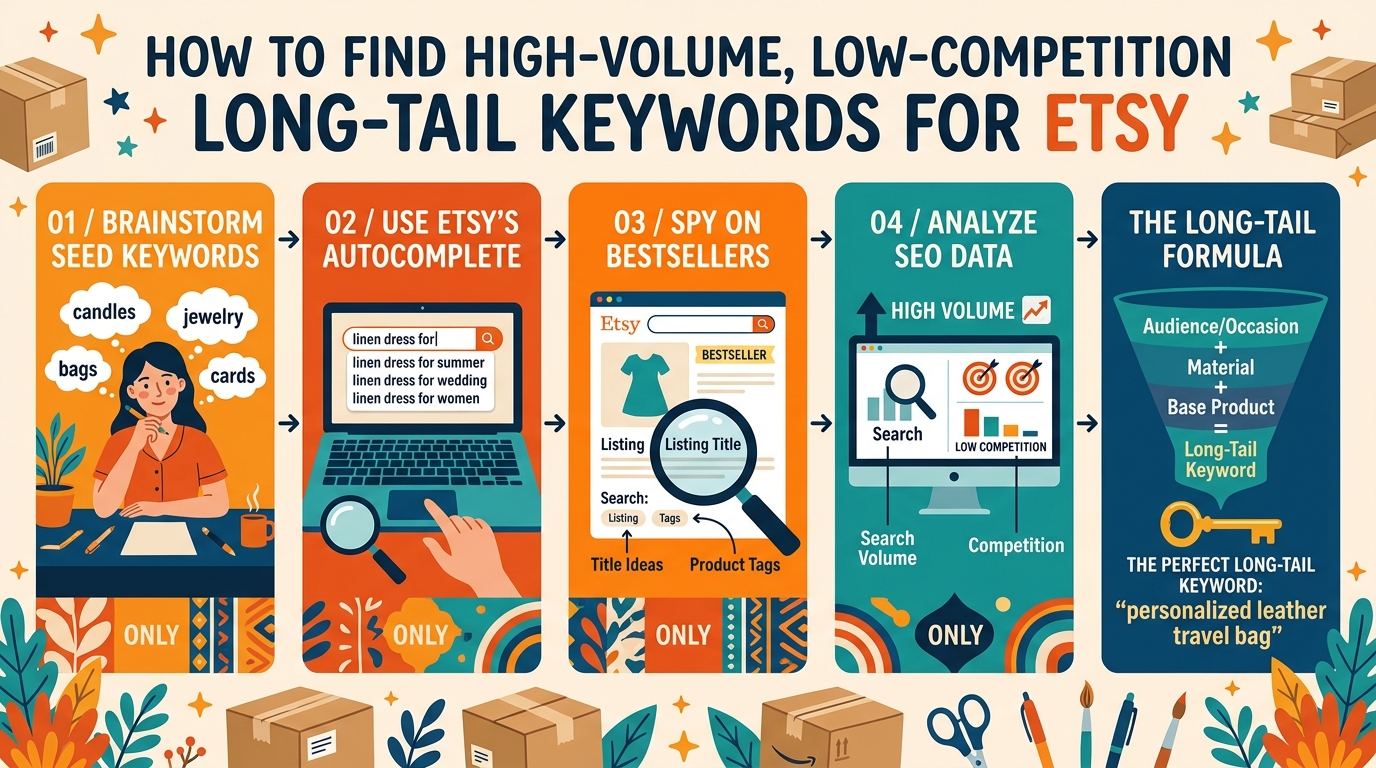
To find long-tail keywords for Etsy, brainstorm specific phrases about your product, expand them with Etsy’s search bar suggestions, then check each one in Etsy’s Marketplace Insights tool, which shows the number of searches and the number of listings over 30 days. Keep phrases with real searches, fewer competing listings, and a close match to what you sell. Then spread them across your title, all 13 tags, attributes, and description.
Most new Etsy sellers pick the obvious keyword, like “mug” or “necklace,” and wonder why nobody finds their listings. Thousands of other shops are using the same word.
Long-tail keywords solve this. They are longer, more specific phrases that describe exactly what makes your product different. This guide shows how to find them with free tools, check demand, and put them in the right places.
The phrase is popular, but it hides a trade-off. Specific phrases are usually searched less often than generic ones. Etsy makes this point itself: long-tail phrases are used less frequently, but they tend to convert better because they describe exactly what a shopper wants (Etsy Seller Handbook: Keywords 101).
So the realistic goal is not a huge volume and no competition. It is a phrase that has enough searches to matter, relatively few listings fighting for it, and a buyer who is ready to purchase. That is the sweet spot this guide helps you find.
Aim for enough demand, clear intent, and a fair fight. Not a magic keyword.
Before you research anything, know what Etsy says about its own search. These points come from the Seller Handbook (Etsy Seller Handbook: How Etsy Search Works; Etsy Seller Handbook: Keywords 101), with the guidance dated August 2025. Etsy notes that search is always changing, so treat this as current best practice, not a permanent rule.
| What Etsy says | What it means for your long-tail research |
|---|---|
| Search has two phases: query matching, then ranking. | First make sure your listing can match the phrase. Then earn the click and sale that lift ranking. |
| Matching looks at title, tags, attributes, descriptions, first photo, and reviews. | Spread your target phrase across fields instead of repeating it everywhere. |
| Using all 13 tags, adding variety, and filling every relevant attribute may help matching. | Treat each tag as a separate chance to match a different search. |
| Exact matches to a query may rank higher. | Write phrases the way a buyer would type them. |
| Tags can be up to 20 characters. Multi-word phrases beat single words. | Break long phrases into chunks like “diamond ring” and “engagement ring.” |
| Categories and attributes act like tags. | Do not waste tags repeating them. |
| Where a phrase sits in a title does not affect ranking. | Still lead with the clearest descriptor, because shoppers scan the first words. |
| Listing engagement (views that turn into purchases) influences placement. | A keyword that brings the wrong buyer can hurt more than it helps. |
Etsy does not hand out a public keyword volume list, and third-party tools use their own estimates. That makes the first-party data below especially valuable.
| Source | What it tells you | Free limit |
|---|---|---|
| Etsy Marketplace Insights | Number of searches and number of listings for a term over the last 30 days, plus related terms and trends. | 15 keyword searches a week for every seller. Results stay available for 7 days. Etsy Plus is unlimited. |
| Shop Stats (traffic details) | The search terms already bringing buyers to your listings. | Free with your shop. |
| Etsy search bar suggestions | What shoppers commonly type after your seed phrase. | Free and unlimited. |
| eRank free plan | Third-party keyword estimates and listing analysis. | Per eRank, up to 5 keyword lookups a day on the free plan. |
For details, see Etsy Help: Marketplace Insights and eRank’s plan comparison. Limits and plans change, so confirm them in your own account.
Write down materials, techniques, style, size, recipient, occasion, and the problem the item solves. Etsy’s own tagging guide groups ideas the same way: descriptive, materials and techniques, who it is for, shopping occasions, solution-oriented, style, and size.
Combine your attributes with the product type. For a ceramic mug seller, that might produce phrases such as “speckled stoneware mug,” “mug for tea lovers,” or “wheel thrown coffee cup.” Avoid one-word seeds. They waste your limited searches.
Type each seed into Etsy’s search bar and note the suggestions that appear. These show how shoppers naturally extend a phrase. Add the relevant ones to your list and delete the ones that do not fit your product.
Etsy suggests looking at the traffic details page in your stats to see the search terms already bringing buyers to your shop. Compare listings with few views against your top performers, and borrow useful keywords for the weaker ones (Etsy Seller Handbook: How Etsy Search Works).
In Shop Manager, go to Stats and select Marketplace Insights, then enter a keyword. Per Etsy’s help page, you can see the number of searches and the number of listings from the last 30 days, view related terms, and spot opportunities with high buyer interest but fewer listings. You get 15 free keyword searches a week, and each result stays available for 7 days (Etsy Help: Marketplace Insights).
Etsy gives you searches and listing counts, but it does not tell you whether a keyword is “good.” Use a simple checklist. This is our own rule of thumb, so adjust it to your category.
| Check | Ask yourself | Good sign | Warning sign |
|---|---|---|---|
| Fit | Does this phrase describe what I actually sell? | A buyer typing it would be happy to see my listing. | I have to stretch the truth to use it. |
| Demand | Does Marketplace Insights show real searches? | Searches are visible and steady or rising. | Almost no searches. |
| Competition | How many listings does it return compared with its searches? | Healthy searches with comparatively fewer listings. | Huge listing count with modest searches. |
| Intent | Is the buyer ready to purchase? | Includes a material, style, recipient, or use. | One generic word. |
| Proof | Does my first photo match the phrase? | The photo shows exactly what the phrase promises. | Photo and phrase disagree. |
Keep a simple sheet with these columns:
There is no official cutoff for “low competition.” Compare phrases against each other within your own niche rather than chasing a universal number.
This is a fictional example to show structure, not a real shop or result. Say you sell wheel-thrown speckled stoneware mugs.
Sample title: Speckled Stoneware Mug: Handmade 12 oz Coffee or Tea Cup, Microwave Safe
Sample 13 tags (each under 20 characters, with no repeats):
Notice what the set avoids. It does not repeat the category word on its own, it uses multi-word phrases, and it mixes style, material, use, recipient, and occasion. Before you copy any tag, check it in Marketplace Insights and make sure it is accurate for your item. Only claim “microwave safe” if your product truly is.
Etsy offers an optional AI-powered tool that suggests updated listing titles from your current title, first photo, and description. It appears in the search visibility dashboard for eligible English listings. AI assistants can also brainstorm seed phrases. Treat suggestions as drafts: check them against real data in Marketplace Insights, and make sure every word is accurate for your product.
Use material, technique, and style phrases that only you can honestly claim.
Pair the format with a use case, such as a planner for a specific job or event.
Combine era, material, and object type, then check which phrasing shoppers use.
Once you know which phrases convert, a branded store can capture that demand directly. Our post on AI chatbots and cart abandonment covers one way to protect those sales.
High Dreams LLC builds Shopify and WordPress stores, AI chatbots, and workflow automation for e-commerce brands. Tell us where your shop is today and where you want it to go.
High Dreams LLC is a Colorado-based AI and digital growth agency focused on practical AI for business. The team builds AI chatbots, voice agents, workflow automation, websites, apps, and e-commerce systems, scoped around the specific workflow a business needs, with human escalation built in from the start.
Etsy’s Marketplace Insights tool shows the number of searches and the number of listings for a term over the last 30 days. Every seller gets 15 free keyword searches a week, and Etsy Plus subscribers get unlimited searches.
You can use up to 13 tags per listing, and each tag can be up to 20 characters long. Etsy recommends using all 13 with varied multi-word phrases.
No. Etsy says it matches root words, so a search for “diaries” can match “diary,” and it redirects shoppers who make common typos. Etsy advises against adding misspellings on purpose.
Etsy says where a phrase appears in a title does not affect ranking. It still recommends leading with the keywords that best describe the item, because shoppers see the first words when scanning results, especially on mobile.
According to Etsy, neither Etsy Plus nor Etsy Ads influences where listings appear in organic search outside designated ad spaces, and Star Seller does not directly change result order.
Etsy suggests reviewing listings that get less traffic, comparing them with your top performers, and refreshing tags using your Shop Stats. Avoid renewing listings only to get a brief boost, since Etsy says that is not an effective strategy.
You do not need a perfect keyword. You need a set of specific phrases that match real shopper searches, describe your product honestly, and face fewer competing listings than the broad terms.
Start with ten seed phrases, narrow them with search bar suggestions, test the best ones in Marketplace Insights, and refresh your tags once you see what your stats say. Repeat monthly.
Etsy search, tool limits, and plans change often, and Etsy states its guidance is always evolving. Details reflect pages retrieved on October 9, 2026. High Dreams LLC is not affiliated with Etsy or eRank. The mug example is fictional and for illustration only.