At 7:30 AM, a small bakery owner opens her shop.
Before the first customer walks in, she has already handled inventory planning, supplier communication, staff scheduling, social media marketing, and customer inquiries. By 10 AM, she is exhausted—not from baking, but from managing the business behind the business.
This is the hidden challenge of small business ownership.
For most entrepreneurs, growth doesn’t fail because of poor products. It fails because operations become overwhelming.
Small business owners wear too many hats:
That workload creates bottlenecks. Tasks pile up. Emails go unanswered. Leads grow cold. Inventory runs out unexpectedly. Marketing becomes inconsistent.
Then comes artificial intelligence. Not as science fiction. Not as robot workers. But as practical business infrastructure.
In 2026, AI has evolved into one of the most powerful productivity multipliers for small businesses. What was once available only to large enterprises is now accessible through affordable tools and SaaS platforms.
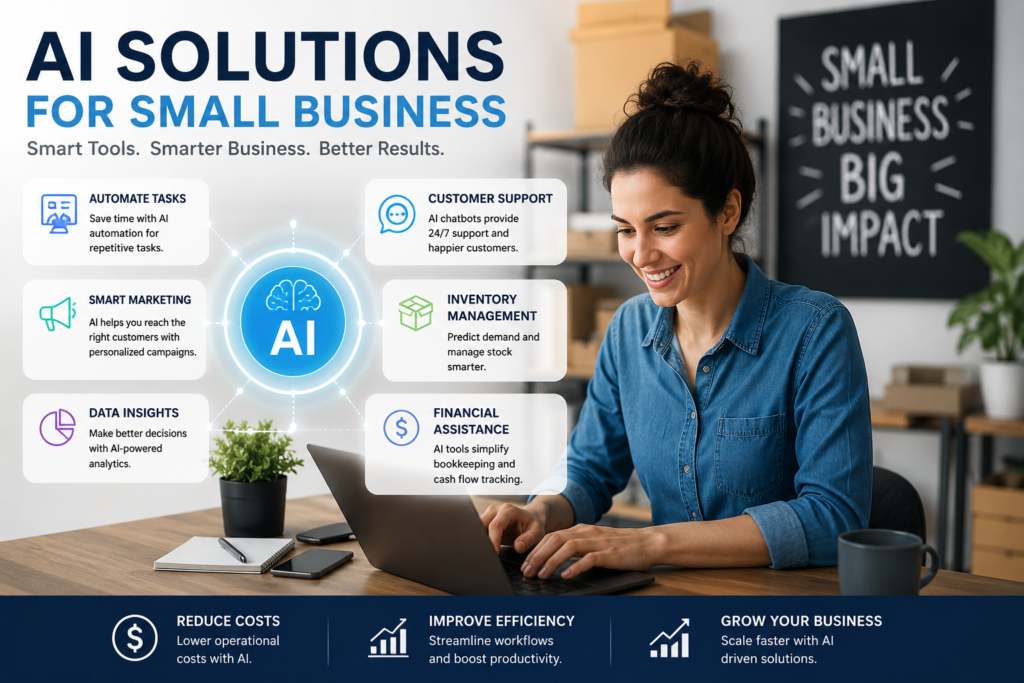
Today, AI can help small businesses:
The real transformation isn’t that AI replaces people. It’s that AI eliminates low-value repetitive work so humans can focus on strategic decisions. This changes the competitive equation. Small businesses no longer need enterprise-scale teams to operate efficiently. They need better systems.
This article explores how AI solutions are reshaping small business operations, where AI creates the highest ROI, what risks owners must consider, and how to implement AI strategically in 2026.
AI adoption is accelerating across industries. OpenAI, Google, Microsoft, and Amazon have pushed AI into mainstream business workflows. But the biggest transformation may happen in small business.
Small businesses often face limited budgets, small teams, operational inefficiencies, and manual workflows. AI directly addresses these constraints.
📊 Industry Impact
| Business Area | Traditional Challenge | AI Impact |
|---|---|---|
| Customer Support | Slow responses | Instant support |
| Marketing | Manual campaigns | Automated personalization |
| Inventory | Overstock/stockouts | Demand prediction |
| Finance | Manual forecasting | Predictive analytics |
| Operations | Repetitive admin work | Workflow automation |
Businesses using AI strategically can improve productivity, profit margins, customer retention, and decision speed. Why should business owners care? Because AI adoption is quickly becoming a competitive advantage. The gap between AI-enabled and non-AI-enabled businesses is widening.
AI doesn’t make small businesses bigger—it makes small teams operate like much larger organizations.
Small businesses struggle to respond quickly to customers. Questions repeat daily: Where is my order? What are your business hours? Is this product available?
Human teams are limited. Support requests scale faster than staff.
⚠️ Risk: High
Slow responses, lost leads, poor customer experience, lower retention.
Deploy AI chatbots and support automation. AI can handle FAQs, order tracking, appointment booking, and basic troubleshooting.
Example: An online fashion store automates 70% of support tickets. Support workload drops dramatically.Security Control: Ensure sensitive customer data remains protected.
Marketing consistency is difficult.
Owners lack time for content creation, campaign management, and customer segmentation.
Risks: Weak brand visibility, lost leads, lower conversion rates.
AI-powered marketing systems. Use AI for email campaigns, ad optimization, SEO recommendations, and content generation.
Example: A small skincare brand uses AI to segment customers by buying behavior. Conversion rate rises.Trend Analysis: Personalized marketing increasingly drives higher ROI.
| Tool Type | Purpose | Best For |
|---|---|---|
| AI Copywriting | Content generation | Blogs, ads |
| Email Automation | Nurture leads | eCommerce |
| AI Analytics | Campaign insights | Growth teams |
| Recommendation Engine | Personalization | Retail |
Inventory mistakes hurt profits.
Forecasting demand manually is unreliable.⚠️ Risk: High
Overstock, dead stock, lost sales, cash flow pressure.
Use predictive analytics. AI analyzes sales history, seasonality, demand trends, and promotions.
Integrate AI with POS system, inventory software, and ERP platform.
Example: A retail shop predicts seasonal spikes in demand. Stock planning improves.Expert Insight: Inventory optimization directly affects profitability.
Cash flow uncertainty kills businesses.
Owners often react instead of forecast.
Risks: Late payments, budget shortfalls, missed opportunities.
AI financial forecasting. Capabilities include revenue prediction, expense monitoring, cash flow alerts, and budget optimization.
Example: AI flags a future cash shortage 45 days early. Owner reduces risk.
| AI Solution | Cost Reduction | Revenue Impact | ROI Speed |
|---|---|---|---|
| Chatbots | High | Medium | Fast |
| Marketing AI | Medium | High | Medium |
| Forecasting AI | High | High | Medium |
| Analytics AI | Medium | Medium | Medium |

Cyberattacks increasingly target small businesses.
Attackers assume weaker defenses.⚠️ Risk: Very High
Ransomware, data breaches, fraud, operational downtime.
AI security tools detect anomalies. AI can identify suspicious logins, malware behavior, fraud patterns, and phishing attempts.
Deploy AI endpoint security, MFA, and threat monitoring.
Example: AI detects suspicious login behavior at 2 AM. Attack blocked.Security Control: AI must enhance—not replace—human oversight.
Many decisions rely on intuition.
Owners lack clean data.
Risks: Poor investments, mispricing, bad hiring decisions.
AI-driven analytics. AI helps identify best-selling products, profitable customers, and underperforming campaigns.
Example: A restaurant identifies top-performing menu items. Profit margin improves.Industry Impact: Data-driven businesses outperform reactive competitors.
Risk Level: High
Find tasks wasting human time.
If Ignored: AI opportunities remain hidden.
Risk Level: High
Start with biggest bottlenecks.
If Ignored: Slow ROI.
Risk Level: Very High
Protect sensitive information.
If Ignored: Breaches and compliance risks.
Risk Level: Medium
Adoption requires education.
If Ignored: Low tool utilization.
Risk Level: Medium
Track outcomes.
If Ignored: Wasteful spending.
“The businesses that win with AI won’t be the ones with the biggest budgets—they’ll be the ones that deploy AI where human time is most expensive.”— Editorial Research Team
| Scenario | Without Controls | With Controls |
|---|---|---|
| Customer Data | Exposed | Protected |
| AI Responses | Inaccurate | Monitored |
| Forecasting | Guesswork | Data-driven |
| Operations | Manual | Automated |
| Growth | Slow | Scalable |
AI is moving beyond automation. Future developments include:
Autonomous systems handling complex workflows.
Customer experiences tailored in real time.
Businesses using voice assistants for operations.
AI forecasting consumer demand before trends emerge.Trend Analysis: Within 12–24 months, AI adoption may become essential for business competitiveness. Businesses that delay risk operational disadvantage.
Artificial intelligence is no longer a luxury reserved for enterprise giants. It is becoming foundational infrastructure for small business growth.
The role of AI in small business ownership extends far beyond automation. AI improves how businesses operate, compete, and scale. It reduces friction in daily operations, strengthens customer relationships, improves forecasting, and enables smarter decision-making.
The most valuable benefit of AI is not cost reduction alone. It is leverage. A five-person team using AI effectively can perform like a twenty-person organization. That changes everything.
Small business owners often face the same challenge: too much work and too little time. AI directly addresses this imbalance by handling repetitive, data-heavy, and operationally intensive tasks.
But implementation matters. Businesses that adopt AI blindly may create new risks: security vulnerabilities, bad automation, poor customer experience, compliance issues. The right approach is strategic adoption. Start small. Identify repetitive tasks. Deploy focused solutions. Measure outcomes. Scale what works.
In the next few years, AI adoption will likely become as standard as using email, accounting software, or CRM tools. The question is no longer whether AI matters. The real question is: How quickly can your business learn to use it effectively? The businesses that answer that question early will build durable competitive advantages.
What are the most common repetitive tasks AI can automate for a small business?
AI can automate customer inquiry responses, appointment scheduling, invoice processing, inventory level alerts, social media posting, and email follow-ups—freeing up hours each week for owners to focus on growth.
How can a small business owner start using AI without technical expertise?
Many AI tools are designed as no-code or low-code SaaS platforms. Start by identifying one high-effort, repetitive task (like customer support or email marketing), choose a well-reviewed AI tool with a free trial, and gradually integrate it into your workflow with minimal setup.
Will using AI make my business feel impersonal to customers?
Not if implemented thoughtfully. AI handles routine interactions efficiently, but it should always route complex or sensitive issues to a human. When paired with personalization engines, AI can actually make customer experiences feel more tailored and responsive.
How do I measure whether an AI tool is actually delivering ROI for my business?
Track clear before-and-after metrics: time saved per task, reduction in support tickets, increase in conversion rates, decrease in inventory waste, or improved cash flow accuracy. Set a baseline and review monthly to see if the tool justifies its cost.
What’s the biggest risk when adopting AI in a small business, and how do I avoid it?
The biggest risk is implementing AI without a clear objective, leading to wasted investment and poor results. Avoid this by starting with a specific pain point, testing the tool with a subset of operations, training employees thoroughly, and maintaining human oversight for quality and security.


How AI is changing SEO strategy for ecommerce stores - highdreamsllc.com
July 10, 2026 at 10:54 am
“ […] AI Chatbot How AI Automation Is Reshaping Ecommerce Service in 2026 AI Chatbot Why Businesses Are Investing in AI Customer Support Amazon Management Amazon Private Label Business Guide, Build a Profitable Amazon Brand in 2026 AI Workflow Agents AI Powered Sales Funnels Explained, How AI Is Rewriting Revenue Growth AI Chatbot Chatbots for E-commerce Stores, The Future of Online Shopping in 2026 AI Chatbot The Role of AI Solutions for Small Business Owners, Competing Smarter in 2026 […] “
AI Chatbot for Service Based Businesses - highdreamsllc.com
July 14, 2026 at 7:32 am
“ […] Needs an AI Chatbot in 2026: The Competitive Advantage Companies Can No Longer IgnoreRead more → The Role of AI Solutions for Small Business Owners: Competing Smarter in 2026Read more → AI Agents for Lead Generation: A Complete Guide to Autonomous Growth Systems in 2026Read more → […] “