Amazon’s ranking system, widely known in the seller community as A10, no longer rewards whoever spends the most on ads. It rewards whoever converts. A listing with a strong conversion rate can outrank a competitor with a bigger ad budget and more reviews — and a listing that converts poorly can slide from page 1 to page 3 in a single quarter, no matter how well it was optimized six months ago. Here’s what actually moves the needle on an Amazon listing in 2026, element by element.
Optimizing an Amazon listing means aligning every element — title, images, bullet points, backend keywords, A+ Content, and pricing — around the two things Amazon’s algorithm weighs most heavily: conversion rate and customer satisfaction signals (reviews, return rate, order defect rate). The benchmark conversion rate in most categories is 10-15%; listings below 5% rarely escape page 3 even with a clean title and decent reviews. Getting there requires more than keyword placement — it means a compliant, zoomable main image, benefit-driven bullets, complete backend search terms, and increasingly, content written in a way Amazon’s Rufus AI shopping assistant can read and recommend confidently.
Amazon doesn’t officially name its ranking system, but the seller community refers to the current version as A10 — the successor to the older, more keyword-and-ad-driven A9 model. Where A9 rewarded whichever listing sold fastest, often propped up by heavy PPC spend, A10 weighs conversion rate, sales consistency, click-through rate, review quality, and return rate together, with conversion rate widely considered the single most influential factor. A listing that converts well tells Amazon it satisfies the searchers it reaches — and Amazon rewards that with better placement, which drives more traffic, which compounds the effect.
Two more recent shifts matter for 2026 specifically. First, return rate now carries real weight: a listing converting at 12% but returning 15% of orders signals a misleading page, and A10 suppresses it accordingly. Second, Amazon’s Rufus AI shopping assistant — used by roughly 250 million shoppers in 2025, with interactions up 210% year over year according to Amazon’s own disclosures — reads listing content, reviews, and Q&A to decide what to recommend, which means listing copy now needs to satisfy an AI reader as well as a human one.
Front-load your primary keyword and strongest benefit in the first 60-80 characters, since mobile truncates titles and over half of Amazon purchases now happen on the app. Avoid keyword stuffing — A10 rewards relevance and readability over repetition.
Pure white background, product filling at least 85% of the frame, minimum 1000 pixels on the longest side for zoom, no text, logos, or props. This single image drives most of your click-through rate from search.
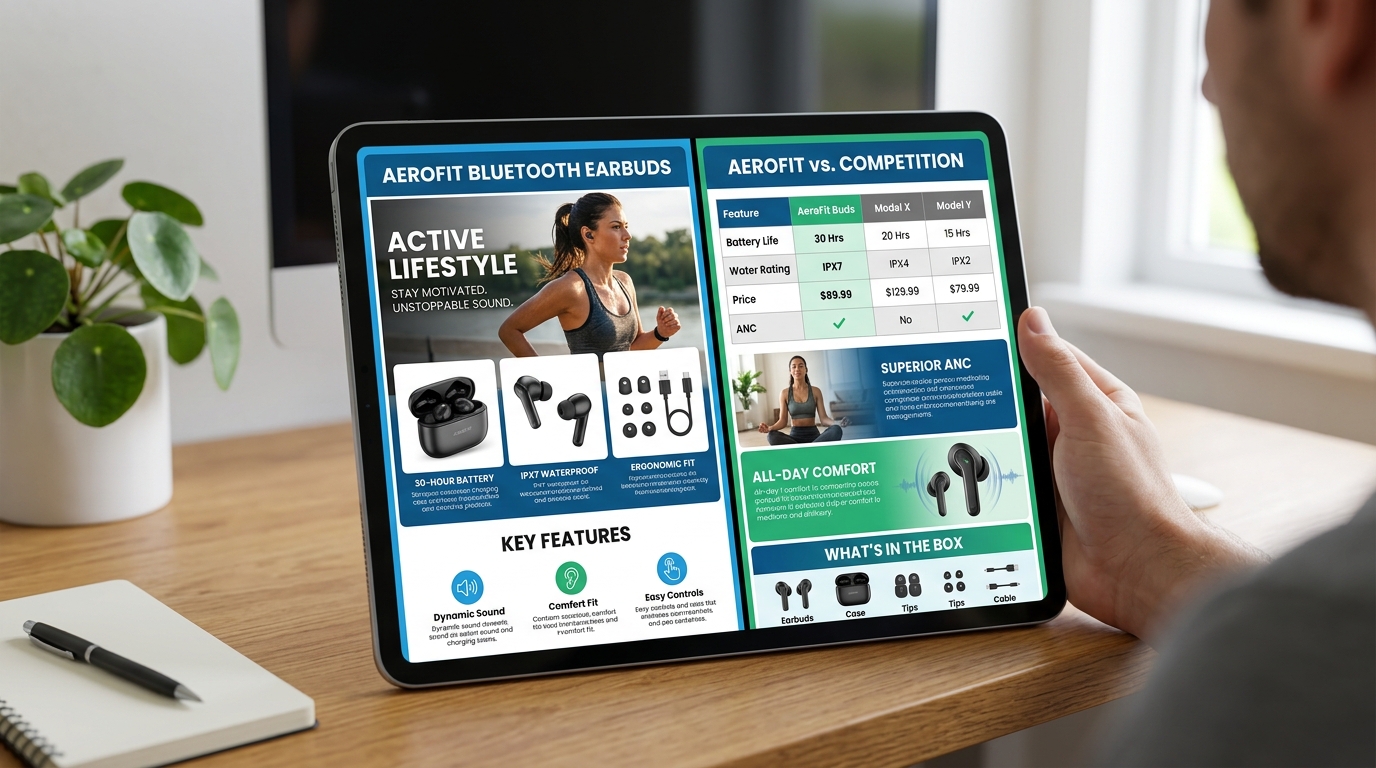
Use slots 2-6 for infographics: feature callouts, dimension diagrams, package contents, and before/after or comparison visuals. These images do the selling once a shopper has already clicked.
Follow a feature-to-benefit structure for each of the five bullets — state the feature, then what it means for the buyer. Mine reviews and Q&A for the exact language customers already use to describe the product.
Brand-registered sellers should invest in A+ Content; Premium A+ Content is commonly associated with a conversion lift of around 20%, particularly for higher-consideration or higher-ticket products.
Use the hidden backend field for synonyms, common misspellings, and terms that don’t fit naturally in customer-facing copy. Avoid repeating words already in your title — it wastes limited character space without adding indexing value.
Volume, recency, and rating all factor into A10’s trust signals, and Rufus reads them directly. Answer every open question and monitor reviews for recurring complaints that signal a real content or product gap.
A10 reacts quickly to price changes and penalizes stockouts almost immediately — and ranking momentum doesn’t fully return the moment you restock. Consistent availability matters as much as the price itself.
| Element | Requirement / Benchmark |
|---|---|
| Main image background | Pure white (RGB 255, 255, 255) |
| Main image size | 1000px+ on longest side (enables zoom) |
| Product frame fill | 85% or more of the image |
| Title priority zone | First 60-80 characters (mobile truncation) |
| Healthy conversion rate | 10-15% (10-20% in competitive categories) |
| A+ Content conversion lift | ~20% (Premium A+, brand-registered sellers) |
A10 rewards relevance and readability, not repetition — cramming the same keyword into the title, bullets, and backend terms wastes limited space without improving indexing.
Search trends shift, competitors update their listings, and new keywords emerge constantly. A quarterly audit cadence is the minimum needed to hold position, not a nice-to-have.
A10 penalizes lost inventory almost immediately, and ranking momentum doesn’t snap back the moment you restock — it has to be rebuilt, which makes inventory planning part of SEO strategy, not just operations.
Since Rufus reads this content directly, unanswered questions and unaddressed negative reviews are conversion leaks and content gaps at the same time — not just reputational noise.
High Dreams LLC is a Colorado-based digital growth agency specializing in Amazon store setup, listing optimization, and advertising management — helping sellers build listings around what A10 actually rewards instead of outdated keyword-stuffing tactics. The agency has shipped work for 150+ clients worldwide across Amazon, Walmart, Etsy, and eBay.
Titles, images, and backend terms reviewed against current A10 ranking factors, not a static 2020-era checklist.
Infographics and Premium A+ Content built to lift conversion on your highest-traffic ASINs.
Conversion rate, stock levels, and review trends tracked continuously, not just at launch.
Services include e-commerce management across Amazon, Walmart, Etsy, and eBay, plus AI chatbots for customer inquiries and website development for sellers building beyond the marketplace.
Get a free consultation and listing audit to see exactly where your conversion rate is leaking.
Conversion rate is widely considered the single most influential factor in Amazon’s current ranking system, followed closely by sales consistency, click-through rate, and return rate.
10-15% is a healthy benchmark in most categories, with competitive categories seeing top performers reach 10-20%. Listings under 5% rarely escape page 3, even with strong reviews.
Premium A+ Content is commonly associated with a conversion lift of around 20%, particularly for higher-consideration products, though results vary by category and execution quality.
A quarterly audit is a reasonable minimum. Search trends, competitor listings, and keyword opportunities shift continuously, and a “set and forget” listing gradually loses ground.
Yes, significantly. Amazon’s algorithm penalizes stockouts almost immediately, and ranking momentum takes time to rebuild after restocking rather than snapping back instantly.
Sources: SellerSprite, “Amazon SEO: How the A10 Algorithm Works in 2026” and “Amazon SEO & Listing Optimization: The 2026 Ultimate Guide” · theStacc, “Amazon SEO: A10 Algorithm Guide (2026)” · Nexscope, “How to Optimize Amazon Listings for Higher Conversions in 2026” · Amazon investor disclosures on Rufus AI shopping assistant usage · Cross-referenced 2026 A10 ranking-factor analyses from Nova Analytics, Seller Labs, and Mind Mingles.


How AI is Revolutionzing Amazon Selling - highdreamsllc.com
July 20, 2026 at 6:18 am
“ […] How to Optimize Amazon Product Listing Step-by-Step Amazon Product Research Guide How AI Voice Agents Improve Amazon Online Business Amazon PPC Guide for Beginners How AI Is Changing SEO Strategy for E-Commerce Stores Amazon Private Label Business Guide: Build a Profitable Brand in 2026 […] “
Step-toStep Amazon Product Research Guide - highdreamsllc.com
July 20, 2026 at 6:19 am
“ […] Private Label Business Guide: Build a Profitable Brand in 2026 How to Optimize Amazon Product Listing Amazon PPC Guide for Beginners Amazon Account Management Best Practices The Algorithmic […] “
Amazon Buy Box Guide: Win More Sales in 2026 Fast
July 21, 2026 at 9:29 am
“ […] How to Optimize Amazon Product Listing Amazon Account Management Best Practices Step-by-Step Amazon Product Research Guide Amazon PPC Guide for Beginners How AI is Revolutionizing Amazon Selling Amazon Private Label Business Guide: Build a Profitable Brand in 2026 […] “
Common Amazon Seller Mistakes That Hurt Sales
July 30, 2026 at 6:01 am
“ […] How to Optimize Amazon Product Listing […] “
Etsy Shop Promotion Strategies Using Social Media
August 4, 2026 at 6:39 am
“ […] ManagementHow to Optimize Amazon Product Listings AI and E-CommerceHow AI Is Changing SEO Strategy for E-Commerce Stores Amazon ManagementAmazon PPC […] “
Etsy Email Marketing Guide for Repeat Customers
August 5, 2026 at 9:12 am
“ […] an AI Chatbot in 2026AI Chatbot Amazon Buy Box Guide: Win More Sales in 2026 FastAmazon Management How to Optimize Amazon Product ListingsAmazon […] “