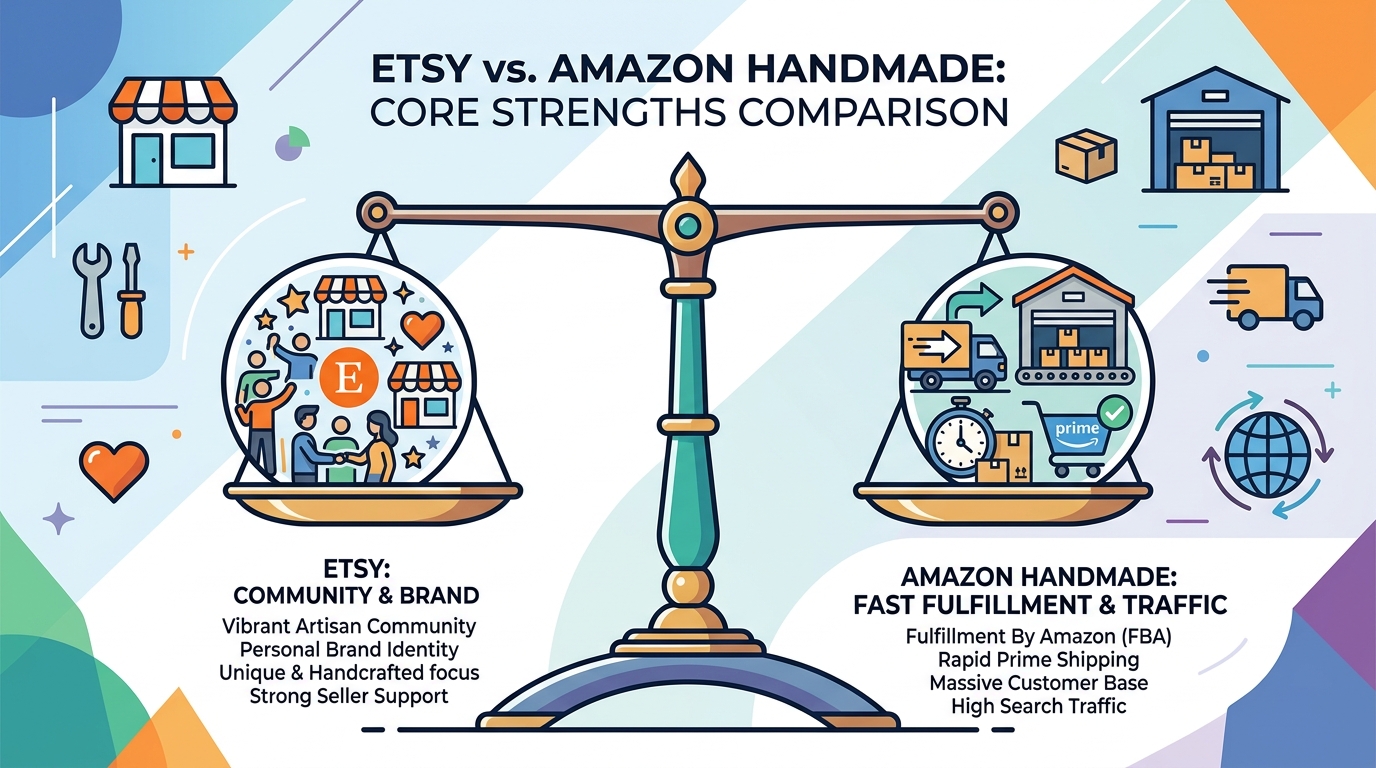
More than half of Etsy’s own sellers already sell on another platform too — so the real question isn’t Etsy versus Amazon Handmade as a permanent choice. It’s which one fits a given product, price point, and stage of business, and whether running both at once actually makes sense. Amazon reports that over 11,000 US-based independent Handmade sellers grew their sales more than 10x in 2025. Etsy still has the larger audience actively looking for handmade goods. Here’s how the two platforms actually compare in 2026 — fees, audience, approval process, and where each one wins.
Etsy has the larger, more intent-driven handmade shopper base (roughly 90 million active buyers) and a lower combined fee load of about 9.5-10.5%, but requires ongoing $0.20 listing fees and offers no built-in Prime shipping advantage. Amazon Handmade charges a flat 15% referral fee with no listing fees and a waived $39.99 Professional account fee for approved sellers, but requires a manual artisan application and audit before you can list a single product. For most makers selling items in the $15-$50 range, Etsy tends to net slightly more per sale; Amazon Handmade often catches up or wins once Prime eligibility and its larger, less handmade-saturated audience are factored in. Many successful sellers run both.
Etsy was built from the ground up as a destination for handmade and vintage goods — buyers arrive already looking for something artisanal, personalized, or one-of-a-kind. Amazon Handmade is a curated section inside the largest general marketplace in the world, meaning a shopper searching for a cutting board might land on a handmade one without ever having sought out “handmade” specifically. That distinction shapes almost every other difference between the two platforms, from buyer expectations to how products need to be marketed.
| Fee | Etsy | Amazon Handmade |
|---|---|---|
| Listing fee | $0.20 per listing, renews every 4 months | None |
| Transaction fee | 6.5% of sale price | 15% flat referral fee (or $0.30/unit, whichever is greater) |
| Payment processing | 3% + $0.25 | Included in referral fee |
| Monthly account fee | None (Etsy Plus optional, $10/month) | $39.99 first month only, then waived for approved sellers |
| Approximate total effective fee | ~9.5–10.5% of sale price | 15% of sale price |
On paper, Etsy’s combined fee load is lower for most transactions. But the comparison shifts depending on price point: for items in the $15-$50 range, Etsy typically nets a seller slightly more per sale. Once Prime eligibility, Amazon’s larger audience, and Amazon Handmade’s genuinely simple flat-fee structure (no listing fees, no separate payment processing charge) are factored in, Amazon Handmade often closes the gap or wins outright — particularly for sellers using FBA or Seller-Fulfilled Prime.
No formal application process. Create a shop, list a product, and start selling the same day — Etsy relies on ongoing policy enforcement rather than upfront vetting.
Requires a Professional Seller account plus a manual application describing your process, materials, and production method. Amazon verifies that products are genuinely handmade, hand-altered, or hand-assembled by a team of 20 or fewer people using hand tools and light machinery — mass production, dropshipping, and resale don’t qualify. Approval typically takes 1-4 weeks, with detailed process descriptions and workspace photos helping applications move faster.
| Factor | Winner |
|---|---|
| Buyer intent (shoppers seeking handmade specifically) | Etsy |
| Total marketplace traffic and reach | Amazon Handmade |
| Ease and speed of getting started | Etsy |
| Fee structure simplicity | Amazon Handmade (single flat fee, no listing costs) |
| Effective take-home on $15-$50 items | Etsy (typically) |
| Prime shipping and conversion lift | Amazon Handmade |
| Brand control and storefront personalization | Etsy |
| Cash flow speed | Etsy (payout on sale vs. Amazon’s post-shipment hold) |
Etsy pays out upon sale, which supports working capital for makers who need to reorder materials quickly. Amazon Handmade holds funds until shipment confirmation, then releases payment within 3-5 business days — a timing structure that works fine for sellers with longer production cycles already built into their process, but can create real cash flow friction for makers who need funds sooner to keep production moving.
The Prime badge is the single lever Amazon Handmade offers that Etsy structurally can’t match. Sellers can earn it two ways: Fulfillment by Amazon (FBA), where Amazon stores, picks, packs, and ships inventory — higher fees, but the most reliable path to Prime and the strongest conversion lift — or Seller-Fulfilled Prime (SFP), which keeps fulfillment in-house but requires meeting Amazon’s fast, reliable shipping standards. For handmade sellers producing items on-demand rather than holding finished inventory, this is often the deciding factor in whether Amazon Handmade’s larger audience translates into real orders.
High Dreams LLC is a Colorado-based digital growth agency with dedicated teams for both Etsy and Amazon store setup, listing optimization, SEO, and account management — helping makers decide which platform fits a given product, or build a coordinated presence across both. The agency has shipped work for 150+ clients worldwide across Etsy, Amazon, Walmart, and eBay.
Product-by-product recommendations on where a listing is likely to perform best, based on price point and category.
Coordinated Etsy and Amazon Handmade storefronts with pricing adjusted for each platform’s real fee structure.
Listing SEO, branding, and account management handled across both marketplaces as the business grows.
Services include e-commerce management across Etsy, Amazon, Walmart, and eBay, plus AI chatbots for customer inquiries and website development for makers building beyond the marketplace.
Get a free consultation to compare your real numbers on Etsy versus Amazon Handmade before you commit.
Etsy’s combined effective fee rate runs roughly 9.5-10.5%, generally lower than Amazon Handmade’s flat 15% referral fee — though Amazon Handmade’s simpler structure (no listing fees, no separate processing fee) can close the gap depending on price point and fulfillment method.
Yes. Etsy requires no application — you can list immediately. Amazon Handmade requires a Professional Seller account and a manual artisan application verifying your process is genuinely handmade, typically taking 1-4 weeks for approval.
Yes, through Fulfillment by Amazon (FBA) or Seller-Fulfilled Prime (SFP) — a meaningful conversion advantage Etsy structurally can’t offer.
Yes, and it’s common — more than half of Etsy’s sellers already sell on other platforms too. Many makers use Etsy as their primary storefront and Amazon Handmade as a secondary channel.
Etsy pays out upon sale. Amazon Handmade holds funds until shipment confirmation, then releases payment within 3-5 business days — a difference worth planning around for makers with tighter cash flow needs.
Sources: Amazon, official Handmade program page (sell.amazon.com) · Craftybase, “How to Apply for Amazon Handmade in 2025 (Step-by-Step Guide)” · TheCraftMap, “Amazon Handmade Application: How to Get Approved as an Artisan in 2026” · MakersMath, “Amazon Handmade Fee Calculator 2026” · Titannetwork, “Amazon Handmade Growth for Sellers | Proven Revenue Systems 2026” · SellerApp, “Amazon Handmade: Everything Sellers Need To Know In 2026” · Etsy, official fee documentation.