Most Amazon sellers who lose ranking aren’t victims of an unfair algorithm — they’re running a strategy that used to work. Amazon’s search system has shifted hard toward rewarding actual customer satisfaction over the raw signals sellers could game a few years ago, and a lot of once-standard advice quietly turned into a liability somewhere along the way. Here’s what’s actually costing sellers ranking and sales right now, and why each mistake works against you specifically.
The Amazon seller mistakes doing the most damage right now are keyword stuffing (which now hurts readability and trust instead of helping), chasing traffic volume instead of conversion quality, ignoring returns and customer service as ranking inputs, applying Google SEO tactics that don’t transfer to Amazon’s closed ecosystem, chasing short-term sales spikes instead of steady velocity, treating A+ Content as decoration, and letting inventory run out. Each of these was defensible advice at some point — the algorithm has simply moved past it.
You’ll see the term “A10” used constantly in Amazon seller circles to describe the current state of the ranking algorithm. Worth knowing upfront: Amazon has never officially confirmed a publicly named “A10” algorithm — it’s industry shorthand sellers use to describe a real, well-documented shift in ranking behavior since the A9 era, not a term Amazon itself uses in its own seller documentation. The underlying behavioral changes described below are genuinely well-corroborated across seller tools and agencies; the “A10” label itself is just useful shorthand, not an official Amazon term.
Cramming a title or bullet points with repeated keywords was a defensible tactic under Amazon’s older, more keyword-matching-driven system. It actively works against you now. Overloaded, unreadable listings hurt buyer trust and engagement, and Amazon’s current ranking behavior weighs semantic relevance and readability over raw keyword density. The fix isn’t abandoning keywords — it’s using them naturally, in service of a title and bullets a human would actually want to read.
Driving more visitors to a listing feels like progress, but traffic that doesn’t convert can actively hurt you. Cheap, poorly targeted clicks — from a bargain social ad campaign, for instance — depress a listing’s conversion rate, and a depressed conversion rate is a direct ranking signal. External traffic is genuinely rewarded when it converts and even qualifies for Amazon’s Brand Referral Bonus program, but the same traffic source that doesn’t convert can quietly work against the listing it was meant to help.
A listing converting at 6% with a 9% return rate loses to one converting at 10% with a 2% return rate, even though the first listing might show more total sales in a given week. Order Defect Rate, return rate, and customer service tickets are direct inputs into how Amazon evaluates a listing’s real customer satisfaction — not a side metric that only matters for account health. Sellers who optimize purely for the sale and ignore what happens after it are optimizing for a number Amazon no longer weighs as heavily as it once did.
Backlink building, off-Amazon content marketing, and domain-authority strategies are staples of Google SEO — and they generate no direct ranking benefit inside Amazon’s closed search ecosystem. Amazon doesn’t evaluate external authority the way Google does. A related version of this mistake: researching keywords the way you would for Google, where informational searches like “best wireless headphones” reflect someone still comparing options. On Amazon, that same phrase reflects a shopper who is typically ready to buy — treating Amazon keyword research as a smaller version of Google keyword research misses that difference in intent entirely.
A sudden burst of sales — a coupon blast, a bulk promotional push — used to translate into a quick ranking boost more reliably than it does now. Current ranking behavior favors consistent, stable sales performance over short-term spikes, which means promotional hacks aimed at a quick jump increasingly produce a temporary bump that fades rather than a durable ranking gain. Long-term, steady performance is what compounds.
A+ Content gets treated by a lot of sellers as a box to check rather than a conversion tool — and well-built A+ Content is commonly cited as lifting conversion rate by 5% to 10%. The versions that actually move that number include a genuine comparison chart against your own product line, lifestyle photography showing real use cases, an FAQ module addressing the actual top questions buyers ask, and a brand story that reads like an honest paragraph rather than corporate copy. Generic template A+ Content, filled in without real product-specific detail, captures little of that lift.
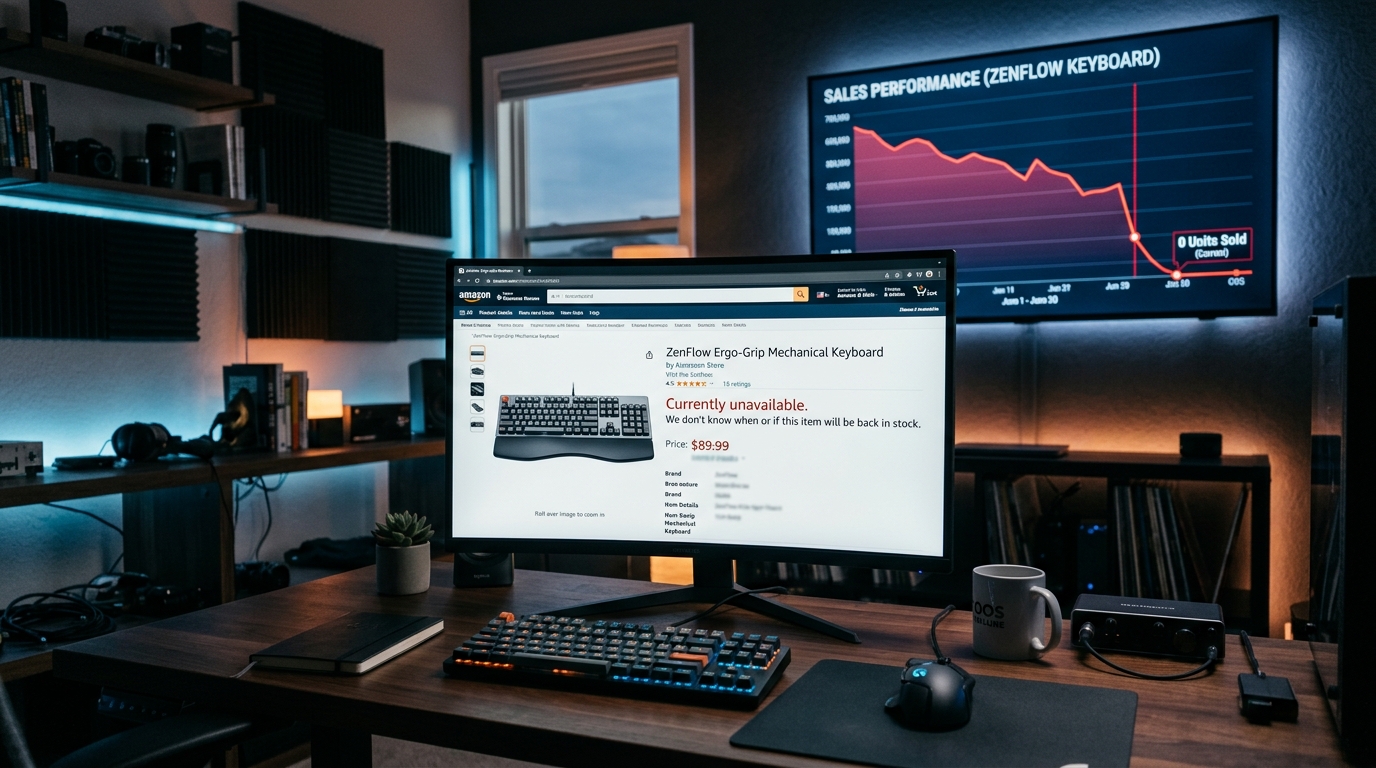
Going out of stock doesn’t just pause sales — it disrupts the sales velocity and ranking momentum a listing had built, and that momentum doesn’t necessarily snap back the moment inventory is replenished. Inventory stability is functionally part of Amazon SEO: a listing can’t rank well if it can’t reliably keep selling, and stockouts during a listing’s growth phase are a particularly costly time to run out.
| Mistake | Why It Hurts Rankings |
|---|---|
| Keyword stuffing | Hurts readability and trust; current ranking behavior favors natural relevance |
| Low-quality external traffic | Depresses conversion rate, a direct ranking input |
| Ignoring returns/ODR | High-conversion, high-return listings can rank below lower-conversion, low-return ones |
| Google SEO tactics | No confirmed ranking benefit inside Amazon’s closed ecosystem |
| Chasing sales spikes | Stable, consistent velocity is favored over short-term bursts |
| Generic A+ Content | Misses the 5–10% conversion lift genuine, product-specific A+ Content provides |
| Stockouts | Breaks sales velocity momentum that doesn’t automatically recover |
Most of these mistakes aren’t a knowledge gap — they’re outdated habits that used to be correct advice. High Dreams LLC manages Amazon accounts against how the algorithm actually behaves today, not how it worked five years ago.
Natural, relevance-driven copy and genuinely differentiated A+ Content, not keyword-stuffed templates.
Traffic quality and post-sale performance tracked as one system, not sales in isolation.
Stock levels managed to protect the ranking momentum a listing has already built.
Explore related services: full e-commerce management for Amazon, Etsy, Walmart, and eBay sellers, and AI workflow agents for automating account monitoring tasks.
Get a free consultation and listing audit to find out what’s actually holding your rankings back.
Get Hired View Our ServicesIs keyword stuffing still effective on Amazon?
No. What may have provided a ranking advantage under Amazon’s older, more keyword-matching-driven system now actively hurts readability and buyer trust. Current ranking behavior favors natural, relevant keyword use over density.
Does driving more traffic to a listing always help its ranking?
No. Traffic that doesn’t convert can depress a listing’s conversion rate, which is a direct ranking input. Poorly targeted, low-intent traffic can hurt a listing’s ranking even as raw visitor numbers go up.
Do backlinks or off-Amazon content marketing help Amazon rankings?
No confirmed direct benefit. Amazon’s closed search ecosystem doesn’t evaluate external authority signals the way Google does, so tactics built around backlinks or domain authority don’t transfer to Amazon rankings.
Is “A10” an official Amazon algorithm?
Not officially confirmed by Amazon. “A10” is industry shorthand sellers use to describe a real, well-documented shift in Amazon’s ranking behavior since the A9 era — a useful way to talk about the trend, but not a term found in Amazon’s own seller documentation.
How much can A+ Content actually improve conversion?
Well-built, product-specific A+ Content is commonly cited as lifting conversion rate by 5% to 10%. Generic, template-based A+ Content that isn’t tailored to the specific product typically captures much less of that benefit.
Sources: SellerSprite, “Amazon SEO: How the A10 Algorithm Works in 2026” · Seller Labs, “Amazon A10 Algorithm in 2026: How to Optimize Your Listings for Maximum Sales” · StarterX, “Amazon Ranking Algorithm: A9, A10 & Ranking Factors (2026)” · theStacc, “Amazon SEO: A10 Algorithm Guide (2026)” · CoSEOCo, “The Amazon A10 Algorithm in 2026: Evolution, Ranking Factors, and Strategic Adaptation” · MarketRealist, “Amazon’s Search Algorithm in 2026: What Drives Rankings and What Sellers Get Wrong” · PlugBooks, “Amazon Ranking Algorithm Guide for Sellers 2026.”