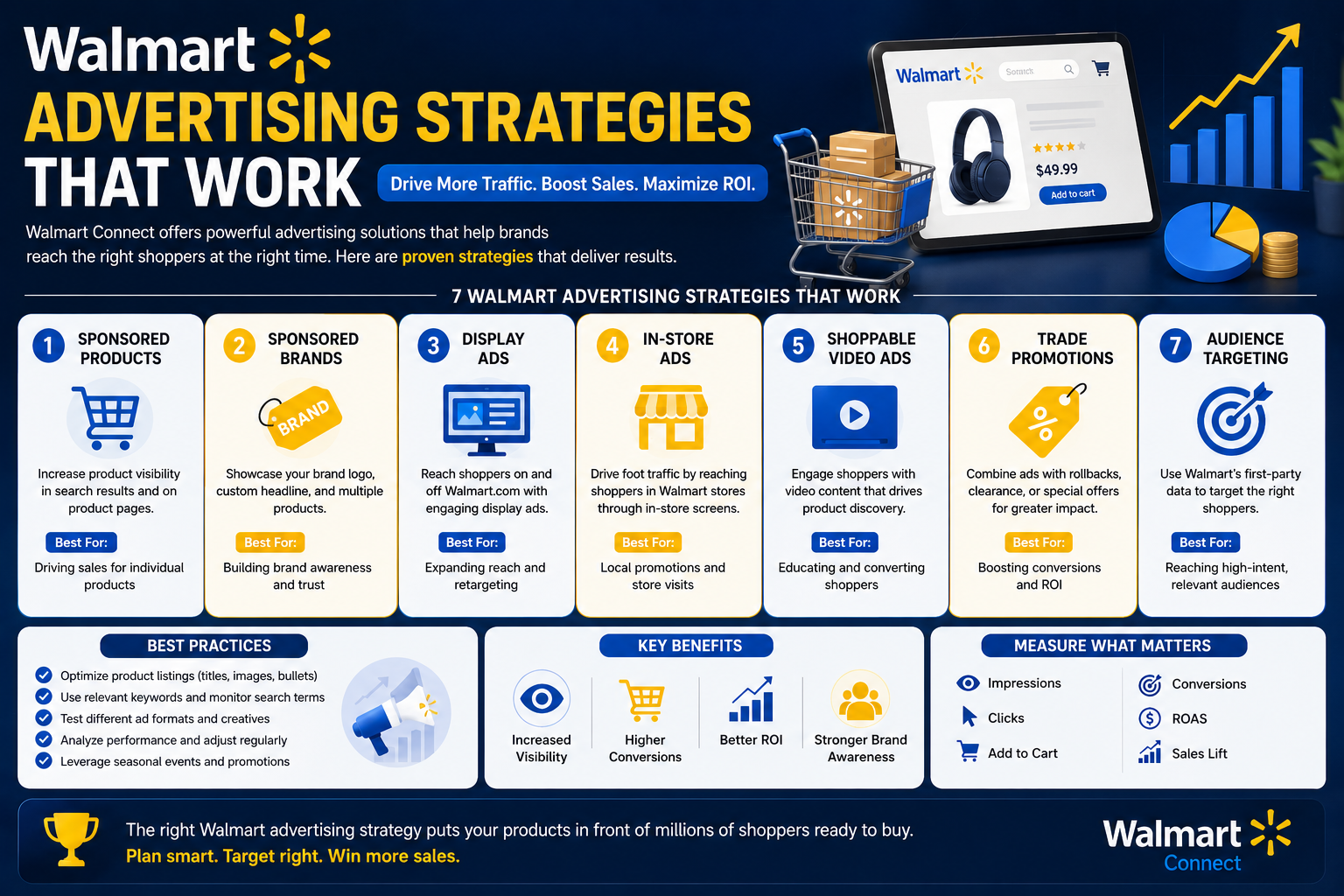
Walmart Connect is one of the fastest-growing retail media networks in the country, and still one of the least crowded. Walmart’s global advertising revenue climbed 46% to nearly $6.4 billion in fiscal 2026, yet most third-party sellers are either not advertising at all or are copying an Amazon playbook that doesn’t map cleanly onto Walmart’s auction. This guide covers the Walmart advertising strategies that are actually working right now, from campaign structure to weekly optimization.
More than 150 million customers shop Walmart every week across its site, app, and roughly 4,600 physical stores, and Walmart’s U.S. eCommerce sales are projected to reach $82.6 billion in 2026. That scale, combined with a second-price auction and comparatively low advertiser competition, makes Walmart Connect one of the more efficient places to spend ad dollars in e-commerce today, if you set campaigns up the right way.
The catch is that Walmart’s ad mechanics are not a copy of Amazon’s. Match types are stricter, the auction rewards true relevance in your listing content, and Buy Box eligibility gates whether your ads show at all. Sellers who transplant an Amazon campaign structure onto Walmart without adjusting for these differences typically see weak results and conclude the platform “doesn’t work,” when the real issue is the setup.
Walmart Connect has quietly become one of the most efficient acquisition channels available to marketplace sellers. A few developments make 2026 a particularly good time to get serious about it:
Walmart Connect also runs on a second-price auction: you set a maximum bid, but you only pay one cent above the next-highest competing bid. That structure rewards advertisers who bid their true maximum value, since overpaying relative to the competition is largely self-correcting. Walmart has also begun layering AI directly into the platform, including an advertiser-facing assistant called Marty that answers natural-language questions about bidding, keywords, and billing, and a consumer-facing shopping assistant, Sparky, that is opening up entirely new sponsored placements inside conversational search.
Before building a strategy, it helps to know exactly what you’re choosing between. Walmart Connect groups its formats into three broad categories: Sponsored Search, Onsite Display, and Offsite media.
| Format | Best for | How it’s billed | Where it appears |
|---|---|---|---|
| Sponsored Products | Driving clicks and conversions on individual SKUs | Cost-per-click, second-price auction | Search results, category pages, item pages, carousels |
| Sponsored Brands | Brand awareness and multi-product showcases for registered brands | Cost-per-click, keyword-targeted | Top of relevant search results, with logo and headline |
| Sponsored Videos | Products that benefit from demonstration or storytelling | Cost-per-click | Within search results, alongside other sponsored formats |
| Onsite Display | Awareness, launches, and seasonal promotions using first-party behavioral data | CPM or CPC | Homepage, category pages, product pages |
| Offsite Media (Walmart DSP) | Upper-funnel reach beyond Walmart.com using Walmart’s shopper data | Programmatic, CPM-based | Partner websites and apps across the open web |
Treat this as a build order. Skipping steps, especially the first one, is the most common reason Walmart campaigns underperform.
If your listing doesn’t hold the Buy Box, your Sponsored Products ads simply won’t display, no matter how well the campaign is built. Competitive pricing, strong reviews, reliable shipping, and healthy in-stock rates are the levers that win it. Fix this first; everything else depends on it.
Automatic campaigns let Walmart match your listing to relevant searches on its own. Run these first on your best-selling, in-stock, category-relevant SKUs to build a real dataset of which search terms actually convert, rather than guessing at keywords upfront.
Once you have converting search terms, move them into Manual campaigns using broad, phrase, and exact match together rather than picking just one. Campaigns structured this way tend to outperform single-match-type setups by a wide margin, because each match type plays a different role: broad for discovery, phrase and exact for control and efficiency.
Brand Term Targeting lets you bid on your own brand terms to reserve the top ad positions against competitors trying to poach your traffic, and can also be used offensively on competitor terms once your fundamentals are solid. Start defensively; it’s the lower-risk, higher-certainty use of the feature.
Review placement and product-level performance weekly. Any product racking up meaningful clicks with a low conversion rate is almost always a listing problem, weak title, thin images, poor pricing, not an advertising problem. Fix the listing before you touch the bid. Products converting well and running efficiently deserve more budget, not a static cap.
Sponsored Brands work best for registered brands with multiple SKUs in a category and help newer brands without strong organic rankings gain visibility. Sponsored Videos are particularly effective for products that benefit from demonstration. Both formats amplify a strong Sponsored Products foundation, they rarely fix a weak one.
Sponsored Search wins the bottom of the funnel, shoppers already searching for what you sell. Onsite Display and the Walmart DSP extend reach to shoppers who haven’t searched yet, using Walmart’s first-party purchase data to build awareness ahead of a launch or seasonal push.
Walmart Connect’s Marty assistant can answer specific, natural-language questions about bidding, keyword performance, and billing directly inside the Ad Center. Sellers managing several campaigns can use it to catch issues and surface recommendations faster than manually digging through reports every week.
Advertising performance is downstream of listing quality, fulfillment reliability, and how quickly a seller can react to weekly performance data, which is exactly why most sellers benefit from combining Walmart Connect management with broader e-commerce optimization. In practice, that means:
High Dreams LLC manages Walmart Marketplace advertising and store operations as part of a broader e-commerce practice that also covers Amazon, eBay, and Etsy, so campaign strategy is built alongside listing optimization, not in isolation from it. The team has delivered results for more than 150 clients worldwide, with an eval-first approach that tracks accuracy, cost, and outcomes from the first week of a campaign rather than waiting for a quarterly review.
Book a free consultation with High Dreams LLC to audit your current listings and Walmart Connect setup, and get a clear plan for what to fix first.
The most common cause is Buy Box eligibility. If your listing doesn’t currently hold the Buy Box, Sponsored Products ads for that item won’t display, regardless of your bid or budget. Check pricing, stock levels, and shipping performance first.
No. Walmart’s auction mechanics, match-type behavior, and shopper intent all differ from Amazon’s. Walmart favors listings with exact keyword phrases present in the content more heavily, so campaign structure and listing copy need to be built specifically for Walmart rather than ported over.
Weekly, at minimum. Reviewing placement and product-level performance weekly lets you catch listing problems, adjust bids, and add negative keywords before they quietly waste budget over a full month.
Sponsored Products are single-SKU, cost-per-click ads that appear throughout search and browse. Sponsored Brands are keyword-targeted placements at the very top of search results featuring your logo, a custom headline, and multiple products, available to brands registered with the Walmart Brand Portal.
Often, yes. Walmart Connect has fewer active advertisers than Amazon in most categories, which generally means lower cost-per-click and a real opportunity to build early sales velocity and organic ranking, provided the underlying listing and Buy Box fundamentals are already solid.
Walmart advertising works when it’s treated as its own discipline rather than an Amazon campaign copy-pasted into a new platform. Win the Buy Box, build from Automatic into Manual campaigns with all three match types, optimize weekly, and only layer in brand and display formats once your Sponsored Products foundation is converting. Sellers who follow that sequence are the ones capturing the low-competition advantage Walmart Connect still offers in 2026.


How to Get Approved for Walmart Marketplace - highdreamsllc.com
July 17, 2026 at 7:01 am
“ […] Walmart Advertising Strategies That Work Amazon PPC Guide for Beginners How to Create a High-Converting eBay Listing How AI Is Changing SEO Strategy for E-Commerce Stores The Algorithmic Marketplace: How to Start Selling on Amazon How AI Can Help Etsy Sellers Grow Faster […] “
Common Ebay Seller Mistakes - highdreamsllc.com
July 20, 2026 at 6:14 am
“ […] to Create a High-Converting eBay Listing Walmart Advertising Strategies That Work Amazon PPC Guide for Beginners How AI Is Changing SEO Strategy for E-Commerce Stores The […] “
Walmart Seller Growth Tips for Beginners - highdreamsllc.com
July 20, 2026 at 6:33 am
“ […] to Get Approved for Walmart Marketplace Walmart Advertising Strategies That Work How to Optimize Amazon Product Listing Etsy SEO Guide for More Sales How to Create a […] “