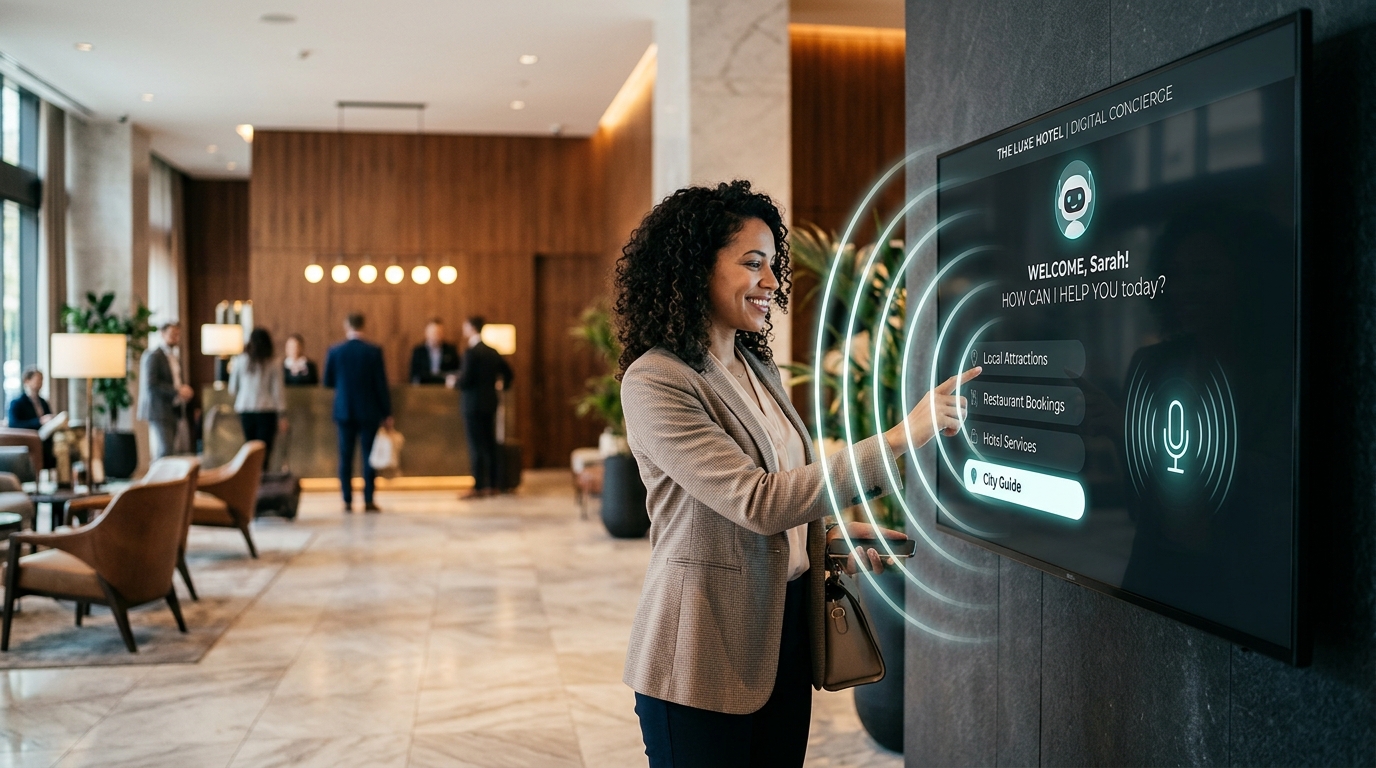
During busy periods or after hours, hotels miss up to 40% of incoming calls — not because demand is too high, but because a front desk with two people can’t answer the phone, check in a walk-in guest, and handle a housekeeping request at the same time. Every missed call is a guest who might book somewhere else instead. AI voice agents built specifically for hospitality are closing that gap, with one Guest Voice AI deployment reporting 95% of inquiries handled automatically and $20,000 in annual savings per property. Here’s what these systems actually do, and where hospitality’s emphasis on tone and warmth changes how they need to be built.
AI voice agents for hotels answer phone calls 24/7 in multiple languages, handling reservations, front-desk inquiries, in-room dining orders, and service requests without adding headcount. Deployments report automating up to 95% of guest inquiries, cutting operational costs by as much as 65%, and lifting guest satisfaction by 28-32% when the voice experience is genuinely well-designed. The catch specific to hospitality: unlike a retail or support chatbot, a hotel voice agent has to sound warm and unscripted, not efficient and robotic — the philosophy behind the better deployments is that AI voice agents should protect the human hospitality experience by absorbing routine call volume, not replace the feeling of being genuinely welcomed.
Hotels run on phone calls in a way few other industries do — reservations, front-desk questions, room service, maintenance requests, and concierge inquiries all funnel through the same handful of phone lines, often staffed by a front desk team already juggling in-person guests. That structural mismatch is exactly why missed calls run as high as 40% during peak periods: the problem isn’t insufficient demand, it’s a phone system that can only handle one conversation at a time serving a business that needs to handle many at once.
Academic research on hospitality voice AI found something worth noting for any hotelier skeptical of automation: guests increasingly view the loss of “human touch” in interactions differently than they once did — in the post-pandemic hospitality landscape, instant, always-available service is now frequently seen as an advantage rather than a compromise, provided it’s designed well.
Answering room availability, rates, and booking a stay directly over the phone — the highest-value call type to never miss, since a caller who can’t get through often books a competing property instead.
Check-in/check-out times, parking, amenities, and general property questions handled instantly, freeing front desk staff to focus on guests physically standing in front of them.
Taking room service orders by phone without pulling a staff member away from the floor — a routine, transactional task well-suited to full automation.
Housekeeping needs, maintenance issues, and extra amenities routed directly to the right team, with details captured accurately the first time instead of relayed through a rushed front desk conversation.
Answering in any major language without needing multilingual staff on every shift — a meaningful advantage for properties serving international travelers around the clock.
Changes and cancellations handled directly by voice rather than requiring a callback or hold time, reducing both guest frustration and staff interruptions.
Some deployments turn inbound inquiries into qualified booking opportunities automatically, ensuring a human sales team only spends time on guests who are ready to commit.
Restaurant suggestions, directions, and local information delivered instantly, covering the routine concierge questions that don’t require a human’s personal touch.
| Deployment | Reported Result |
|---|---|
| Guest Voice AI (Venza) | Automates up to 95% of guest inquiries; ~$20,000 in annual savings per property |
| Global hotel chain rollout | 65% drop in operational costs with round-the-clock multilingual support |
| Marriott personalized voice services | Guest satisfaction rose 32% with room service and preference integration |
| Industry-wide guest sentiment | 58% of guests say AI improves their booking and stay experience; 28% average satisfaction increase |
| Lance (50+ hotels, incl. Marriott/Hilton/Hyatt properties) | Answers guests 24/7 across call, SMS, and email; routes and escalates automatically |
Figures reflect vendor and industry-reported results. Actual outcomes depend on property type, call volume, and integration quality with existing hotel systems.
Hospitality is relational in a way that most industries a voice agent gets deployed in are not — tone, timing, and warmth carry real weight in a hotel interaction, not just accuracy. The philosophy behind stronger deployments is explicit about this: AI shouldn’t replace hospitality, it should protect it, by absorbing the routine call volume that otherwise pulls staff away from the in-person moments where hospitality actually happens. A voice agent that sounds scripted or robotic undermines the exact experience a hotel is trying to protect — which is why hospitality-specific voice platforms invest heavily in natural, unhurried conversational design rather than the fast, transactional tone that works fine for a retail support line.
Hotel technology stacks are often more fragmented than they appear from the outside — reservation systems, property management systems (PMS), loyalty programs, and in-house operations software frequently weren’t designed with voice AI in mind, and many properties still run older, on-premise systems that require a different integration approach than a modern cloud API. The voice agents seeing the strongest real-world results are the ones built to navigate this fragmentation directly, integrating with existing PMS and reservation platforms rather than requiring a hotel to rip out and replace its core systems just to add voice automation.
A voice agent built for retail support and lightly re-skinned for hospitality tends to sound exactly like what it is — efficient but cold. Hospitality-specific tone design isn’t a cosmetic detail; it’s central to whether guests trust and enjoy the interaction.
A voice agent that can’t actually check real-time availability or update a reservation in the hotel’s core system is limited to answering questions, not resolving them — integration depth determines how much of the call volume genuinely gets handled versus escalated.
Special requests, complaints, and unusual circumstances still need a person. A voice agent without a fast, natural handoff frustrates exactly the guests most likely to leave a negative review.
Properties serving international travelers should scope multilingual support from day one — retrofitting it later means redesigning conversation flows that were only ever tested in one language.
High Dreams LLC is a Colorado-based AI and digital growth agency that has shipped AI voice agents for 150+ clients worldwide — moving from idea to production in 1 to 4 weeks, with a design process built around the tone and integration challenges specific to hospitality rather than a generic call-center template.
Your call volume, missed-call patterns, and PMS/reservation system are mapped before anything is built.
A working voice agent is tested against real guest scenarios, tuned for a warm, unscripted tone rather than a transactional one.
Booking accuracy, escalation handling, and guest experience quality are tested against defined thresholds before launch.
Relevant services include AI voice agent development, AI chatbots for web-based inquiries, and AI workflow agents for service request routing.
Get a free consultation to see what a 24/7 multilingual voice agent would look like for your property.
Up to 40% during busy periods or after hours, according to hospitality AI industry data — not because demand exceeds capacity, but because front desk teams handling in-person guests can’t simultaneously manage phone volume.
Yes. Voice agents integrated with a hotel’s property management and reservation systems can check real-time availability, quote rates, and complete a booking directly over the phone.
Not when designed well. Industry data shows 58% of guests say AI improves their booking and stay experience, with satisfaction increases of 28-32% reported in strong deployments — the key is a warm, natural conversational tone rather than a robotic, transactional one.
Yes, and this is one of the more valuable capabilities for properties serving international travelers — answering in any major language without needing multilingual staff on every shift.
Integration with existing, often fragmented hotel technology — reservation systems, PMS platforms, and loyalty programs that weren’t originally designed with voice AI in mind. Deployments that integrate deeply with these systems handle far more call volume than ones that only answer questions.
Sources: Y Combinator, company profiles for Riviera (“AI Employees for Hotels”) and Lance (“AI Agents That Run Hotel Operations”) · Venza, “Venza to Acquire Guest Voice AI to Elevate Hotel Communication” · roverIQ, “roverIQ Brings Always-On AI Hospitality to Hotels Through Seamless StayNTouch Integration” · RaftLabs, “How Voice AI Is Reshaping Hospitality” · Buhalis, D. & Moldavska, I., “In-room Voice-Based AI Digital Assistants Transforming On-Site Hotel Services and Guests’ Experiences,” Springer (2020, PMC open access).