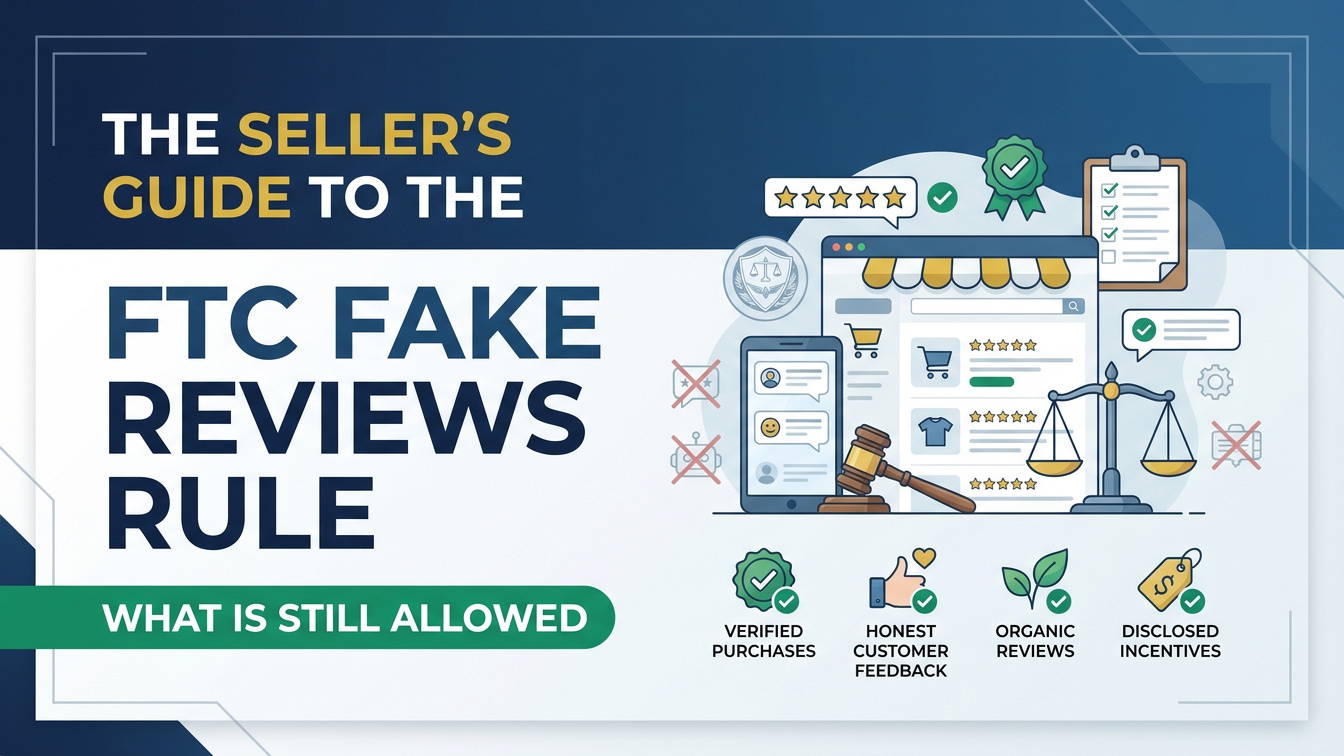
The FTC fake reviews rule bans fake and AI-generated reviews, buying reviews tied to a positive or negative rating, undisclosed insider reviews, fake independent review sites, review suppression, and fake social media followers. Sellers can still ask all customers for reviews, respond to negative reviews, and offer incentives that do not depend on sentiment. Marketplace rules can be stricter, so check them too.
If you sell online, you have probably asked yourself the same question. Is this review tactic still okay? The answer used to be vague. Since 2024, the FTC fake reviews rule has drawn clearer lines.
This guide explains what the FTC fake reviews rule bans, what you can still do, and where trouble remains. It uses the FTC’s own rule summary and staff Q&A. It is general information, not legal advice.

The rule is the Trade Regulation Rule on the Use of Consumer Reviews and Testimonials, also known as 16 CFR Part 465. According to the FTC’s staff Q&A on the rule, it went into effect on October 21, 2024. It lets courts impose civil penalties for knowing violations.
A few basics help you read the FTC fake reviews rule correctly:
the FTC’s announcement of the final rule lists six prohibited practices. Here are the six bans of the FTC fake reviews rule in plain words.
| The rule bans | In plain words |
|---|---|
| Fake or false reviews and testimonials | Reviews by people who do not exist, did not use the product, or misstate their experience. This includes AI-generated fake reviews. Businesses cannot write, sell, or buy them. |
| Buying reviews conditioned on sentiment | Incentives that depend on a positive or negative review, whether stated or implied. |
| Undisclosed insider reviews | Reviews by officers, managers, employees, or agents that hide their connection to the business. |
| Fake “independent” review sites | Sites you control that claim to give independent reviews of products that include your own. |
| Review suppression | Using groundless legal threats, intimidation, or certain false accusations to stop or remove reviews. It also bars claiming your reviews are complete when you hid some based on rating. |
| Fake social media indicators | Buying or selling bot followers or views, when the buyer knew or should have known they were fake. |
Under the FTC fake reviews rule, notice the words “knew or should have known.” For several bans, you are liable when you had clear warning signs. The FTC gives examples, such as reviews that appear so fast after purchase that they cannot be real.
Many everyday tactics remain allowed under the FTC fake reviews rule. These answers come from the FTC’s staff Q&A. Conditions matter, so read the last column.
| # | What you want to do | Verdict | Condition |
|---|---|---|---|
| 1 | Ask all recent customers for reviews | Allowed | Generalized solicitations to purchasers are exempt from the insider-review section. |
| 2 | Send automatic review request emails | Allowed | Same exemption. Do not pick only customers you expect to be happy. |
| 3 | Offer an incentive for a review | Allowed by the rule | It cannot depend on a positive or negative review. Disclose the incentive, because the FTC Act can apply. |
| 4 | Reply publicly to a negative review | Allowed | Do not make false accusations or use threats or intimidation. |
| 5 | Contact unhappy customers to fix the problem | Allowed | The FTC says this is not prohibited, and neither is asking satisfied customers to update reviews. |
| 6 | Threaten legal action over a defamatory review | Allowed with a real basis | The threat cannot be unfounded or groundless. |
| 7 | Ask family members to review you | Allowed with disclosure | They must clearly and conspicuously disclose the relationship. |
| 8 | Ask insiders to review with a disclosure | Allowed with disclosure | If insider reviews lift the star rating, the FTC Act may still apply. |
| 9 | Sort reviews by “most helpful” | Allowed | Sorting is not suppression. Burying negatives could still be deceptive under the FTC Act. |
| 10 | Skip reviews about the wrong business or product | Allowed | Apply the policy equally to positive and negative reviews. |
| 11 | Hire influencers to post about your product | Allowed | Their testimonials must be truthful. You can be liable if you knew or should have known they were not. |
| 12 | Use AI avatars or virtual influencers | Not banned outright | They cannot give fake testimonials, and misleading use can still violate the FTC Act. |
One distinction is worth remembering. The FTC says a business hosting reviews is not liable for fake ones it did not write or buy. However, once you feature a review in your ads, it becomes a testimonial, and the hosting exemption no longer applies.
These practices fall under the FTC fake reviews rule or run straight into it. Several come directly from the FTC’s examples.
| Practice | Why it fails |
|---|---|
| Buying five-star reviews | The rule bans buying reviews expressing a particular sentiment. |
| “Leave a 5-star review and get 10% off” | The incentive depends on sentiment. |
| “Tell us how much you loved your visit and get a coupon” | The FTC says this implies the review must be positive. |
| Employees posting glowing reviews without disclosure | Undisclosed insider reviews are banned. |
| Writing reviews with AI and posting them as customers | Reviews by people who do not exist are fake. |
| Buying bot followers to look popular | Fake social media indicators are banned when you knew or should have known. |
| Running a “top 10” site you own and calling it independent | Company-controlled sites cannot claim independence. |
| Threatening customers with baseless lawsuits | Groundless legal threats are review suppression. |
| Hiding reviews below a certain star rating while saying the page shows all reviews | This misrepresents the reviews as complete. |
| Paying a broker for “review packages” | Brokers and buyers can both be liable. |
The FTC also gives a plain test for incentives. If you suggest, even without saying so, that a review has to be positive to earn the reward, you have crossed the line. Offering a reward for “honest feedback” is different from rewarding “how much you loved it.”
Not every risky tactic violates the FTC fake reviews rule. However, the FTC Act and the Endorsement Guides still apply. The FTC repeats this in its Q&A, so do not read silence in the rule as permission.
| Gray area | What the FTC says |
|---|---|
| Asking only happy customers | No specific rule ban, but it could violate the FTC Act and the Endorsement Guides. |
| Incentives with no disclosure | The rule allows non-sentiment incentives, but failing to disclose them could violate the FTC Act. |
| Paying to change or remove a negative review | Not banned by the rule, but it may be unfair or deceptive under the FTC Act. |
| Showing only your best reviews in ads | The rule does not cover it, but unrepresentative reviews can be deceptive. |
| Ordering reviews to bury negatives | Sorting is not suppression, but making negatives hard to find can be deceptive. |
| Expecting a review to be positive | Not a rule violation by itself, but the FTC Act may apply. |
The practical lesson from the FTC fake reviews rule is simple. Ask yourself whether a shopper looking at your reviews would be misled. If yes, you are in risky territory, even if no rule line fits.
The FTC fake reviews rule sets a federal floor. Marketplaces set their own rules on top of it. As a result, something can be legal and still get your listing removed or your account suspended.
Amazon is a clear example. In Amazon’s announcement on incentivized reviews, the company said its community guidelines prohibit incentivized reviews unless they go through its Vine program. The FTC rule, by contrast, does not prohibit incentives that are not tied to sentiment. In Amazon’s seller forum post on review policy, an Amazon team member also points sellers to the Request a Review button in Seller Central, and to Vine for brand-registered sellers.
We could not verify the current review rules for Etsy, Walmart, or eBay for this article. Read each platform’s own policy before you run any review campaign. Our guide on AI chatbots and cart abandonment covers another way to improve customer experience without touching reviews.
Enforcement of the FTC fake reviews rule is real. Here is a timeline based on FTC releases and law firm summaries.
| Date | Event | Why it matters |
|---|---|---|
| Oct 21, 2024 | Rule takes effect | Civil penalties become available for knowing violations. |
| Dec 22, 2025 | FTC sends warning letters to 10 companies | First public enforcement step, per law firm summaries. |
| Apr 2026 | FTC announces TruHeight case | Allegations include employee-written five-star reviews and incentives for five-star reviews. |
| May 11, 2026 | Premium Home Service lawsuit filed | Allegations include thousands of fake listings and fabricated five-star reviews. |
| Jul 2026 | TruHeight final order | The order bars fake or improperly incentivized reviews and requires a payment of $750,000 per press coverage. |
On the TruHeight case, the FTC’s April 2026 TruHeight announcement alleges that the company used employee-written five-star reviews and offered free products or discounts for five-star reviews. the final order in July 2026 followed. In the Premium Home Service case, the FTC’s May 2026 press release says the defendants created thousands of fake listings and fabricated five-star reviews.
The December 2025 warning letters cited civil penalties of up to $53,088 per violation, according to a law firm summary of the December 2025 warning letters. The FTC adjusts penalty amounts for inflation, so check the current figure.
Run this audit of your FTC fake reviews rule compliance once a quarter. It takes about an hour for a small shop. Write down what you find, and fix the problems before they grow.
This template fits the FTC fake reviews rule. It asks for honest feedback and offers help. It does not promise anything for a positive rating.
If you automate requests, keep the message generalized and send it to every eligible buyer. Also remember the rules for email itself. the FTC’s CAN-SPAM guide requires accurate header information, a postal address, and a clear opt-out.
Most problems with the FTC fake reviews rule come from the same few habits. Check your shop against this list.
| Mistake | Better approach |
|---|---|
| Offering a discount for “a 5-star review” | Offer it for an honest review, and never tie it to sentiment. |
| Hiding an incentive | Disclose it clearly, and follow your platform’s rules. |
| Letting staff review the shop | Require a clear disclosure, or do not ask. |
| Using AI to “fill out” new product reviews | Never. Collect real reviews only. |
| Deleting reviews you dislike | Respond and resolve. Do not suppress by rating. |
| Assuming the FTC rule overrides marketplace policy | Read each marketplace’s own rules too. |
Use the platform’s own review request tools, and never offer rewards outside its rules.
Send generalized review requests after delivery, and display all reviews fairly.
Ask every customer, respond to every negative review, and never write reviews for yourself.
Audit client review programs against the FTC fake reviews rule. Agencies and review brokers can be liable under the rule. Our AI chatbot vs live chat comparison shows why human review still matters.
High Dreams LLC builds e-commerce systems, workflow automation, and AI chatbots with human review built in. Tell us how you collect customer feedback today.
High Dreams LLC is a Colorado-based AI and digital growth agency focused on practical AI for business. The team builds AI chatbots, voice agents, workflow automation, websites, apps, and e-commerce systems. Each project starts with the workflow a business actually needs, and human escalation is built in from the start.
Yes. The rule applies to the conduct of businesses, and it does not carve out small ones. Courts can impose civil penalties for knowing violations. Ordinary consumers who write reviews are not liable under the rule.
The FTC rule does not prohibit incentives for reviews, as long as nothing says or implies the review must be positive or negative. You should disclose the incentive, because the FTC Act can apply. Platforms such as Amazon prohibit most incentivized reviews, so check their rules first.
The rule has no specific ban on this, but the FTC says the practice could violate the FTC Act. Sending a generalized request to all recent buyers is safer.
Yes, but they must clearly and conspicuously disclose their relationship to you. The FTC also warns that insider reviews which materially raise your star rating could still violate the FTC Act, even with a disclosure.
Reviews that claim to be from someone who does not exist, including AI-generated ones, are prohibited. The rule has no blanket ban on AI avatars in marketing, but they cannot give fake testimonials or mislead people.
The FTC’s December 2025 warning letters cited civil penalties of up to $53,088 per violation, according to law firm summaries. Penalty amounts adjust over time, so confirm the current figure with the FTC.
The safest way to follow the FTC fake reviews rule is also the simplest. Ask every customer. Reward honesty, never ratings. Disclose connections, and never fake or hide anything. Then check your marketplace’s own rules.
Run the seven-step audit this week. Fix what you find, and write down the date. That record shows you take the rule seriously.
This article is general information, not legal advice. FTC staff guidance is not a safe harbor, and outcomes depend on the facts. Laws, penalty amounts, and marketplace policies change. Details reflect pages retrieved on November 25, 2026. We could not verify current review rules for Etsy, Walmart, or eBay. High Dreams LLC is not affiliated with the FTC or any marketplace.