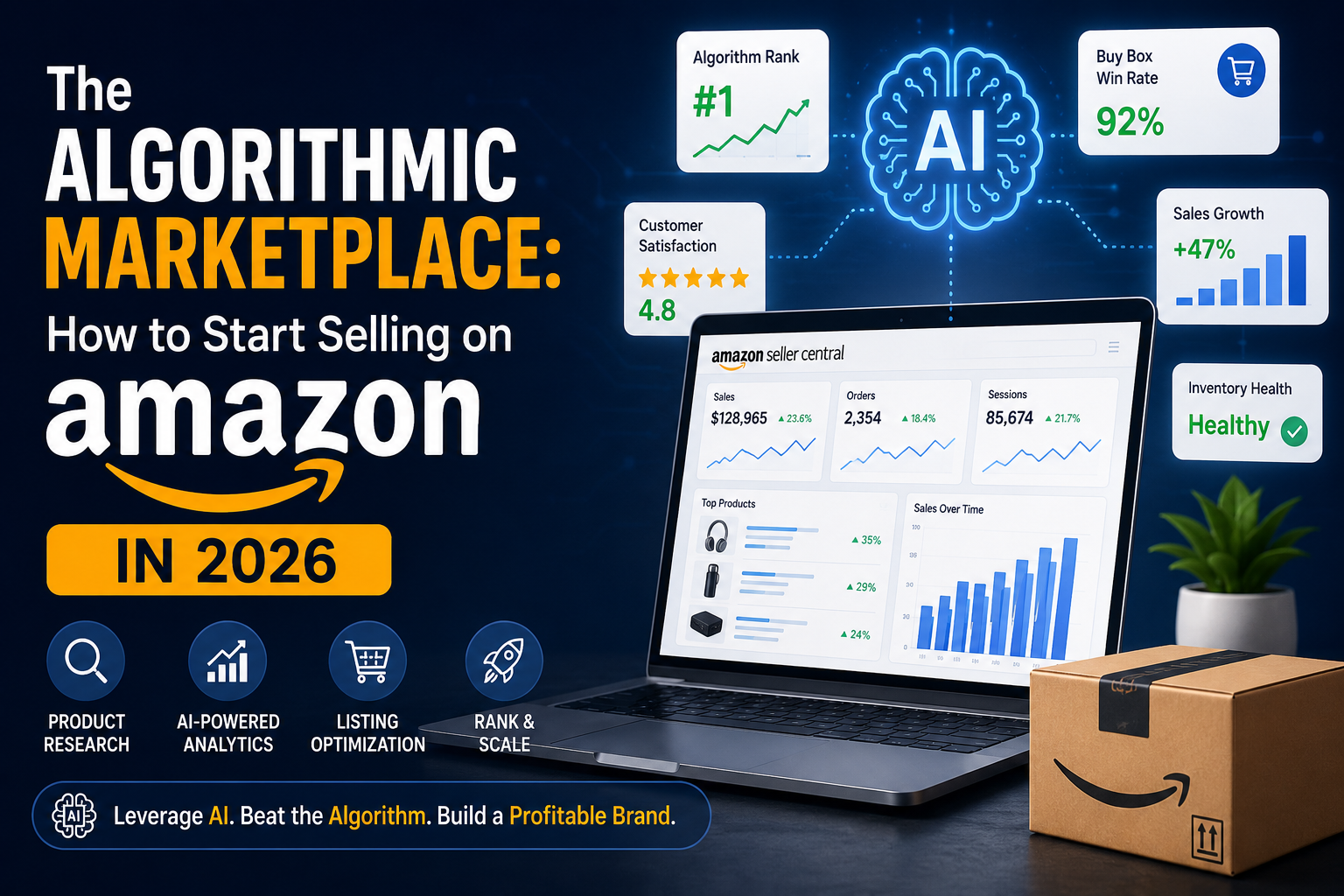
At 11:42 PM on a Tuesday, an independent private-label brand specializing in ergonomic home office goods updates its inventory parameters. By 6:00 AM the following morning, an automated agent has analyzed shifting regional demand spikes caused by an unseasonal heatwave, renegotiated cross-docking rates with a third-party logistics provider, adjusted the Amazon dynamic pricing matrix by $1.14 to capture peak search intent, and deployed three variations of hyper-targeted visual assets across Amazon’s contextual ad placements.
This is not the future of e-commerce; this is the operational baseline for selling on Amazon in 2026.
The era of searching for a generic product on a wholesale directory, slapping a basic logo on it, and generating millions via simple keyword stuffing is officially over. The Amazon marketplace has transformed from a straightforward retail directory into a highly sophisticated, multi-layered algorithmic platform driven by advanced machine learning, strict supply-chain compliance, and intense regulatory shifts.
For new sellers, entering this ecosystem requires a fundamental shift in perspective. You are no longer merely a merchant; you are a data coordinator managing a complex network of manufacturing pipelines, digital asset generation, machine learning search algorithms, and capital allocation. The stakes are undeniably high. Brand registry requirements are stricter than ever, Amazon’s fee structures penalize inefficient inventory management heavily, and deep-pocketed aggregators utilize enterprise-grade software to defend their market share.
Yet, despite the barriers, the market potential remains unprecedented. Amazon’s global net sales continue to climb, powered by deeper integration of generative shopping agents (like Rufus) and hyper-personalized consumer feeds. The platform is structurally shifting traffic away from static search terms and toward context-aware, assistive buying journeys.
This comprehensive guide serves as an authoritative operational blueprint for launching a highly resilient, profitable, and technologically optimized Amazon storefront in 2026.
The Amazon marketplace is experiencing a structural revolution driven by two forces: the complete integration of AI-assisted conversational commerce and stringent logistics monetization.
In previous years, optimization meant matching exact-string search queries. In 2026, Amazon’s AI shopping assistant dictates user behavior by synthesizing product listings, customer reviews, and comparative metrics directly into personalized chat interfaces. If your product information cannot be parsed effectively by semantic algorithms, your brand ceases to exist in the user’s conversational funnel.
Trend shift: Traditional keyword matching → Semantic parsing agent → AI synthesized recommendations.
Furthermore, supply chain mechanics have shifted radically. With the maturation of Amazon’s multi-channel distribution network and complex low-inventory fee frameworks, localized inventory placement is paramount. Sellers can no longer afford to dump months of unvetted stock into centralized fulfillment centers. Success demands a lean, data-backed supply chain leveraging predictive analytics to maintain high inventory health scores while minimizing capital lockup.
The Core Distinction
Winning on Amazon in 2022 was about mastering keyword optimization. Winning on Amazon in 2026 is about mastering data architecture and supply-chain liquidity.
Risk: Very High — Traditional backward-looking data leads to saturation and price erosion.

Historical monthly sales volumes are lagging indicators, causing overcrowding as sellers target identical stale data.
SaaS research tools historically scraped static ranking metrics, presenting an incomplete picture of market velocity. Consumer trends shift faster due to algorithmic social platforms, making historic-average models obsolete.
Deploy a predictive multi-source validation matrix tracking micro-trends, raw component shifts, and semantic review gaps.
✅ Implementation: Semantic gap analysis of top 5 competitors’ negative reviews → cross-platform micro-trend mapping (TikTok, Reddit) → regulatory auditing before capital commitment.
A seller notes 40% YoY growth for “modular home studio gear.” Instead of a generic desk organizer, they parse competitor reviews and find 70% of complaints about fixed cable routes. They launch a private-label solution with adjustable magnetic routing, patent the mechanism, and capture an uncontested sub-market.
Risk: High — Both over‑stocking and under‑stocking trigger severe fee penalties.
Amazon’s structural fee updates heavily penalize both over‑stocking and under‑stocking. Sellers face strict Low Inventory Fees if historical inventory levels relative to sales volume fall below thresholds, yet holding excess inventory triggers steep storage penalties.
Implement a hybrid logistics architecture pairing a rapid-replenishment 3PL network with Amazon AWD for seamless auto-replenishment.
Operational flow: Global Factory → Ocean/Air Freight → AWD (bulk) → Auto-replenishment → FBA Regional Centers (Prime Delivery). Maintain IPI > 500 and restructure schedules to pass through AWD, eliminating low‑inventory fee exposure.
| Operational Vector | Traditional FBA Only | Hybrid AWD + FBA (2026 Standard) |
|---|---|---|
| Low-Inventory Fee Exposure | High during demand spikes | Fully mitigated via auto‑replenish |
| Storage Fee Efficiency | Poor (seasonal spikes) | Excellent (flat wholesale rates) |
| Capital Liquidity Impact | High capital lockup | Optimized capital velocity |
Risk: Critical — Exclusion from AI recommendation summaries kills organic visibility.

Traditional keyword stuffing destroys conversion rates and causes semantic misalignment. Listings optimized purely for old-school SEO fail to rank within Amazon’s interactive AI shopping assistants.
Build structured, technical listings written for human readability but deeply optimized for semantic entity mapping. Use structured specification attributes, conversational long-tail copy, and advanced A+ content with comparative charts.
✅ Example: Instead of “Ergonomic Office Chair Mesh High Back,” use “High‑back ergonomic task chair with adaptive lumbar support designed to alleviate lower back pain during extended programming sessions.” This signals clear contextual utility to conversational engines.
01
BRAND REGISTRY MANDATE
Risk Level: High. Expedited trademark via IP Accelerator before inventory clears customs. Consequence: hijacking, no A+ content, cloning vulnerability.
02
SEMANTIC LISTING SYNTHESIS
Risk Level: Medium. Fill every hidden catalog attribute. Consequence: invisibility inside interactive AI search results.
03
HYBRID INVENTORY ROUTING
Risk Level: High. Set up automated thresholds inside Seller Central to replenish forward‑deployed FBA. Consequence: performance penalties and organic rank collapse.
Day 01:Social platform viral video → sales spike +650% in 36h.
↓Day 04:Regional FBA inventory depletes; 3PL processing bottleneck.
↓Day 07:Inventory availability drops below threshold → Low‑Inventory Fee applied.
↓Day 11:Organic rank falls from #2 to #43; delivery window jumps to 6 days.
↓Day 14:Emergency air‑freight recovery → high costs but recovers Account Health.
Lesson:AWD auto‑replenishment would have prevented the cascade entirely.
“The sellers who will survive the next decade on Amazon are those who treat the platform as a data node rather than a digital flea market. If you don’t control your supply chain telemetry and IP vectors, the algorithm will naturally deprecate your visibility.”
— Amazon Retail Strategy Research Group
| Market Scenario | Unsecured/Legacy Brand | Modernized/Secure Brand |
|---|---|---|
| Competitor Hijacking | Recovery takes weeks | Automated takedown via Project Zero |
| AI Conversational Queries | Excluded (static keyword stuffing) | Curated recommendation inclusion |
| Capital Efficiency | Locked in poor inventory placement | Just‑in‑time routing, minimal dead capital |
| Abrupt Fee Shifts | Margin compression | Dynamic pricing and AWD routing |

We anticipate Amazon will roll out dynamic visual generation engines inside Seller Central, altering product main images in real time based on individual browsing history. Autonomous supply chains will integrate deeply with global industrial networks. Successful brand owners will operate as overseers of automated agents that continuously negotiate manufacturing schedules based on localized consumer habits and macro-economic shipping indicators.
Succeeding in 2026 requires moving past outdated e‑commerce playbooks. Focus on brand registration, data clarity for LLM search, and hybrid AWD logistics to turn Amazon’s algorithms into a long‑term growth engine.
Call To Action
Ready to build an ironclad Amazon business architecture? Download our 2026 Inventory Telemetry Framework Spreadsheet →
1.What is the minimum capital to start selling on Amazon in 2026?
A professional private label launch requires $5,000–$15,000 covering trademark, lab testing, 3PL integration, and algorithmic PPC campaigns.
2.How does Amazon Rufus alter listing optimization?
Rufus uses contextual parsing and review sentiment. Listings must use natural language, answer common questions, and maintain high customer satisfaction.
3.What is Amazon AWD?
Amazon Warehousing & Distribution offers flat‑rate bulk storage with auto‑replenishment to FBA, bypassing low‑inventory fees.
4.Can I sell without a trademark?
Not recommended. Brand Registry prevents hijacking and unlocks A+ Content, video ads, and Transparency.
5.How are low-inventory fees calculated?
Based on historical supply vs. demand across 14‑ and 90‑day periods. AWD auto‑replenishment eliminates exposure.
6.Are external Google Ads still viable?
Only hyper‑targeted, context‑aligned traffic (micro‑influencers, niche programmatic platforms) signals strong intent and boosts organic rank.
7.Should I use AI‑generated product images?
Main image must be an accurate photo of the physical item. Generative AI can create lifestyle backgrounds but any discrepancy spikes returns.
8.What is the most important metric for account health?
Inventory Performance Index (IPI) above 500 is mandatory; falling below triggers storage limits and fee penalties.


How to Create High-Converting Ebay Listing - highdreamsllc.com
July 13, 2026 at 11:59 am
“ […] Selling Strategies for 2026: How Smart Sellers Win in a Hyper-Competitive MarketplaceRead more → The Algorithmic Marketplace: How to Start Selling on Amazon in 2026Read more → How to Find Profitable Etsy Niches in 2026Read more → How AI Can Help Etsy Sellers Grow Faster: […] “
How to optimize Amazon Product Listing - highdreamsllc.com
July 16, 2026 at 6:13 am
“ […] Private Label Business Guide: Build a Profitable Brand in 2026 The Algorithmic Marketplace: How to Start Selling on Amazon Amazon PPC Guide for Beginners How AI Voice Agents Improve Amazon Online Business How AI Is […] “
Amazon Private Label Business Guide: How to Build a Profitable Brand in 2026 - highdreamsllc.com
July 16, 2026 at 12:32 pm
“ […] Private Label Business Guide: Build a Profitable Brand in 2026 Amazon PPC Guide for Beginners The Algorithmic Marketplace: How to Start Selling on Amazon How AI Voice Agents Improve Amazon Online Business How AI Is Changing SEO Strategy for E-Commerce […] “
How to Get Approved for Walmart Marketplace - highdreamsllc.com
July 17, 2026 at 7:01 am
“ […] How to Create a High-Converting eBay Listing How AI Is Changing SEO Strategy for E-Commerce Stores The Algorithmic Marketplace: How to Start Selling on Amazon How AI Can Help Etsy Sellers Grow […] “
Amazon Account Management Best Practices - highdreamsllc.com
July 17, 2026 at 7:02 am
“ […] Private Label Business Guide: Build a Profitable Amazon Brand in 2026Amazon Management The Algorithmic Marketplace: How to Start Selling on Amazon in 2026Amazon Management How AI Voice Agents Improve Amazon Online Business in 2026AI Voice Agents How to Start Selling on […] “
Common Ebay Seller Mistakes - highdreamsllc.com
July 17, 2026 at 7:19 am
“ […] That Work Amazon PPC Guide for Beginners How AI Is Changing SEO Strategy for E-Commerce Stores The Algorithmic Marketplace: How to Start Selling on Amazon How AI Can Help Etsy Sellers Grow […] “
Step-toStep Amazon Product Research Guide - highdreamsllc.com
July 20, 2026 at 6:14 am
“ […] Amazon Product Listing Amazon PPC Guide for Beginners Amazon Account Management Best Practices The Algorithmic Marketplace: How to Start Selling on Amazon How AI Is Changing SEO Strategy for E-Commerce […] “