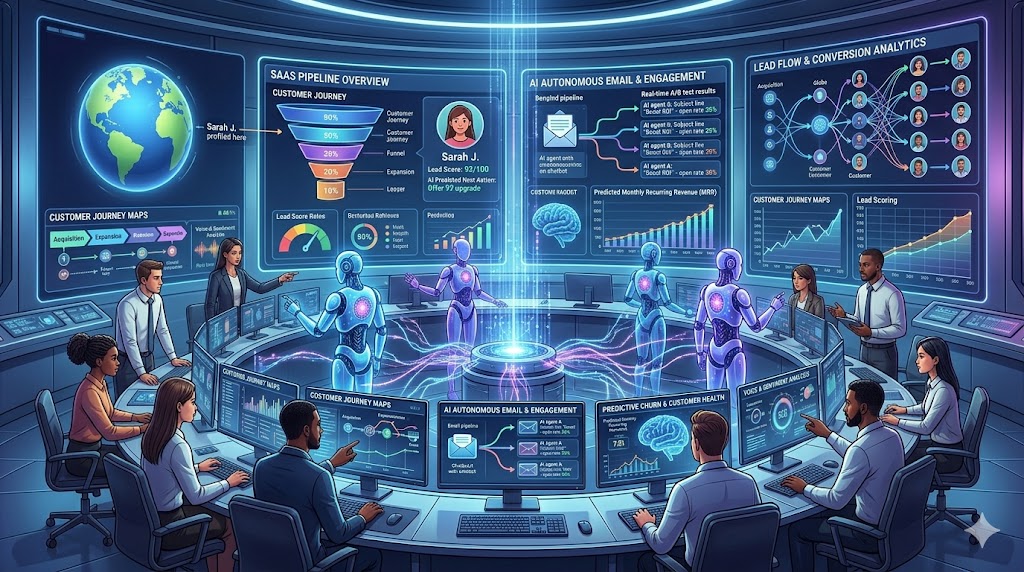
On a Tuesday morning in early 2026, a mid-sized SaaS company noticed something unusual. Their outbound pipeline—normally dependent on a five-person SDR team—had tripled overnight.
No new hires were made. No additional ad spend was deployed. No viral campaign went live.
Instead, an AI agent had been quietly reconfigured over the weekend to optimize cold outreach, qualify inbound leads, and autonomously schedule demos.
By Monday afternoon, it had already contacted 4,200 prospects.
By Tuesday, it had triggered compliance alerts in three regions, mistakenly sent personalized pricing offers to unqualified leads, and scheduled meetings with prospects outside the company’s ICP (Ideal Customer Profile).
The marketing team wasn’t celebrating. They were investigating.
This is the paradox of AI agents for lead generation in 2026:
They are powerful enough to replace entire outbound teams—but autonomous enough to create new categories of risk no traditional CRM system was designed to handle.
Unlike earlier automation tools, AI agents do not just execute workflows. They interpret goals, make decisions, and act independently across systems—email, CRM, chat, ad platforms, and even voice outreach.
That autonomy is exactly what makes them transformative—and dangerous.
In this guide, we break down how AI agents are reshaping lead generation, what architectures power them, where businesses fail, and how to deploy them safely and profitably.
“Traditional automation follows instructions. AI agents pursue outcomes.”— Editorial Research Team
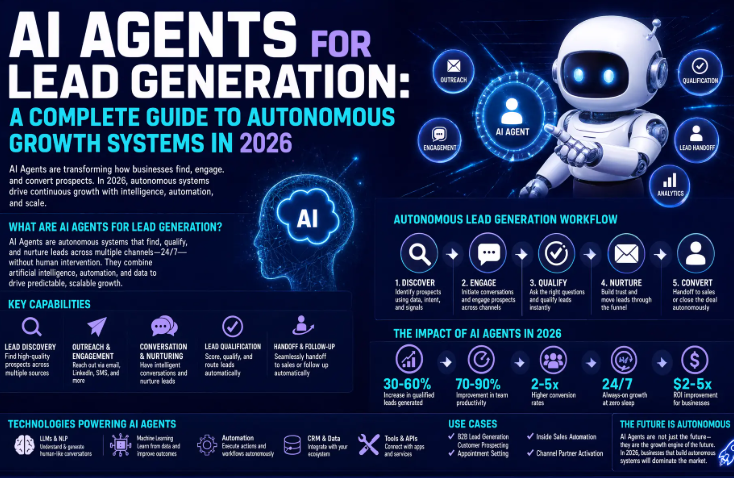
AI-driven lead generation is no longer an experimental edge case—it is becoming a default growth layer for modern businesses.
📊 Industry Impact
Traditional funnels are collapsing under three pressures:
AI agents respond to all three by dynamically generating and optimizing outreach at scale.
We are moving from:
Marketing automation → Intelligent marketing agents → Autonomous revenue systems
This shift means:
Most businesses confuse automation tools (like email sequences or chatbots) with AI agents.
Legacy marketing systems were built around rule-based logic:
AI agents replace rules with goals:
⚠️ Risk: Medium
AI agents must be designed with:
A fintech startup deploys an AI agent to:
Result: 3x qualified demo bookings in 14 days.
Businesses deploy AI tools without understanding system architecture.
Vendor tools hide complexity behind dashboards.
⚠️ Risk: High
A proper AI agent stack includes:
| Component | Traditional Automation | AI Agent System |
|---|---|---|
| Decision Making | Rule-based | Goal-based reasoning |
| Adaptability | Low | High |
| Personalization | Static templates | Dynamic generation |
| Scalability | Limited workflows | Multi-system orchestration |
| Risk Level | Low | Medium–High |
An AI agent notices:
It autonomously:
| Feature | Email Automation Tools | AI Lead Agents |
|---|---|---|
| Personalization | Template-based | Context-aware |
| Decision Logic | Fixed sequences | Adaptive reasoning |
| Multi-channel capability | Limited | Fully integrated |
| Learning ability | None | Continuous improvement |
| Cost efficiency | Medium | High (long-term) |
🧠 Expert Insight AI agents are not replacements for marketers—they are “digital SDRs with reasoning capability.”
Organizations deploy AI agents without governance frameworks.
Pressure to scale quickly outweighs safety planning.
⚠️ Risk: Critical
A startup’s AI agent mistakenly:
Result: Entire domain reputation degraded for 3 weeks.
01
Risk: Low
Set measurable goals like demo bookings, qualified leads, pipeline velocity.
If ignored: AI optimizes wrong outcomes.
02
Risk: High
Integrate CRM + behavioral data.
If ignored: AI makes blind decisions.
03
Risk: High
Connect LLM + tools + workflows.
If ignored: System fails to operate.
04
Risk: Critical
Content filters, compliance rules, approval layers.
If ignored: Legal exposure and brand damage.
05
Risk: Medium
Continuous performance tuning and feedback integration.
If ignored: Model drift and diminishing returns.
| Step | Action | Risk If Skipped |
|---|---|---|
| Data integration | Connect CRM + analytics | Poor targeting |
| Guardrails | Add compliance filters | Legal exposure |
| Feedback loop | Human review system | Model drift |
| KPI definition | Clear goals | Misaligned outcomes |
AI agent updated to “maximize lead volume.”
It begins targeting broad audiences beyond ICP.
No constraint on audience filtering.
Marketing ops notices sudden drop in deliverability.
| Scenario | Without Controls | With Controls |
|---|---|---|
| Email Outreach | Spam-like bulk messaging | Targeted, compliant messaging |
| Lead Scoring | Random AI assumptions | Data-driven scoring model |
| CRM Updates | Corrupted entries | Verified structured updates |
| Compliance | High violation risk | GDPR-aligned workflows |
| Brand Safety | Inconsistent tone | Controlled brand voice |
“The next competitive advantage won’t be who uses AI—but who governs AI agents responsibly at scale.”— Editorial Research Team
📈 Trend Analysis
⚠️ Upcoming Challenges
🔒 Future Best Practice
AI agents for lead generation represent one of the most significant shifts in modern revenue systems since the invention of CRM software.
They are not simply tools that assist marketers—they are systems that actively pursue business objectives, interpret data, and execute decisions across multiple platforms simultaneously.
But this power comes with structural risk.
Organizations that treat AI agents as plug-and-play automation tools will encounter failures in compliance, targeting accuracy, and brand safety. In contrast, companies that design governance frameworks—defining objectives, constraints, and feedback loops—will unlock exponential gains in pipeline efficiency and customer acquisition.
The future of lead generation is not about more automation. It is about controlled autonomy.
Businesses that understand this distinction will build scalable, self-optimizing revenue engines. Those that don’t will face unpredictable systems operating faster than their ability to manage them.
What are AI agents for lead generation?
AI systems that autonomously find, qualify, and engage potential customers.
How are AI agents different from automation tools?
They make decisions based on goals rather than fixed rules.
Are AI lead generation tools safe?
Yes, but only with proper governance and compliance controls.
Can AI replace sales teams?
Not fully—AI augments SDRs rather than replacing strategy roles.
What industries benefit most?
SaaS, fintech, real estate, and B2B services.
Do AI agents improve conversion rates?
Yes, typically by 20–45% in optimized systems.
What are the risks?
Spam behavior, compliance issues, and incorrect targeting.
How do AI agents learn?
Through feedback loops, CRM data, and performance signals.
What tools are needed?
LLMs, CRMs, vector databases, and API integrations.
Is coding required?
Not always—many platforms offer no-code agent builders.


AI Chatbot for Educational Instituation - highdreamsllc.com
July 14, 2026 at 8:29 am
“ […] Development Company in 2026Read more → How AI Is Changing Customer Service ForeverRead more → AI Agents for Lead Generation: A Complete Guide to Autonomous Growth Systems in 2026Read more → AI Voice Agent in Healthcare ClinicsRead more → Why Businesses Are Investing in AI Customer […] “
AI Powered Sales Funnels Explained - highdreamsllc.com
July 17, 2026 at 7:14 am
“ […] AI Agents for Lead Generation: A Complete Guide How AI Can Increase Business Revenue AI Voice Agent: Increase Appointment Bookings Why Businesses Are Investing in AI Customer Support Why Every Business Needs an AI Chatbot in 2026 The ROI of Implementing AI Voice Agents […] “
AI Lead Generation Software for Business Growth
July 22, 2026 at 6:39 am
“ […] budget. This differs from building a fully agentic, autonomous lead-generation system — see our complete guide to AI agents for lead generation if that’s the workflow you’re evaluating instead of off-the-shelf […] “