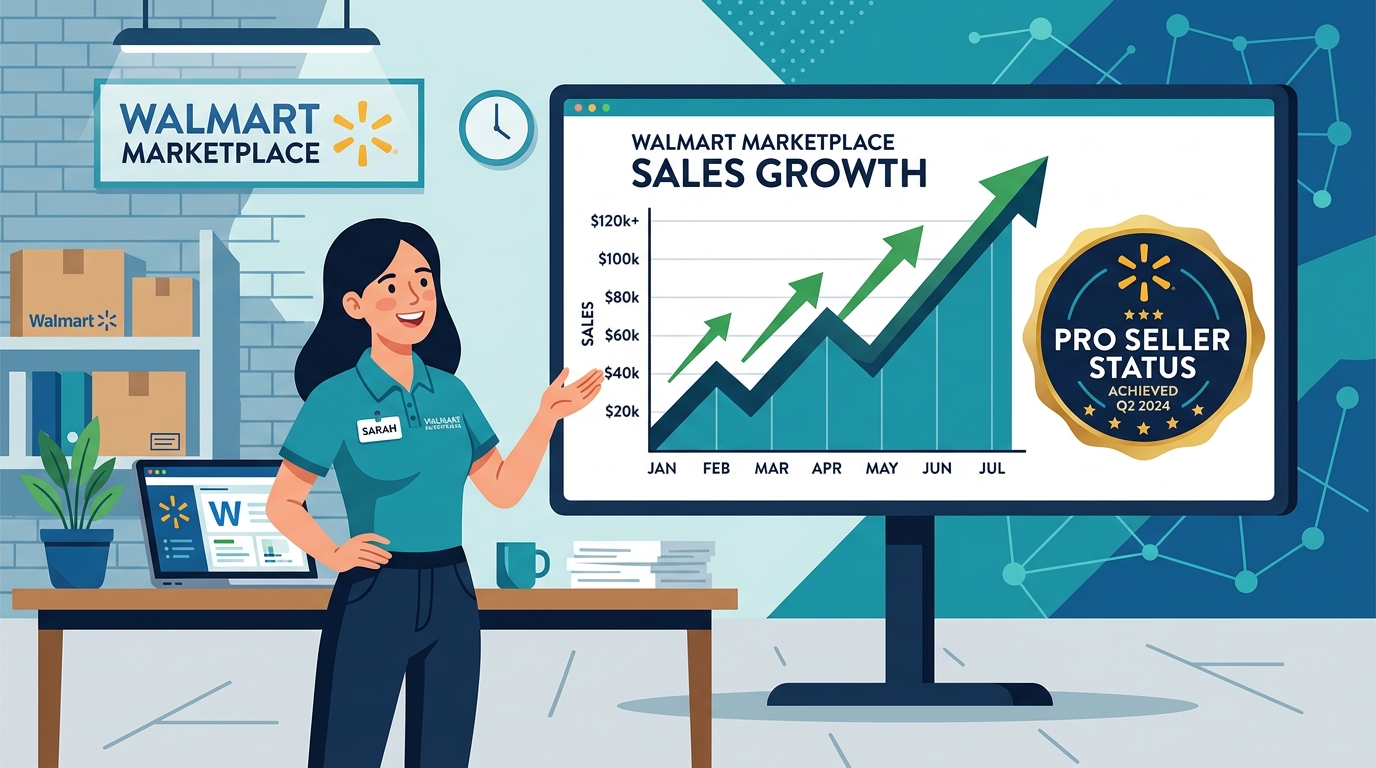
Items fulfilled by Walmart with 2-day shipping tags see 50% higher GMV growth on average, according to Walmart’s own first-party seller data. Recommended items in the Assortment Growth dashboard sell 2.6 times more often than the rest of a seller’s catalog. These aren’t third-party estimates — they’re numbers straight from Walmart Seller Center, and they point to a clear pattern: growth on Walmart Marketplace comes from a specific set of habits, not from listing more products and hoping for the best.
Growing a new Walmart Marketplace store comes down to five things: building complete, high-quality listings from day one, choosing a fulfillment method that supports fast shipping (Walmart Fulfillment Services listings see 50% higher GMV growth on average), using the free Assortment Growth dashboard to add catalog items with proven demand, layering in Walmart Connect advertising once you have sales data, and completing Seller Academy certifications to avoid early compliance mistakes. Walmart.com reaches over 120 million monthly unique visitors and 85% of its shoppers make at least one online purchase monthly — the opportunity is real, but Walmart’s own data shows the sellers who follow this sequence outperform those who skip straight to listing volume.
Walmart Marketplace’s official Seller Center guidance frames beginner growth as three stages, and the sequence matters — skipping ahead tends to produce weaker results than following it in order.
Stage 1: Newcomers. After completing account setup, the priority is getting products listed with complete, high-quality content — Walmart’s own guidance is explicit that listing quality is what makes a catalog “stand out to customers” from the very first listing, not something to improve later.
Stage 2: Gain more experience. Once live, the focus shifts to building a consistent rhythm for managing and fulfilling orders — deciding between self-fulfillment, Walmart Fulfillment Services (WFS), or a third-party Solution Provider, and settling into that operational cadence before trying to scale further.
Stage 3: Become a scale-seeker. With sales history established, sellers can start actively expanding reach — Walmart specifically recommends Search Engine Marketing (SEM) to promote listings to shoppers already searching Google for similar products.
Walmart’s own onboarding guidance leads with listing quality before any growth tactic — thin listings undercut every other effort that follows, including paid advertising.
Walmart’s first-party data shows items with WFS and 2-day shipping tags see 50% higher GMV growth on average. For beginners deciding between self-fulfillment and WFS, this is one of the highest-leverage decisions in the entire setup process.
This free Seller Center tool uses customer demand signals, competitor pricing, and category data to recommend specific items to add to your catalog — and Walmart reports these recommended items sell 2.6 times more often than the rest of a typical catalog.
Walmart periodically offers up to 100% off referral fees for listing or optimizing “Customer Favorite” items flagged in the Assortment Growth dashboard — a meaningful, easy-to-miss margin advantage for new sellers building out their catalog.
Once you have baseline sales data, Walmart’s own growth path recommends promoting listings through paid search, both on-platform via Walmart Connect and off-platform via SEM targeting shoppers already searching for similar products on Google.
Free certification courses cover promotional pricing, catalog expansion via Assortment Growth, and onboarding fundamentals — a low-effort way to avoid the early policy and compliance mistakes that slow new sellers down.
The 50% GMV growth figure tied to WFS and 2-day shipping isn’t a marginal edge — it’s one of the largest single levers available to a new seller, and it’s driven by shopper expectations Walmart has actively trained: 85% of Walmart.com shoppers make at least one online purchase per month, and fast, reliable shipping is a major factor in whether they choose a given seller’s listing over a competitor’s. For beginners without the volume to justify WFS immediately, a reliable third-party Solution Provider offering comparable shipping speed is a reasonable interim step — but self-fulfillment with slow, inconsistent shipping is the single easiest way to underperform Walmart’s own growth benchmarks from day one.
| Feature | What It Does |
|---|---|
| Curated recommendations | Suggests best-selling items to add within categories you already sell in |
| Competitive gap alerts | Flags in-demand items not currently available on Walmart.com at all |
| Seasonality & pricing trends | Weekly/monthly trend data to help plan inventory around peak selling windows |
| Cross-platform price visibility | Shows how products are priced on other platforms for competitive positioning |
| Refresh cadence | Suggestions and offers refresh biweekly, so it rewards regular check-ins |
Access via Seller Center: Growth > Assortment Growth. Free for all Walmart Marketplace sellers.
Walmart’s own onboarding guidance leads with listing quality for a reason — a thin listing undermines every growth tactic that follows, including paid traffic driven to it.
Given the documented 50% GMV growth tied to fast shipping tags, prioritizing the lowest-cost fulfillment method over shipping speed can cost far more in lost sales than it saves in fulfillment fees.
It’s a free tool built directly on Walmart’s own demand data, refreshed biweekly — skipping it means guessing at catalog expansion instead of using signals Walmart is actively surfacing for you.
Walmart’s own 3-stage growth path places advertising in the “scale-seeker” stage, after fulfillment and catalog fundamentals are solid — ad spend on a weak listing or slow shipping option underperforms the same spend applied later.
High Dreams LLC is a Colorado-based digital growth agency specializing in Walmart Marketplace store setup, listing optimization, and advertising management — helping new sellers follow Walmart’s own proven growth sequence instead of guessing at what to prioritize first. The agency has shipped work for 150+ clients worldwide across Amazon, Walmart, Etsy, and eBay.
Complete, high-quality listings built from day one to meet Walmart’s content standards.
Fulfillment method chosen to support the fast shipping tags tied to Walmart’s documented GMV growth data.
Assortment Growth recommendations and Walmart Connect advertising layered in at the right stage, not all at once.
Services include e-commerce management across Walmart, Amazon, Etsy, and eBay, plus AI chatbots for customer inquiries and website development for sellers building beyond the marketplace.
Get a free consultation to build a Walmart growth plan around what actually moves the numbers.
Fulfillment speed. Walmart’s own first-party data shows items with Walmart Fulfillment Services and 2-day shipping tags see 50% higher GMV growth on average compared to slower-shipping listings.
A free Seller Center tool that recommends catalog items based on customer demand signals, competitor pricing, and category data. Recommended items sell 2.6 times more often than the rest of a typical seller’s catalog.
Walmart’s own 3-stage growth guidance places advertising in the “scale-seeker” stage — after listing quality and fulfillment fundamentals are solid, once baseline sales data exists.
Yes. It’s free, covers pricing, catalog expansion, and onboarding fundamentals, and helps new sellers avoid early compliance mistakes that can slow growth.
Walmart.com reaches over 120 million monthly unique visitors, and 85% of Walmart.com shoppers make at least one online purchase per month.
Sources: Walmart Marketplace, official Seller Center growth guidance (marketplace.walmart.com) · Walmart, “Expand Your Catalog” and Assortment Growth Dashboard documentation · Walmart, 2025 Walmart Marketplace Playbook for Sellers · Walmart Marketplace Learn, Seller Academy · Walmart first-party seller performance data (WFS and 2-day shipping GMV analysis, February–July 2024; Assortment Growth item performance, May–June 2023).