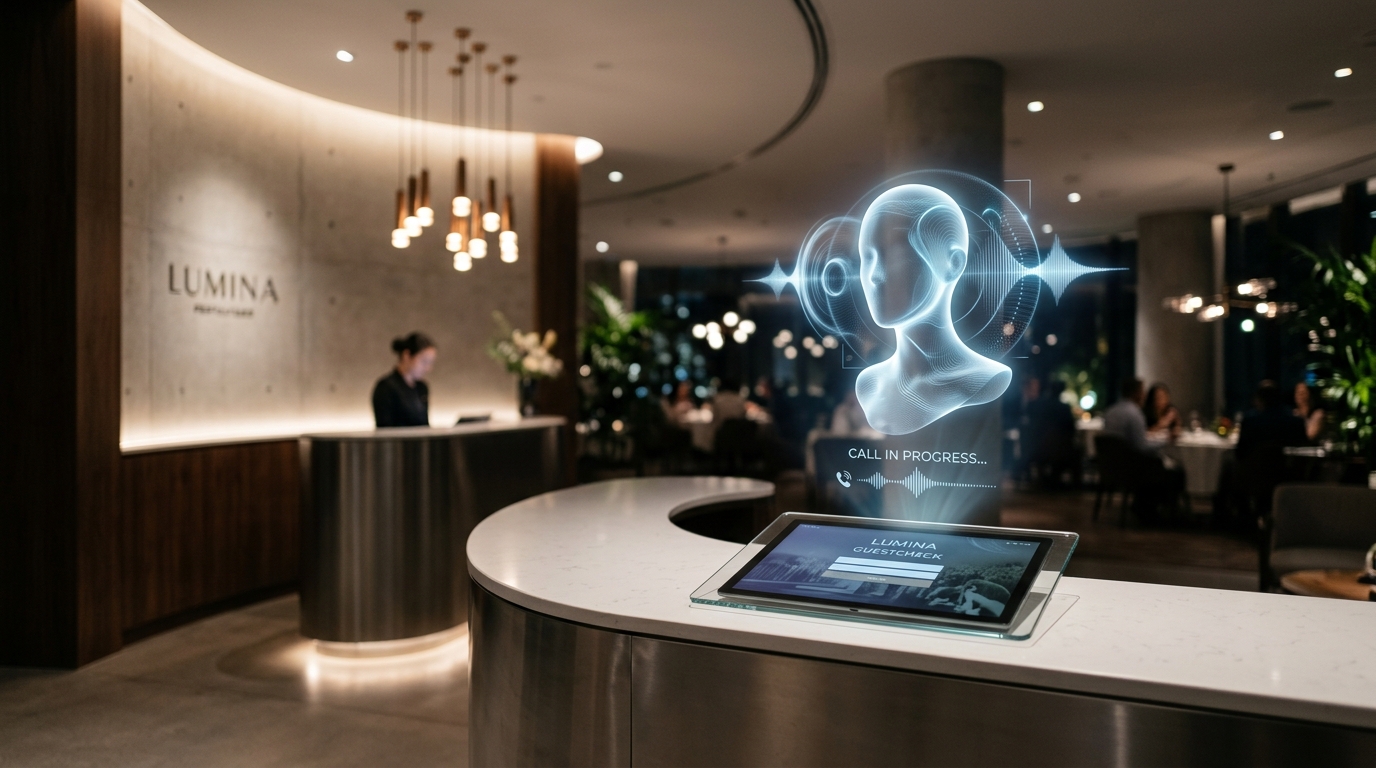
The phone still rings the same way it did twenty years ago — it just rings a lot more, and a lot more often nobody picks it up in time. A caller wants a table for six on Saturday, a to-go order phoned in during the rush, or just wants to know if the kitchen closes at nine or ten. If that call goes to voicemail, a large share of those customers don’t call back — they call the next restaurant on the list. AI voice agents exist to close that gap: software that answers every call instantly, books the reservation, takes the order, and hands the details straight to the POS and reservation system without a host ever touching the phone.
An AI voice agent for restaurants is a phone-answering system built on speech recognition and conversational AI that takes reservations, phone-in orders, and FAQ calls automatically, 24 hours a day, and syncs the results with the restaurant’s POS and reservation platform. Restaurants typically deploy them to recover the 30–40% of calls that go unanswered during peak hours, and pricing generally runs $99–$499 per month per location depending on call volume and integration depth.
An AI voice agent for restaurants is a piece of software, not a person, that picks up the phone the same way a trained host would. It uses automatic speech recognition to transcribe what the caller says in real time, a language model to work out the intent behind it, and text-to-speech to reply in a natural-sounding voice — all within about a second of the caller finishing a sentence. Underneath that conversation, the agent is checking table availability, reading the live menu, applying today’s specials or 86’d items, and writing the result directly into the restaurant’s reservation platform or point-of-sale system.
That’s the detail that separates a restaurant voice agent from a generic call-center bot: it has to hold context across a multi-minute call while a caller changes their mind twice, asks about a gluten-free option, and then wants to add a side. Restaurant-specific platforms are built around that kind of conversation; general-purpose voice AI tools built for scheduling desks or support lines tend to struggle once the call gets messy.
Two pressures are colliding at once. On the demand side, the National Restaurant Association’s 2026 State of the Restaurant Industry report projects total U.S. restaurant and foodservice sales will reach $1.55 trillion this year, with the industry adding more than 100,000 jobs — but nearly three-quarters of operators say they still expect real difficulty finding experienced managers and staff. On the cost side, Restaurant365’s mid-year 2026 survey of more than 420 operators found that staff recruiting and retention jumped from the industry’s 18th-ranked concern to its top challenge — rising from 18% to 33% of operators citing it — within a single year.
That’s the environment pushing phone automation from “nice to have” to standard practice. The same Restaurant365 survey found that operator use of AI for back-office tasks climbed from roughly 25% to 69% of operators in just six months, and among restaurants actively using AI, 62% reported lower labor costs and 61% reported lower food costs. Voice agents are simply the customer-facing extension of that same shift — automating the one task (answering the phone) that consistently gets dropped first when a dining room gets busy.
The revenue math backs up the urgency. Industry surveys reviewed by restaurant-tech platforms including Popmenu found that 83% of customers will order from a competitor rather than call back a second time after reaching voicemail, and separate call-audit data compiled by review site BestAgentPick puts the average restaurant’s missed-call rate at 30–40% during peak hours — which, at typical takeout ticket sizes, can add up to thousands of dollars in lost orders every month for a single location.
Most deployments cluster around six jobs:
One frequently cited implementation example from vendor Famulor illustrates the operational effect: pre-qualifying group reservations before handoff cut the average staff time spent per large-party inquiry from roughly nine minutes down to two, and reading every order back before it hits the kitchen display system was credited with a 41% drop in wrong-order complaints over a three-month stretch.
A voice agent that can talk isn’t useful on its own — it has to write into the systems a restaurant already runs on. This is where deployments succeed or stall.
| Category | What It Connects To |
|---|---|
| Point-of-sale (POS) | Toast, Square, Clover, Lightspeed, Revel — orders route straight to the kitchen display system |
| Reservation platforms | OpenTable, Resy, Tock, Quandoo, SevenRooms — live availability, booking, and changes |
| Restaurant-specific voice platforms | Loman, Certus AI, RestoHost, Foreva, Maple, VOICEplug, OpenTable Voice AI, Slang.ai |
| Generic / developer voice platforms | Vapi, Retell, Bland AI — used for fully custom builds |
Restaurant-specific platforms tend to outperform generic voice AI tools on messy, real-world menu calls specifically because they’re trained around restaurant-shaped conversations from the start — modifiers, 86’d items, dine-in versus delivery context, and split checks. Independent testing referenced by review site Bite Buddy AI found as much as a 47-percentage-point accuracy gap between the strongest and weakest voice agents when handling complex restaurant orders, which is exactly the kind of gap that turns into refunds and staff cleanup work rather than saved labor hours.
| Metric | Reported Figure | Source |
|---|---|---|
| Calls missed during peak hours | 30–40% | BestAgentPick, 2026 call-volume audit |
| Customers who won’t call back twice | 83% | Popmenu survey, cited industry-wide |
| Reduction in phone-related labor cost | Up to 40% | EchoCall AI Voice Agent Statistik 2026 |
| Added revenue per location, per month | $3,000–$18,000 | 2026 Forbes report on AI host implementation |
| Annual recovered revenue (2+ AI agents) | ~$42,000/year | Bite Buddy AI, restaurant automation ROI study |
| Reservations captured after hours | 15–25% of total bookings | Bite Buddy AI |
| Typical monthly subscription cost | $99–$499 per location | TECHSY, 2026 platform comparison |
Most analyses agree the break-even point sits around 50 or more calls a month — below that volume, the monthly subscription can cost more than the calls it recovers. Above it, the math tends to flip quickly, since a single recovered reservation or catering order at a typical restaurant covers a meaningful share of a month’s subscription fee on its own.
Pricing pages rarely tell the full story — Techsy’s 2026 review of eight restaurant-specific platforms found that seven of twelve vendors examined gate pricing behind a required sales call. Before signing anything, it’s worth confirming:
Independent multi-vendor comparisons — including reviews from Techsy, Bite Buddy AI, and BestAgentPick — consistently note that restaurant-specific platforms outperform general-purpose call-center voice AI on real menu conversations, while developer-first platforms like Vapi, Retell, and Bland AI remain the better fit for teams that want to build a fully custom agent in-house.
High Dreams LLC designs and integrates AI voice agents for restaurants and other service businesses, connecting them directly to the POS and reservation systems operators already run — rather than shipping a chatbot that just takes messages.
Menu-aware agents trained on your actual items, modifiers, and daily specials — not a generic scheduling script repurposed for food service.
Orders and bookings write directly into the systems your staff already use, so nothing depends on someone checking an inbox.
Specials, 86’d items, and handoff rules get updated as your operation changes — not left to drift after launch.
Explore related capabilities: AI chatbots for web and SMS inquiries, AI workflow agents for back-office automation, and website development for restaurants building a stronger online ordering presence.
Get a free consultation on which calls your restaurant is missing and what a voice agent would recover.
Get Hired View Our ServicesCan an AI voice agent really handle a complicated restaurant order?
Restaurant-specific platforms can generally handle modifiers, substitutions, and allergen questions, and they read the order back before confirming it. Accuracy varies significantly between vendors, though — independent testing has found accuracy gaps of up to 47 percentage points between the strongest and weakest platforms on complex menus, so testing with your actual menu before committing matters more than any spec sheet.
How much does an AI voice agent cost for a restaurant?
Most restaurant-specific platforms run $99 to $499 per month per location, based on 2026 market comparisons, though a number of vendors require a sales call before disclosing pricing. Custom builds on developer platforms can cost more upfront but offer more control over behavior.
Will it replace my host or front-of-house staff?
In most deployments, no — it absorbs overflow and after-hours calls that staff couldn’t answer anyway, and it hands off complex or sensitive calls to a person. The stronger case for adoption is recovered revenue from calls that were previously missed entirely, not headcount reduction.
Does it integrate with OpenTable, Resy, or my POS?
Most restaurant-specific platforms integrate with major reservation systems including OpenTable, Resy, Tock, Quandoo, and SevenRooms, and major POS platforms including Toast, Square, Clover, Lightspeed, and Revel. Integration depth varies by vendor, so confirming whether it reads and writes live availability — versus just sending a summary — is worth checking before signing.
How many calls does a restaurant need to make it worthwhile?
Industry analysis generally puts the break-even point around 50 or more calls per month, which is where the value of recovered missed-call revenue starts to outweigh the monthly subscription cost.
Sources: National Restaurant Association, “2026 State of the Restaurant Industry” · Restaurant365, “2026 State of the Restaurant Industry: Mid-Year Report” · Popmenu customer survey (as cited by Voiceflow and Famulor) · BestAgentPick, “Best AI Voice Agents for Restaurants 2026” · Bland AI, citing EchoCall Blog “AI Voice Agent Statistik 2026” · Voiceflow, citing a 2026 Forbes report on AI host implementation · Bite Buddy AI, “AI Agents for Restaurants (2026): Types & ROI” and platform comparison review · Famulor, “AI Voice Agent for Restaurants: 24/7 Orders & Bookings” · TECHSY, “AI Voice Agent for Restaurants: What Works” · Revmo AI, “Best AI Voice Agents for Restaurants in 2026.”