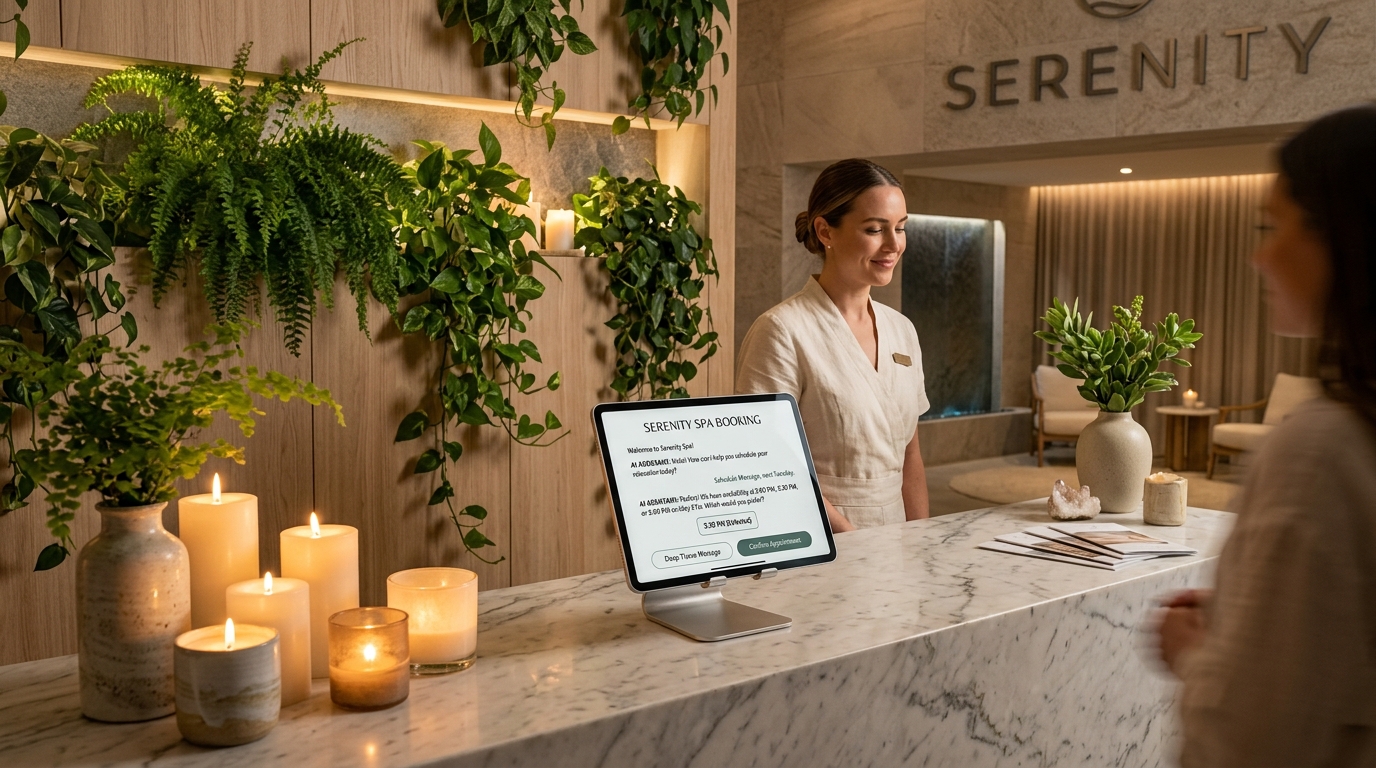
A salon front desk has one of the worst jobs in customer service: answer the phone, except you’re usually mid-foil, mid-facial, or mid-checkout with someone standing right in front of you. The phone doesn’t wait for a natural pause. Neither does the caller — and a 2025 Zenoti industry survey found 69% of salon and spa customers have simply abandoned a booking attempt because they couldn’t reach a human. That’s not a small operational annoyance; for a business built almost entirely on booked chair time, it’s a direct and repeating revenue leak.
AI voice agents help salons and spas by answering every call instantly — including the ones that arrive mid-service, when staff physically can’t pick up — booking appointments directly into systems like Vagaro, Mindbody, Fresha, or Boulevard, and sending reminders that meaningfully cut no-show rates. A 2025 Zenoti survey found 69% of salon and spa customers have abandoned a booking attempt over difficulty reaching someone, and no-shows are commonly estimated to cost the average salon 20–25% of potential revenue — both problems a well-integrated voice agent addresses directly.
Salons and spas have a structural problem most businesses don’t: the staff who could answer the phone are, by design, always with a client. A stylist mid-color or a therapist mid-massage isn’t stepping away to book a call — nor should they. That means missed calls aren’t an occasional lapse, they’re baked into how the business runs during every single open hour. Layer on top of that a booking system that’s genuinely more complex than a simple table reservation — matching a specific service, a specific stylist or therapist’s availability, and often a specific room or chair — and it’s easy to see why phone-based booking friction runs higher here than in most service industries.
This is what makes voice AI a different proposition for salons and spas than for, say, a restaurant. A restaurant reservation is largely a one-off transaction. A salon’s business model runs on recurring visits — the client who gets a cut every six weeks, a color touch-up on a schedule, a monthly facial. A voice agent that proactively calls to rebook that recurring appointment, rather than waiting passively for the client to remember, is addressing a completely different kind of revenue leak than after-hours call capture alone. Industry reporting on this specific use case describes it as one of the higher-ROI applications precisely because it targets clients who are already loyal — the easiest revenue to protect, if someone actually reaches out before they drift away.
| Booking Platform | Common In |
|---|---|
| Vagaro, Fresha, Booksy | Independent salons and small chains |
| Mindbody, Booker | Spas, wellness centers, med spas |
| Boulevard, Zenoti, Shore, Salonized | Multi-location and larger operators |
Salon and spa scheduling is genuinely more complex than most voice AI vendors design for out of the box — multiple staff, multiple rooms, recurring clients who need proactive rebooking, not just inbound call answering. High Dreams LLC builds for that actual complexity.
Full write access to your existing platform — Vagaro, Mindbody, Fresha, or whatever you already run — not a read-only bolt-on.
Proactive recall for recurring clients, not just inbound call capture.
Stylist, room, and service duration reasoned about together, matching how your business actually books.
Explore related capabilities: AI chatbots for text-based booking, AI workflow agents for connecting booking data to your broader operations, and our full services for salons and spas scaling beyond a single location.
Get a free consultation on how many calls you’re missing during service hours — and what that’s actually costing you.
Get Hired View Our ServicesHow many salon customers actually give up trying to book if they can’t reach someone?
A 2025 Zenoti industry survey found 69% of salon and spa customers have abandoned a booking attempt because it was too difficult to reach someone or book online — a significant, directly addressable revenue leak.
Can a voice agent actually handle salon scheduling, given how complex it is?
Yes, but only if it’s built for that complexity specifically. Salon and spa scheduling involves matching service type, stylist or therapist availability, and often a specific room, which requires more sophisticated logic than a simple single-resource booking system. A voice agent needs write access to the booking platform and multi-resource scheduling logic to handle this correctly.
How much revenue do no-shows actually cost a typical salon?
Industry estimates commonly put no-show losses at 20–25% of a salon’s potential revenue, with automated reminders reported to cut that rate roughly in half in many deployments.
What makes voice AI particularly valuable for salons compared to other service businesses?
The recurring-client business model. Unlike a one-off restaurant reservation, salon and spa revenue depends heavily on repeat visits — a voice agent that proactively calls to rebook a client due for a recurring service protects revenue a purely inbound-only tool would miss.
Does a salon voice agent replace the front desk entirely?
No, typically not. It’s built to absorb the calls staff physically can’t answer while mid-service, and to handle routine booking and rebooking tasks, while front desk staff continue handling in-person client needs and anything requiring more nuanced judgment.
Sources: Famulor, “AI Voice Agent for Beauty Salons and Day Spas in 2026” (citing Zenoti 2025 industry survey) · OnGraph, “AI Voice Agent for Salons and Spas: Reduce Missed Bookings” (citing Zenoti 2025 survey) · OmniDimension, “What Are the Top Voice AI Use Cases for Salons and Spas in 2026?” · CloudTalk, “7 Best AI Receptionists for Salons & Spas in 2026” · Bland AI, “10 Best AI Voice Agents for Salons for 24/7 Appointment Booking” · theStacc, “AI for Salons and Spas: Complete Guide (2026).”