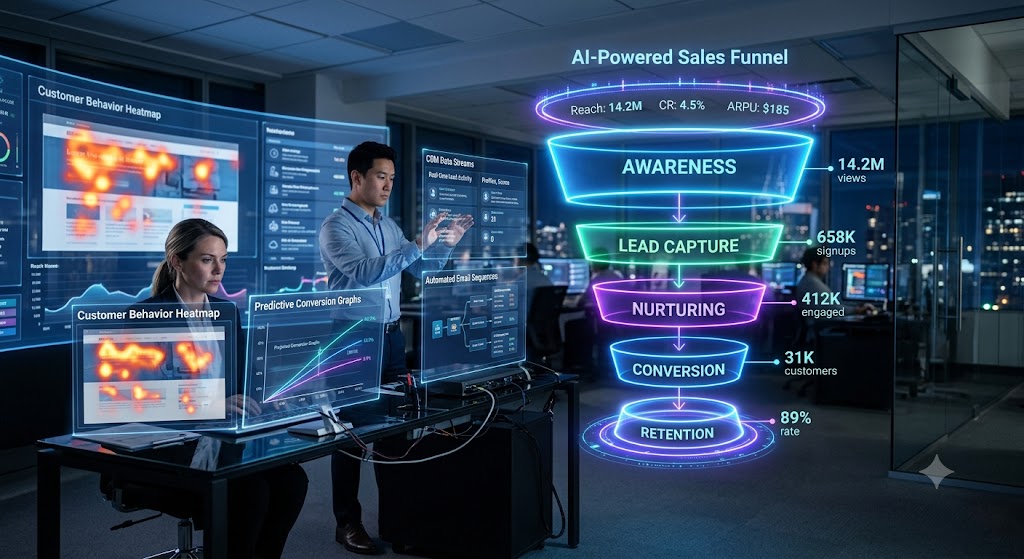
A SaaS company launches a new product on Monday.
By Tuesday, 12,000 visitors land on its website.
By Wednesday, the company knows something unusual: only 4% of visitors opened the pricing page—but AI predicts exactly which 280 prospects are likely to convert within 72 hours.
The marketing team doesn’t blast everyone with the same email.
Instead, AI dynamically personalizes landing pages, changes pricing offers based on engagement patterns, triggers custom email sequences, prioritizes high-intent leads, and alerts sales reps before prospects book a call.
By Friday, conversion rates jump 41%.
No extra ad spend. No bigger team.
Just better intelligence.
This is the new reality of AI-powered sales funnels.
The Core Distinction
Traditional funnels move leads through stages. AI-powered funnels decide what each lead needs next.
AI in sales is no longer experimental. Organizations are deploying AI across lead scoring, customer segmentation, email automation, predictive analytics, CRM optimization, sales forecasting, and personalization engines.
Industry analysts estimate AI-driven sales enablement platforms are becoming one of the fastest-growing enterprise software categories.
Three forces are accelerating adoption:
📊 Industry Impact: Businesses using AI-driven personalization often report higher conversion rates, better lead qualification, faster sales cycles, improved retention, and increased average order value.
An e-commerce pet brand selling grooming tools may see 100,000 visitors/month with a 2% conversion rate, leaving 98% non‑buyers.
Without AI, all non‑buyers may receive generic retargeting.
With AI: cart abandoners get urgency offers; comparison shoppers get product demos; repeat buyers get upsells; high‑value customers receive premium bundles. That precision creates revenue.
Traditional funnels assume all users move through identical stages. Reality disagrees. Customers behave unpredictably.
Buyer journeys now include multi‑device browsing, social proof validation, competitor comparisons, delayed purchases, and cross‑platform engagement.
Without intelligence: ⚠️ Risk: High — Wasted ad spend, poor segmentation, low email engagement, missed conversions.
AI turns static funnels into adaptive systems using machine learning, predictive analytics, behavioral scoring, natural language AI, and automation workflows.
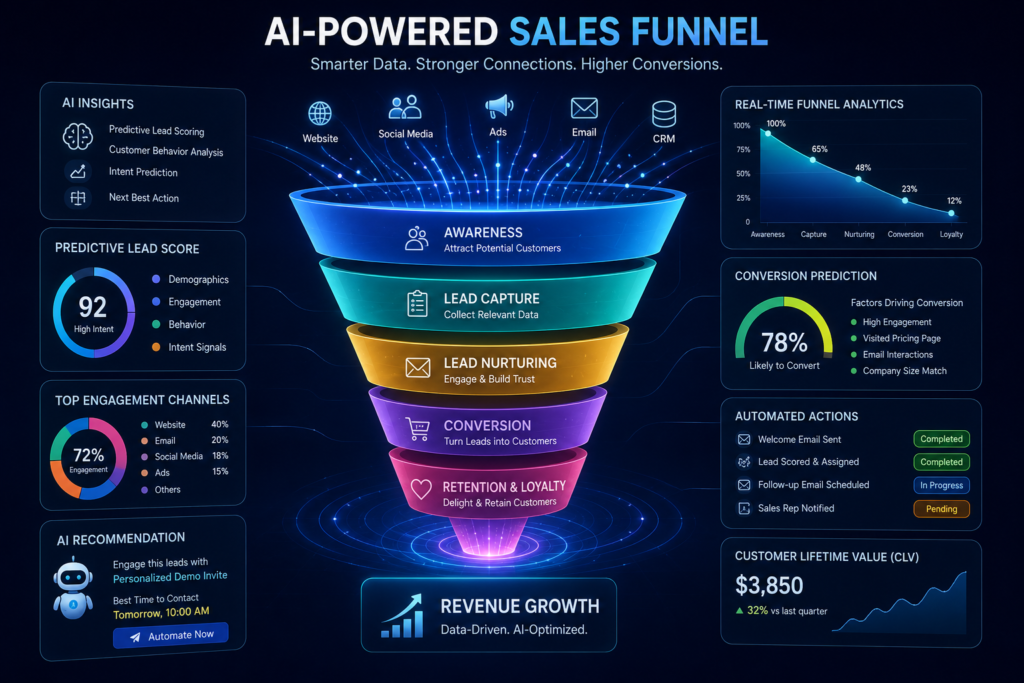
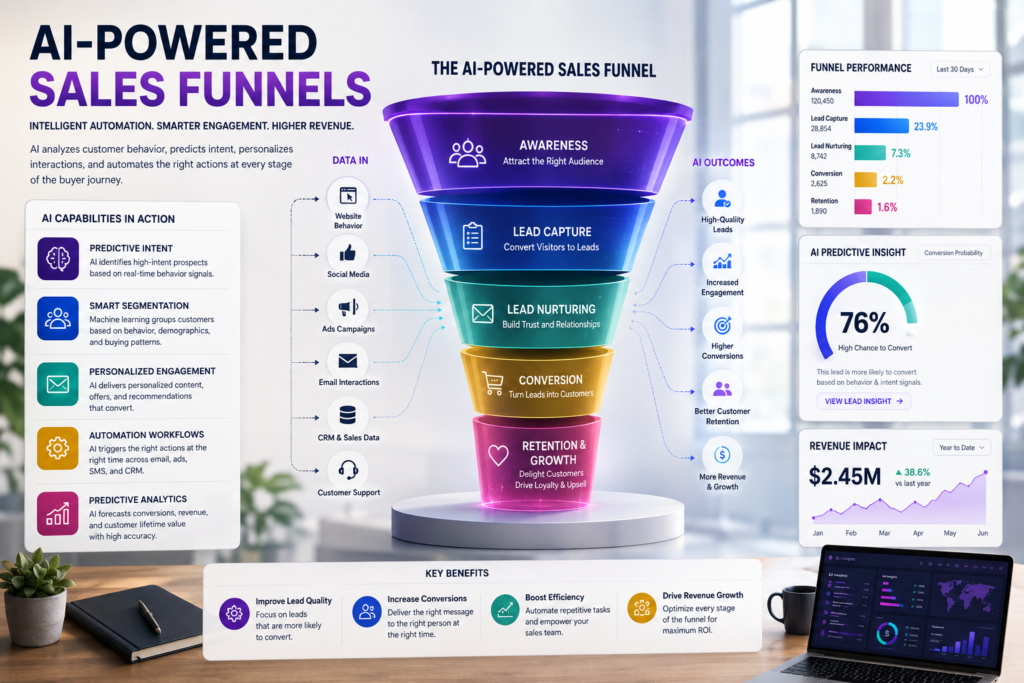
Core funnel stages enhanced by AI: Awareness, Lead Capture, Qualification, Nurturing, Conversion, Retention, Upsell.
A visitor spends 6 minutes reading pricing. AI detects high intent, return visit, and pricing comparison behavior. It automatically raises lead score, triggers sales outreach, and sends a case study email.
| Funnel Stage | Traditional Method | AI Enhancement |
|---|---|---|
| Awareness | Broad ads | Audience prediction |
| Lead Capture | Forms | Smart forms |
| Qualification | Manual scoring | Predictive scoring |
| Nurturing | Generic emails | Hyper-personalization |
| Conversion | Sales calls | Intent prediction |
| Retention | Basic follow-up | Churn prevention |
Many leads are low quality. Sales wastes time.
Traditional lead generation rewards volume. More leads ≠ better leads.
⚠️ Risk: High — Sales burnout, pipeline inflation, forecast inaccuracies.
AI scores lead quality automatically using traffic source, session duration, intent signals, demographics, company size, purchase history.
🔒 Security Control: Use clean CRM data. Bad data leads to bad predictions.
Deploy AI scoring inside CRM, ad platforms, CDPs, marketing automation tools.
Two leads download same ebook. Lead A: student researcher. Lead B: VP at enterprise company. AI ranks Lead B higher. Sales prioritizes accordingly.
Generic messaging reduces conversions.
Teams cannot manually personalize at scale.
AI personalization engines customize headlines, product recommendations, pricing, emails, and offers.
📈 Trend Analysis: Personalization is shifting from segmentation to individual optimization.
Feed models with purchase data, behavior data, session activity, channel attribution.
Pet store: Cat owner sees cat grooming bundle; dog owner sees dog nail grinder. Same landing page, different experience.
Prospects hesitate before purchase. Questions block conversions.
Human support isn’t always available.
Risks: cart abandonment, lost revenue, poor trust.
AI assistants provide 24/7 engagement answering pricing, shipping, features, compatibility.
🧠 Expert Insight: The best AI chatbots do not replace humans—they accelerate human sales.
Deploy conversational AI with escalation when deal size is large, intent is high, or complexity rises.
Visitor asks: “Is this safe for long-haired cats?” AI responds instantly. Purchase completed.
Forecasting often depends on guesswork.
Human judgment has bias.
⚠️ High Risk — Revenue misses, hiring mistakes, inventory issues.
AI predicts conversion probability, deal closure time, churn risk, revenue outcomes.
Models analyze historical sales, seasonality, lead velocity, engagement patterns.
AI predicts Q4 demand for grooming kits rises 38%. Inventory increases before demand spike. Revenue saved.
| Tool Type | Best For | Pros | Cons |
|---|---|---|---|
| CRM AI | Lead scoring | Strong pipeline visibility | Requires clean CRM |
| Chatbots | Conversion | 24/7 support | Poor setup hurts UX |
| Predictive Analytics | Forecasting | High accuracy | Needs large datasets |
| Personalization Engines | CRO | Revenue uplift | Complex integration |
Awareness Layer → Ads, SEO, social
Data Collection Layer → Pixel, CRM, analytics
AI Intelligence Layer → Prediction, scoring, segmentation
Action Layer → Emails, chatbot, sales outreach
Revenue Layer → Conversion, retention, expansion
Companies adopt AI tools without strategy.
Tool buying exceeds operational readiness.
Risks: stack complexity, poor ROI, workflow friction.
Adopt phased implementation.
Collect CRM data, behavioral data, purchase history. Risk: Medium If ignored: AI outputs become unreliable.
Map every customer touchpoint. Risk: High If ignored: Automation becomes fragmented.
Start with one use case (e.g., lead scoring, email personalization). Risk: Medium If ignored: Overengineering increases failure.
Measure conversion rate, CAC, ROAS, retention. Risk: High If ignored: No measurable ROI.
01 — Clean Customer Data Risk: High
Remove duplicates and outdated records. Implementation: Use CRM hygiene tools. If ignored: Bad predictions.
02 — Define Funnel KPIs Risk: Medium
Track CTR, CPL, SQL rate, close rate. Implementation: Dashboard monitoring. If ignored: No optimization visibility.
03 — Implement Lead Scoring Risk: High
Prioritize revenue potential. If ignored: Sales chases weak leads.
04 — Personalize Messaging Risk: Medium
Dynamic content improves engagement. If ignored: Lower conversions.
05 — Human Escalation Path Risk: High
AI cannot close every deal. If ignored: Enterprise deals stall.
“The future of sales isn’t more automation—it’s smarter decision-making at every customer interaction.”— Editorial Research Team
| Scenario | Without Controls | With Controls |
|---|---|---|
| Lead Scoring | Manual guesswork | AI prioritization |
| Email Campaigns | Mass sending | Dynamic personalization |
| Sales Outreach | Slow response | Instant intent alerts |
| Retention | Reactive | Predictive churn prevention |
| Forecasting | Spreadsheet estimates | AI probability modeling |
Problem: Too much automation hurts trust. Solution: Keep human oversight.
Problem: Poor data quality. Solution: Regular audits.
Problem: Optimizing vanity metrics. Solution: Focus on revenue metrics.
Problem: Uncontrolled AI decisions. Solution: Set approval workflows.
AI-powered sales funnels are moving toward autonomy.
📈 Trend Analysis: Static campaigns are fading. Adaptive systems are becoming standard.
AI-powered sales funnels represent one of the most important shifts in modern revenue operations.
For decades, sales funnels were treated as static diagrams—awareness at the top, conversion at the bottom. But customer behavior has outgrown that framework. Buyers are more informed, less predictable, and increasingly resistant to generic outreach.
That change has made traditional funnel optimization insufficient. AI offers something fundamentally different.
Instead of asking, “How do we move everyone through the same funnel?” companies can now ask, “What does this individual customer need right now to convert?” That is a strategic advantage.
The organizations seeing the strongest results are using AI to identify buying intent, personalize engagement, prioritize leads, reduce churn, and improve forecasting accuracy. They are not replacing sales teams—they are augmenting decision-making.
However, AI is not magic. Poor data, weak governance, over-automation, and misaligned KPIs can quickly turn AI from an advantage into a liability. Successful implementation requires discipline: clean infrastructure, clear objectives, measurable outcomes, and human oversight.
The next 12–24 months will likely define winners and losers in digital commerce. As AI becomes embedded into CRMs, ad systems, support platforms, and analytics stacks, intelligent funnels will become less of a competitive edge and more of a baseline requirement.
The question is no longer whether AI belongs in the sales funnel. The real question is: How fast can your organization adapt before competitors do?
Businesses that begin now—even with small, focused implementations—will be better positioned to lower acquisition costs, improve conversion efficiency, and build stronger customer relationships.
The future of sales is not just automated. It is adaptive, predictive, and deeply intelligent.
1. What is an AI-powered sales funnel?
An AI-powered sales funnel uses artificial intelligence to optimize customer acquisition, nurturing, conversion, and retention through automation and prediction.
2. How does AI improve conversion rates?
AI improves personalization, lead scoring, and timing, increasing purchase probability.
3. Can small businesses use AI funnels?
Yes. Many SaaS tools offer affordable AI automation for SMBs.
4. What data does AI need?
Typically CRM data, website behavior, purchase history, campaign data.
5. Is AI replacing sales teams?
No. AI augments teams by improving efficiency and prioritization.
6. What are the risks?
Main risks include bad data, over-automation, and poor governance.
7. Which industries benefit most?
High-volume digital industries: SaaS, E-commerce, Fintech, EdTech, Healthcare.
8. What tools are used?
Common tools include Salesforce, HubSpot, Klaviyo, Google Analytics.
9. Is AI funnel setup difficult?
It depends on data maturity and tool integration.
10. What is the biggest implementation mistake?
Deploying AI before cleaning data.


How AI Voice Agents Improve Amazon Online Business in 2026 - highdreamsllc.com
July 8, 2026 at 7:23 am
“ […] Brand in 2026 AI Chatbot Why Every Business Needs an AI Chatbot in 2026 AI Workflow Agents AI-Powered Sales Funnels Explained: How AI Is Rewriting Revenue Growth AI Chatbot Chatbots for E-commerce Stores: The Future of Online Shopping in […] “
How AI is changing SEO strategy for ecommerce stores - highdreamsllc.com
July 8, 2026 at 9:19 am
“ […] Amazon Private Label Business Guide, Build a Profitable Amazon Brand in 2026 AI Workflow Agents AI Powered Sales Funnels Explained, How AI Is Rewriting Revenue Growth AI Chatbot Chatbots for E-commerce Stores, The Future of Online Shopping in 2026 AI Chatbot The […] “
10 Signs Your Business Needs an AI Voice Agent - highdreamsllc.com
July 9, 2026 at 7:53 am
“ […] for 2026 AI Chatbot Why Businesses Are Investing in AI Customer Support AI Workflow Agents AI-Powered Sales Funnels Explained: How AI Is Rewriting Revenue Growth AI Chatbot Why Every Business Needs an AI Chatbot in 2026 AI and E-Commerce How AI Automation […] “