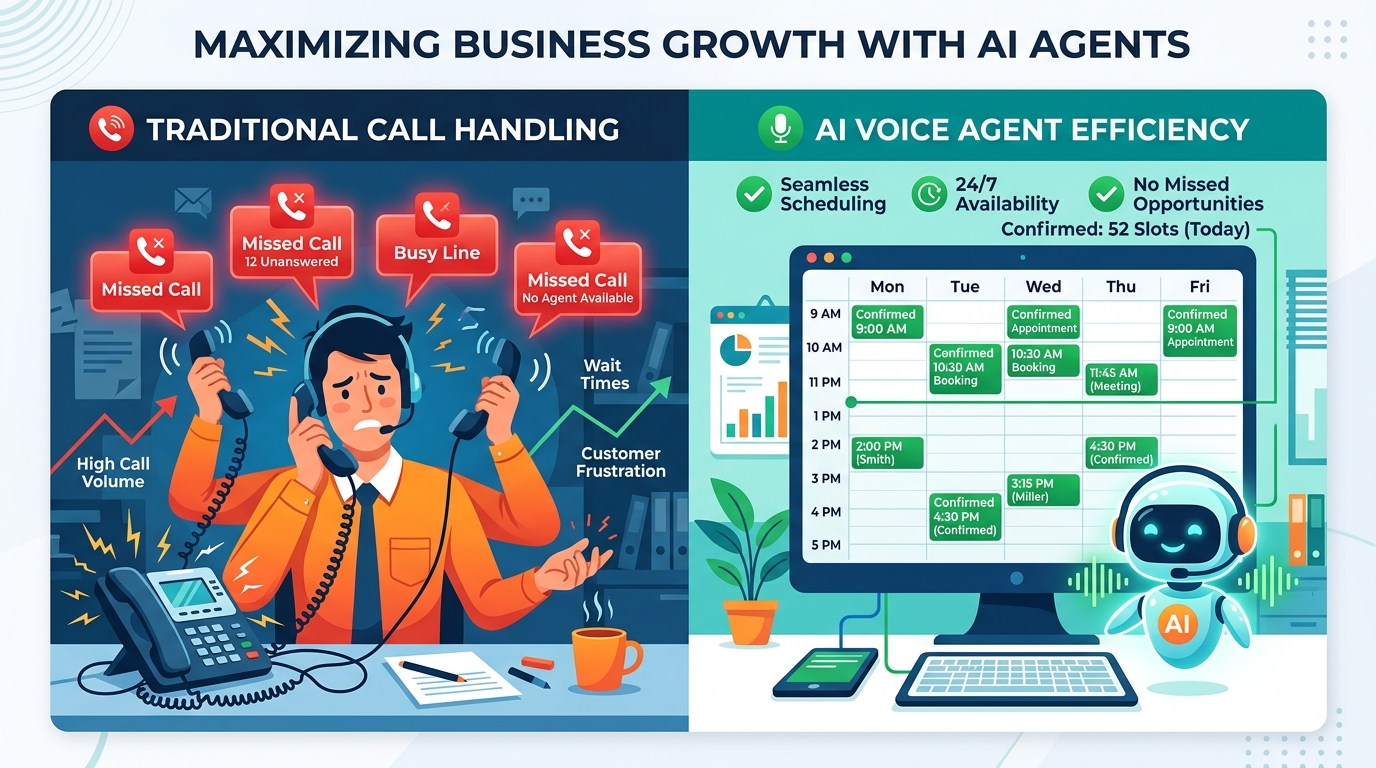
Every unanswered call is a booking that either goes to a competitor or never happens at all. AI voice agents increase appointment bookings through a handful of specific, measurable mechanisms, not by being generically “smarter” on the phone: they answer instantly instead of putting callers on hold, they capture calls your team physically can’t take, and they run reminder and re-engagement sequences no front desk can sustain by hand. This guide breaks down exactly how those mechanisms work and what results businesses are actually reporting in 2026.
The scale of the opportunity starts with a simple, well-documented pattern: response speed is the single strongest predictor of whether an inquiry turns into a booked appointment. Widely cited lead-response research has found that responding to an inbound inquiry within one minute, instead of five, can lift conversion by several hundred percent, and separate industry data shows 78% of buyers commit to whichever business responds first. A voice agent that answers on the first ring, at 9pm on a Thursday or during a lunchtime rush, is directly attacking the biggest lever in the entire booking funnel.
The strongest, most rigorously documented result in this space comes from a peer-reviewed study of a UAE primary health care network, which tracked 135,393 appointments and found the no-show rate dropped from 20.82% to 10.25%, a 50.7% relative reduction, after AI-driven reminder calls were introduced. Vendor-reported case studies push that range even wider, and should be read as directional rather than guaranteed, but the peer-reviewed result confirms the underlying mechanism is real, not just a marketing claim.
One named automotive dealership tracked its AI-handled service calls against booked appointments and reported an 80% call-to-appointment conversion rate, compared with an industry best-practice range of 30 to 40% for human call-handling teams. A separate dealership reported rescuing 6,300 calls from 3,400 unique customers who initially went unanswered, over just 30 days. These are vendor-published case studies rather than independently audited figures, so they’re best read as evidence of what’s achievable with a well-configured deployment, not a number every business should expect by default.
| Mechanism | What it fixes | Typical impact |
|---|---|---|
| Instant, 24/7 answer | Callers who hang up during hold time or reach voicemail after hours | Captures the ~40% of bookings that happen outside business hours |
| Missed-call rescue | Calls that went unanswered and would otherwise be lost entirely | Re-engages callers before they book with a competitor |
| Multi-step reminders | Single, easy-to-ignore confirmation texts or calls | Meaningfully reduces no-show rates when paired with two-way confirmation |
| Live rescheduling and waitlist fill | Cancellations that leave a slot empty until someone notices | Recovers revenue from a slot that would otherwise sit empty |
This is the fastest, lowest-risk win: an agent that answers calls your team can’t get to, whether that’s after hours, during a lunch rush, or when every line is already busy. Measure your current call capture rate first, including calls that went unanswered entirely, to see the real size of the gap before optimizing anything else.
An agent that can see real-time availability and book directly converts far more calls than one that just takes a message for a callback. Every callback is another chance for the caller to book elsewhere in the meantime.
Since response time is consistently the strongest predictor of conversion, prioritize sub-30-second pickup over almost any other feature. A highly polished agent that takes minutes to engage loses to a simpler one that answers instantly.
The strongest-performing setups combine an early reminder, typically a few days out, with a closer one nearer the appointment, using two-way conversation rather than a one-way “press 1 to confirm” prompt. Classic IVR-style confirmations see meaningfully lower response rates than a natural conversation that can actually reschedule on the spot.
When a caller needs to move an appointment, an agent that can immediately offer new slots and confirm the change, without a callback, converts far more of those moments into a kept appointment instead of a quiet cancellation.
A cancellation detected and immediately offered to the next waitlisted customer recovers revenue that would otherwise sit as an empty, unnoticed slot. This only works if the agent is integrated with your live schedule, not operating from a static list.
A single blended booking rate hides where the real opportunity is. Break performance out by time of day, especially after-hours and lunch-hour windows, to see where a voice agent is adding bookings a human team structurally couldn’t have taken.
Scheduling and reminder calls are the easiest place to prove value quickly. Establish a clear baseline, run the pilot for a defined period, and expand into rescheduling and waitlist management once the core booking flow is proven.
| Industry | Typical baseline no-show rate | Reported reduction range |
|---|---|---|
| Outpatient healthcare | 23–33% | 28–50%+ reduction reported across studies and vendor deployments |
| Dental and physiotherapy | 15–25% | Meaningful reduction reported, with a single missed hygiene visit often costing $150–300 |
| Beauty, salons, and fitness | 30–50% | Reported reductions vary widely by implementation quality |
| Automotive service | Varies by dealership | Named dealership case studies report substantially higher call-to-booking conversion |
| Legal and financial consultations | 15–25% | High-value appointments make even modest improvements financially significant |
The gap between a voice agent that takes messages and one that measurably increases bookings comes down to how deeply it’s integrated with a business’s actual calendar and workflow. High Dreams LLC builds custom AI voice agents connected directly to scheduling systems, paired with workflow automation for reminder cadences and waitlist management, so the agent is scoped around the specific booking flow a business needs, not a generic call-answering script.
Book a free consultation with High Dreams LLC to map your current call capture rate and see what a pilot around your highest-volume booking flow could look like.
A peer-reviewed study of over 135,000 appointments found a 50.7% relative reduction in no-shows after AI-driven reminder calls were introduced. Vendor-reported results range more widely, from roughly 25% to 80%, depending heavily on implementation quality and reminder cadence design.
Widely cited lead-response research has found that responding within one minute versus five minutes can dramatically increase conversion, and separate data shows a large majority of buyers commit to whichever business responds first. A voice agent that answers instantly directly addresses this, especially outside business hours.
Generally no. The strongest-performing setups use a multi-step cadence, an earlier reminder followed by one closer to the appointment, with genuine two-way conversation rather than a single one-way confirmation prompt, which sees meaningfully lower response rates.
Yes, largely. An agent that can only take a message and route it for a callback reintroduces the delay that costs bookings in the first place. Direct, real-time calendar integration is what allows an agent to book, reschedule, and fill cancellations in a single call.
Healthcare, dental, home services, automotive, and beauty and wellness businesses tend to see the strongest results, largely because they combine high call volume with a real dollar cost attached to every no-show or missed call.
AI voice agents increase appointment bookings through mechanisms that are specific and measurable: answering instantly instead of putting a caller on hold, capturing calls a human team physically can’t take, running reminder cadences no front desk can sustain by hand, and turning cancellations into immediately-filled slots instead of quiet losses. The peer-reviewed evidence backs the core claim, even if the flashier vendor numbers deserve a skeptical read. Businesses that pilot on their highest-volume call type, measure capture rate honestly, and build real calendar integration from the start are the ones actually seeing the booking increase, not just the marketing promise of one.


AI Strategies that Save Time and Money - highdreamsllc.com
July 14, 2026 at 7:34 am
“ […] Chatbot for Service Based Businesses AI Voice Agent: Increase Appointment Bookings How AI Can Increase Business Revenue The ROI of Implementing AI Voice Agents The Role of AI Voice […] “
AI Voice Agent vs Human Receptionists - highdreamsllc.com
July 15, 2026 at 6:19 am
“ […] AI Voice Agent: Increase Appointment Bookings 10 Signs Your Business Needs an AI Voice Agent The ROI of Implementing AI Voice Agents The Role of AI Voice Agents in Growing Your Business Best Industries to Use an AI Voice Agent in 2026 How AI Voice Agents Improve Amazon Online Business […] “
AI Voice Agents for Hotels - highdreamsllc.com
July 21, 2026 at 9:26 am
“ […] AI Voice Agent: Increase Appointment Bookings 10 Signs Your Business Needs an AI Voice Agent Best Industries to Use an AI Voice Agent in 2026 Voice AI vs Human Call Center AI Voice Agent vs Human Receptionists The ROI of Implementing AI Voice Agents […] “
AI Voice Agents for Dental Clinics - highdreamsllc.com
July 23, 2026 at 6:55 am
“ […] Industries to Use an AI Voice Agent in 2026 AI Voice Agent vs Human Receptionists AI Voice Agent: Increase Appointment Bookings AI Voice Agents for Hotels AI Chatbots for Banks 10 Signs Your Business Needs an AI Voice […] “
Future of AI Voice Technology - highdreamsllc.com
July 25, 2026 at 6:33 am
“ […] Voice AgentsAI Voice Agents for Dental Clinics AI Voice AgentsHow AI Voice Agents Increase Appointment Bookings AI Voice AgentsVoice AI vs Human Call Center AI Voice AgentsAI Voice Agent vs Human Receptionists […] “
AI Chatbots for Healthcare Clinics: Better Care Fast
July 25, 2026 at 6:51 am
“ […] AI Voice Agent Increase Appointment Bookings […] “
AI Voice Agents for Insurance Companies Guide 2026
July 27, 2026 at 7:20 am
“ […] AI Voice Agent Increase Appointment Bookings […] “
AI Chatbot Automation for Better Customer Engagement
July 28, 2026 at 6:20 am
“ […] AI Voice Agent Increase Appointment Bookings […] “
AI Voice Agents That Answer Calls 24/7 for Business
July 31, 2026 at 10:09 am
“ […] AI Voice Agent Increase Appointment Bookings […] “
AI Voice Agents for Beauty Salons and Spas Guide
August 1, 2026 at 7:20 am
“ […] AI Voice Agent Increase Appointment Bookings […] “
AI Voice Agents for Home Service Businesses
August 4, 2026 at 6:56 am
“ […] AI Voice AgentsAI Voice Agents for Dental Clinics AI Voice AgentsAI Voice Agents for Restaurants: Automating Reservations and Customer Calls AI Voice AgentsHow AI Voice Agents Improve Customer Satisfaction and Retention AI Voice AgentsThe Future of AI Voice Technology: What’s Coming Next AI Voice AgentsAI Voice Agent vs Human Receptionists AI Voice AgentsHow AI Voice Agents Increase Appointment Bookings […] “