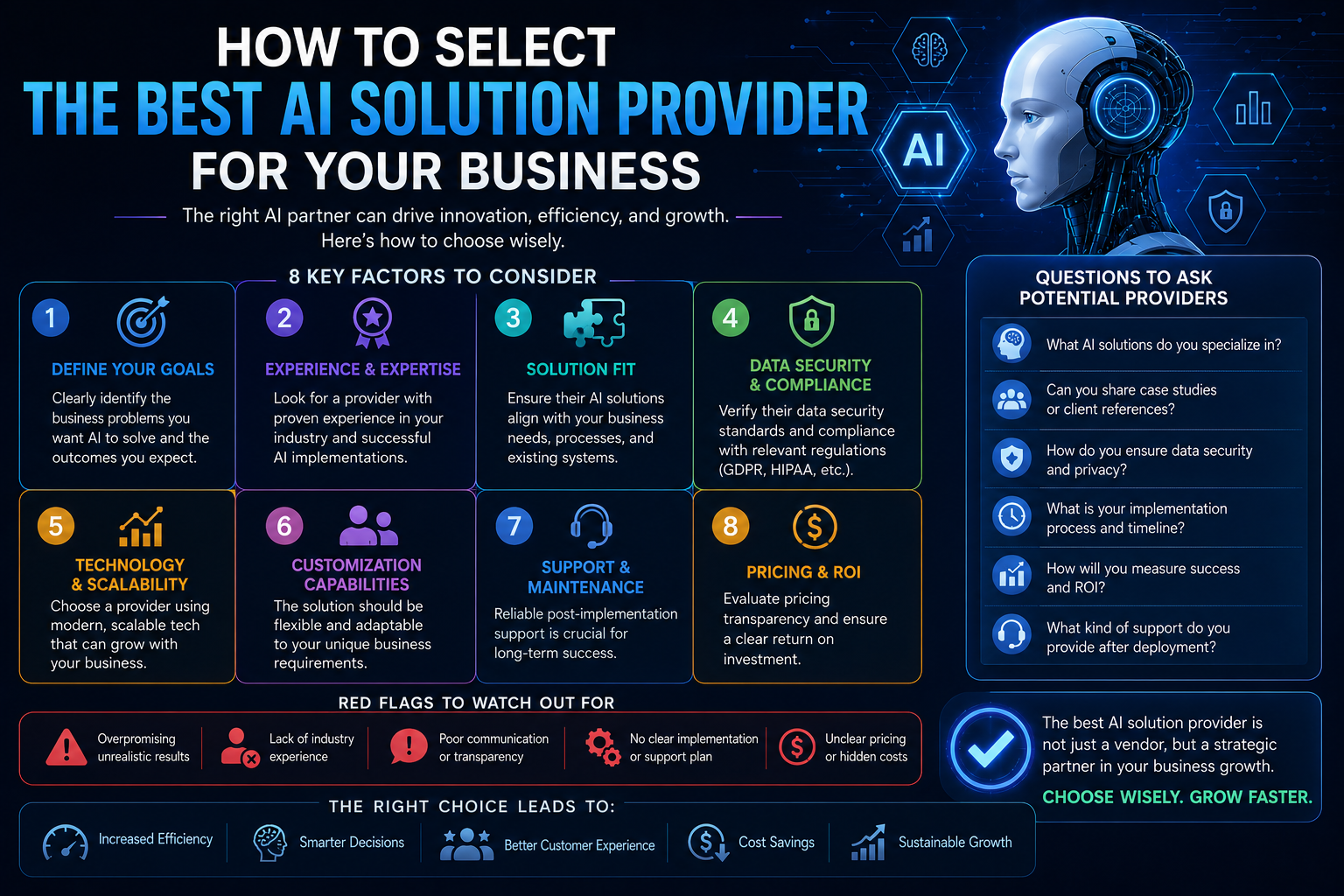
Choosing the wrong AI partner is rarely about the technology, it’s about mismatched expectations, weak data foundations, and vague success metrics. Independent research from RAND and MIT puts the failure rate of enterprise AI initiatives above 80%, and most of those failures trace back to the selection process, not the model. This guide walks through a practical, step-by-step framework for evaluating and choosing the best AI solution provider for your business, so your investment lands on the right side of that statistic.
Artificial intelligence has moved from experimental to essential. McKinsey’s 2025 State of AI survey found that 88% of organizations now use AI in at least one business function, up ten percentage points from the year before. But adoption and value are two very different numbers. MIT’s Project NANDA reported that roughly 95% of generative AI pilots produce no measurable financial return, and S&P Global Market Intelligence found that 42% of companies abandoned most of their AI initiatives in 2025, up sharply from 17% the year before.
The common thread across this research isn’t the sophistication of the model, it’s how the business chose, scoped, and partnered with its AI provider. This article breaks down exactly what to evaluate before you sign a contract, the red flags that predict a failed rollout, and a practical checklist you can use in your next vendor meeting.
It’s tempting to assume that AI failure is a technology problem, that the model wasn’t smart enough or the tool wasn’t mature enough. The data says otherwise. Analysis from RAND Corporation found that AI projects fail at roughly twice the rate of comparable non-AI IT projects, and traced the majority of failures to unclear objectives, weak data readiness, and fading executive sponsorship rather than model performance. Gartner’s research points the same direction, projecting that a large share of generative AI projects unsupported by AI-ready data will be abandoned before they ever reach production.
In other words, the provider you choose determines whether your business becomes part of the roughly 1-in-10 that captures real value from AI, or part of the majority that quietly shelves the project after a disappointing pilot.
Treat this as a sequence, not a checklist to skim. Each step filters out providers who look strong on paper but won’t hold up in production.
The most consistent finding across vendor-selection research, from the NCPERS AI vendor guide to Panorama’s ERP advisory work, is that evaluations should start with a specific, measurable business problem, not a general desire to “use AI.” Write down the process you want to improve, the current baseline metric, and the target outcome. A provider that can’t map its solution to that specific outcome isn’t ready for your shortlist.
Ask what business functions the provider’s models are actually built to support, how performance is benchmarked, and where the solution has already been deployed successfully in businesses like yours. A provider with proven experience in your industry will understand your data, your workflows, and your compliance obligations without a lengthy education process.
An AI solution that can’t connect to your CRM, e-commerce platform, or support desk becomes a silo instead of a system. Confirm the provider offers real APIs or native connectors, ask how the architecture handles growth in users and data volume, and favor modular platforms that let you add use cases later without a full rebuild.
Before any sensitive business data touches a vendor’s system, get specifics on encryption in transit and at rest, access controls, audit logging, and relevant compliance certifications. If the provider can’t produce documentation or a clear answer, treat that as a hard stop rather than a detail to revisit later.
Setup fees are only part of the picture. Factor in licensing, integration work, training, ongoing maintenance, and the cost of switching providers later if the relationship doesn’t work out. Vendor lock-in, where your workflows or data are trapped in a proprietary format, can turn a reasonable initial quote into a very expensive exit years later.
Before a company-wide rollout, test the solution against a defined success metric, such as a resolution rate, response time, or accuracy threshold, on a limited but representative workload. Review what failed and why. A provider’s ability to diagnose and fix real pilot failures is a stronger signal of long-term value than any product demo.
Speak directly with existing customers, ideally in a similar industry or of a similar size, about implementation timelines, support responsiveness, and measurable outcomes. Case studies on a vendor’s website are marketing; a reference call is due diligence.
AI systems need monitoring, tuning, and occasional retraining after they go live. Ask how the provider handles ongoing support, how quickly they respond to issues, and whether continuous improvement is included or billed separately. The best providers treat launch as the beginning of the relationship, not the finish line.
Most businesses choose between four broad paths. Each has a different cost structure, speed to deployment, and risk profile.
| Option | Best for | Typical speed | Key trade-off |
|---|---|---|---|
| Building in-house | Large enterprises with dedicated data science and ML engineering teams | Months to years | Highest control, highest cost, and the slowest path to a first working version |
| Hiring a freelancer | Very narrow, single-feature tasks with limited long-term support needs | Days to weeks | Low cost upfront but limited accountability and no ongoing partnership |
| AI solutions agency | SMBs and mid-market businesses that want production-ready AI in weeks, not quarters | 1–4 weeks for a first deployment | Balances speed, cost, and support, but quality varies widely between agencies |
| Enterprise AI platform | Large organizations standardizing AI across many departments | Weeks for pilots, quarters for full rollout | Strong governance and scale, but higher cost and potential platform lock-in |
For most small and mid-sized businesses, a specialized AI agency offers the best balance: faster time-to-value than building in-house, more accountability and integration depth than a freelancer, and a lower cost of entry than an enterprise platform contract.
Once you’ve settled on an evaluation framework, it helps to know where AI investment is currently paying off. Adoption data shows the strongest, fastest returns cluster around a handful of proven use cases rather than open-ended experimentation:
Businesses that scope their first AI project around one of these proven categories, rather than trying to automate everything at once, consistently see faster time-to-value and a clearer path to measurable ROI.
High Dreams LLC is an AI-driven agency built around the same principles outlined in this guide: define the outcome first, prove it in a short sprint, then scale. The team has shipped AI systems for more than 150 clients worldwide, with production-ready deployments typically delivered in one to four weeks rather than months.
Whether you’re exploring your first AI chatbot, evaluating a voice agent for your call volume, or looking to automate operations with a custom AI workflow agent, the same evaluation framework above applies, and it’s exactly how High Dreams LLC structures every new engagement.
Book a free consultation with High Dreams LLC to scope your use case, define success metrics, and see what a working pilot could look like for your business.
For most small and mid-sized businesses, a structured evaluation, from defining requirements to completing a pilot, takes three to eight weeks. Rushing past the pilot stage is one of the most common causes of failed rollouts.
An AI solution provider designs, trains, and maintains systems that make decisions or generate output from data, such as chatbots, voice agents, or predictive models, rather than simply hosting static software. That distinction matters most for support, since AI systems need ongoing tuning that traditional software doesn’t.
Costs vary widely by scope, but many agencies offer entry packages, such as a basic AI chatbot or a starter website, in the few-hundred-dollar range, with more advanced voice agents and custom workflow automation priced according to complexity. Always ask for an itemized quote that separates setup, licensing, and ongoing support.
Unless you already have a dedicated data science and engineering team, hiring a specialized AI provider is almost always faster and less risky. In-house builds make sense once AI becomes core to your product and you need full control over the underlying models.
Research from RAND and MIT points to organizational factors, unclear success metrics, weak data foundations, and fading leadership support, far more often than the AI model itself. Choosing a provider who insists on defining success criteria upfront directly addresses this risk.
The best AI solution provider for your business isn’t necessarily the one with the flashiest demo or the biggest name. It’s the one that starts with your business problem, can prove technical and industry fit, protects your data, and commits to a measurable pilot before asking for a long-term contract. Use the framework and checklist above in your next vendor conversation, and you’ll be evaluating from a position of clarity rather than reacting to a sales pitch.


AI Automation Trends Businesses Cannot Ignore - highdreamsllc.com
July 14, 2026 at 8:20 am
“ […] Scaling and Infrastructure Challenges of Advanced AI How to Select the Best AI Solution Provider for Your Business The Future of AI in eCommerce: Trends Every Seller Should Know How AI Can Increase Business Revenue […] “
AI for Startups: Boost Growth and Innovation Fast
July 21, 2026 at 9:20 am
“ […] AI Automation Trends Businesses Cannot Ignore AI Powered Sales Funnels Explained AI Agent for Sales Team How AI Chatbot Help Reduce Support Costs AI Strategies That Save Time and Money How to Select the Best AI Solution Provider for Your Business […] “
Enterprise AI Implementation Guide - highdreamsllc.com
July 23, 2026 at 7:16 am
“ […] Automation Trends Businesses Cannot Ignore AI for Startups How to Select the Best AI Solution Provider for Your Business Rapid Scaling and Infrastructure Challenges of Advanced AI AI Cybersecurity Trends AI Strategies […] “